- Indian buyers stay away amid currency volatilities
- Bangladesh’s volumes high despite political unrest
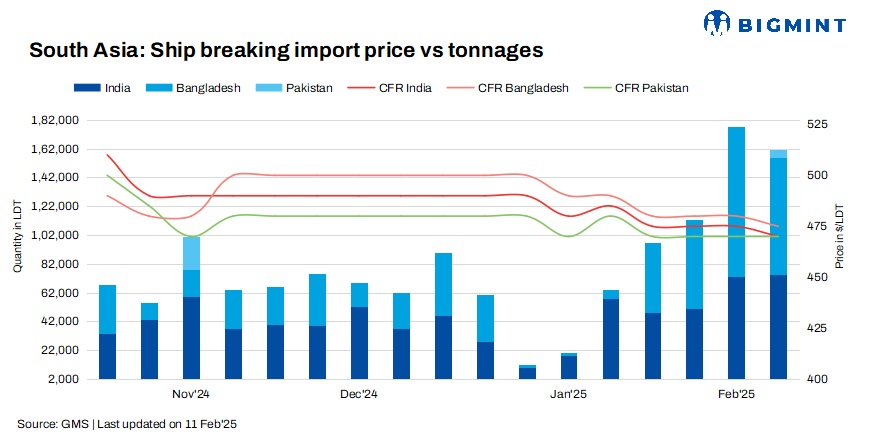
South Asia’s ship-breaking markets faced mixed sentiments during the week. India’s Alang market remained subdued, with pressure on offers, while Pakistan showed signs of recovery, though challenges persisted. Bangladesh continued to see active local buying, especially for smaller vessels.
Alang market remains quiet, with no buyers present
India’s ship recycling landscape remained subdued in week 7, but Alang recyclers continued to hold a prominent market share despite ongoing volatility.
According to a participant, “The ship-breaking market in India is sluggish, with overall activity down.” Another participant highlighted, “The market remains weak, with no offers for any type of ship, as no buyers are present at the current rates due to INR-USD currency rate fluctuations.”
Ship-breakers have secured a good number of ships this year, but their offers, at around USD 450/light displacement tonne (LDT), are under pressure. Recently, the ship recycling sector grappled with a weak FY’25-26 Budget, a depreciating rupee, and the influx of cheaper Chinese steel. Despite these challenges, in week 7, Alang managed to secure six ships, totalling nearly 75,000 LDT, including a rare passenger vessel. However, some concerns regarding regulatory compliance emerged following the delivery of some sanctioned tankers.
Current offers
- Dry bulk carriers: $430-440/LDT
- Containers: $480-490/LDT
- Tankers: $445-465/LDT
Prices may vary depending on specifications.
In week 7, Alang Port received 74,349 LDT, up slightly from 73,048 LDT in the previous week.
Pakistan faces slow recovery amid challenges
In week 7 of CY’25, the Pakistani ship recycling market showed signs of recovery, with increased bidding for smaller LDT vessels. However, activity remained slow overall, with limited interest in larger tonnage. Challenges include stagnant steel prices at $644/t, cheaper Chinese steel impacting local recycling, and a struggling economy, further hindered by delayed financial aid and ongoing IMF corruption investigations.
Infrastructure upgrades at Gadani yards are critical to meet the Hong Kong Convention (HKC) standards by 1 July 2025. Without these improvements and price adjustments, Pakistan risks losing its competitiveness in the ship recycling market by 2026.
According to market participants, “ship-breakers are now targeting prices below $440/LDT for bulk carriers”, which reflects the overall weakness in the market.
In week 7, Gadani Port received 5,204 LDT, marking a rebound after the port had remained empty for the last 4-5 months.
Bangladesh remains strong, delayed upgrades may impact volumes
In week 7, Bangladesh’s ship-recycling market put up a strong show despite various challenges. Political unrest continued to add to Bangladesh’s economic struggles, while slow construction progress and limited steel movements contributed to a lack of interest from ship-breakers.
Despite fewer ships coming into the market, local recyclers continued to buy, focusing on smaller vessels, as Chinese and Far Eastern owners finished their charters. However, prices were lower, and top recyclers secured tonnage for their yards, leaving fewer options for other buyers.
Around 10 Panamax bulk carriers have already been sold to the local market this year, and more are expected, especially older 90s-built bulk carriers.
While Bangladeshi prices are slightly higher than India’s, making it the preferred market for Far Eastern tonnage, the upcoming HKC deadline and delayed yard upgrades may affect the market in Q3.
Around 81,597 LDT arrived at Chattogram Port in week 7. The previous week saw arrivals of 104,446 LDT.

Leave a Reply