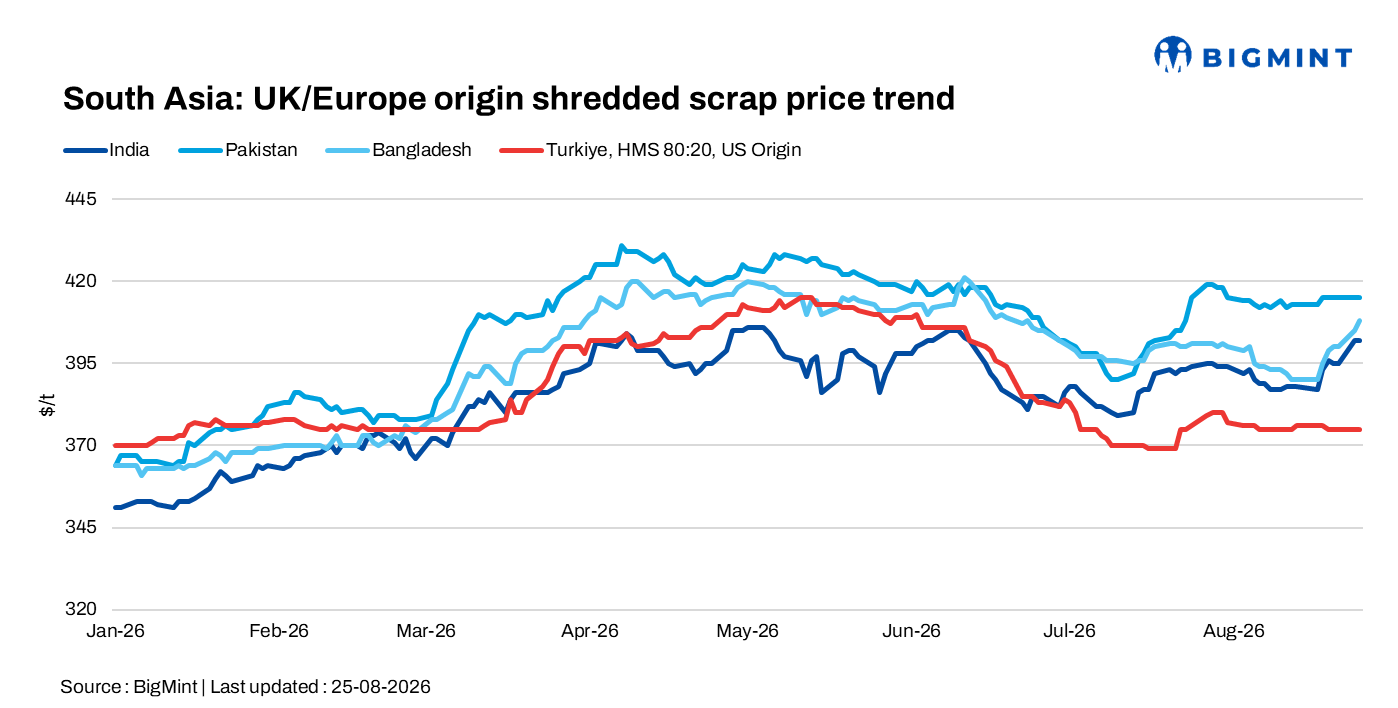
- Firm supplier offers widen bid-offer gaps
- Turkiye scrap prices stable amid limited trade interest
Imported ferrous scrap markets across South Asia and Turkiye remained subdued on 25 August, as cautious mill buying, weak downstream demand and firm supplier expectations limited trading activity. While workable levels remained below offers in several markets, higher freight costs and tight vessel availability continued to support seller resistance, keeping regional scrap prices largely stable.
India: India’s imported scrap market remained quiet today, with mills resisting higher offers and sellers holding firm. Australian HMS 80:20 was offered at around $325-335/t CFR Chennai, while shredded scrap was heard offered at $382-385/t. Chennai buyers were targeting $365-370/t for Australian shredded in containers, $340-345/t for African HMS, and around $310/t for turnings. UK suppliers were also holding their offers firm, with shredded scrap around $400/t, African HMS at $350-355/t, and turnings at $325-330/t.
Bulk scrap buyers in Chennai and Kandla were looking at around $350-360/t, while US HMS 80:20 remained higher at $380-385/t.
With mills unwilling to stretch on prices and sellers reluctant to lower offers, the bid-offer gap remains the main hurdle to fresh business. Trading volumes therefore remained limited, with buyers largely waiting for more workable levels before committing to imported cargoes.
Pakistan: Imported shredded scrap market remained subdued amid weak downstream steel demand, monsoon-related disruptions, and cautious mill procurement. Shredded scrap offers were heard at $418-420/t CFR Qasim, while workable levels were around $412-415/t. Mill bids were reported at $410-412/t CFR.
A 1,000 t UK-origin shredded scrap cargo was booked at $415/t CFR Qasim, confirming workable levels near the lower end of supplier offers. Higher freight costs and tighter container availability continued to support seller price expectations, with September freight rates expected to increase by $400-450/container.
Domestic scrap prices were reported at PKR 145,000-147,000/t, while billet stood at PKR 216,000-218,000/t exw and rebar at PKR 234,000-236,000/t exw.
Mill operating rates remained around 30-35%, while heavy monsoon rains disrupted construction activity and weighed on rebar demand. As a result, mills continued to limit scrap purchases, with procurement largely restricted to immediate requirements.
Bangladesh: The imported scrap market remained subdued amid limited material availability and cautious buying from mills, while UK-origin material was offered at around $400-410/t CFR. However, buyers continued to avoid large-volume purchases, keeping overall import activity limited. Recent deals included 1,000 t of PNS from Singapore at $415/t and 1,000 t of HMS 1 from the Philippines at $375/t.
Cargo requirements remained stringent, particularly for shipments involving Singapore, Hong Kong, Malaysia and Japan, making suitable vessels increasingly difficult to secure. Market participants noted that Bangladesh’s scrap import volumes have been declining continuously due to selective inquiries from major mills.

Turkiye: Deep-sea imported scrap prices remained stable d-o-d on 25 August amid very limited trading activity. US and EU-origin offers were available, but no fresh deals were heard. HMS 80:20 was assessed at around $375/t CFR Turkiye, while tradable values were indicated at $375-376/t CFR for US-origin material and $369-371/t CFR for EU-origin scrap.
Turkish mills continued to face pressure from higher raw-material, energy, and freight costs. Firm dry-bulk rates, with New Jersey-Turkiye Supramax freight at around $35-36/t, were adding to scrap replacement costs. Black Sea metallic deliveries remained on hold, forcing mills to rely more on scrap and long-distance metallic, billet and slab supplies from the Far East.
In the billet market, a Turkish producer reportedly sold around 120,000 t at $545/t, up sharply from its previous sale at $530/t three weeks earlier. The higher billet price reflects mills’ efforts to raise finished steel prices amid elevated input costs. However, downstream demand remained muted, limiting the scope for further scrap price increases.

Leave a Reply