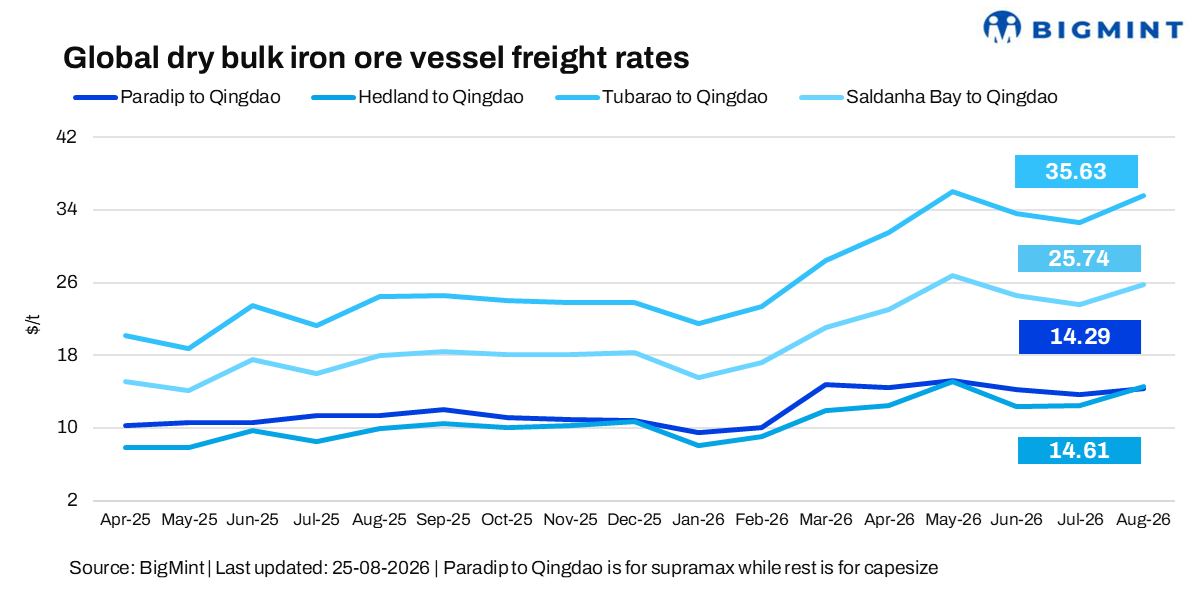
- Pacific rates strengthen on firmer vessel demand, consistent Australian miner activity
- Typhoon Saudel may disrupt Pacific vessel operations, tighten prompt availability
Dry bulk iron ore freights showed a mixed but broadly resilient trend in the week ended 24 August 2026 amid active fixtures and firmer vessel demand. The Pacific provided the main support, driven by stronger operator demand and consistent Australian miner activity, while the Atlantic remained comparatively subdued as limited trading and a steady ballaster list capped gains.
The Pacific market strengthened, with Hedland-Qingdao rates rising w-o-w. Consistent Australian miner activity supported the route, while increased operator demand helped rates recover from earlier weekly lows. The move was also partly attributed to efforts to secure tonnage ahead of potential weather disruptions in the northern South China Sea.
In the Atlantic, Tubarao-Qingdao and Saldanha Bay-Qingdao rates increased w-o-w, with the latter reaching an over two-month high. However, the Brazil-China market remained subdued despite healthy cargo availability, as limited trading and a broadly stable ballaster list restricted further gains. Market attention has also shifted towards upcoming end-September cargo nominations.
India-China activity remained steady, with Paradip-Qingdao rates unchanged. Fresh enquiries remained under negotiation, keeping fixture activity measured and limiting significant rate movement.
Route-wise sentiment

Weather watch
Typhoon Saudel, locally known as Obet, entered the Philippine Area of Responsibility on 24 August and is forecast to potentially affect the East China Sea and eastern China coast around 26-27 August. Rough seas and strong winds could temporarily disrupt vessel operations and port activity, potentially tightening prompt vessel availability across parts of the Pacific.
Outlook
Iron ore freight markets are expected to remain supported but divergent across regions. Continued Australian miner activity and stronger operator demand should underpin Pacific Capesize rates, while weather-related disruptions may provide additional short-term support.
The Atlantic market is likely to remain comparatively restrained, with healthy cargo availability offset by limited trading and a stable ballaster list. Fresh cargo nominations, vessel positioning and weather developments will remain key to rate direction in the coming week.
Leave a Reply