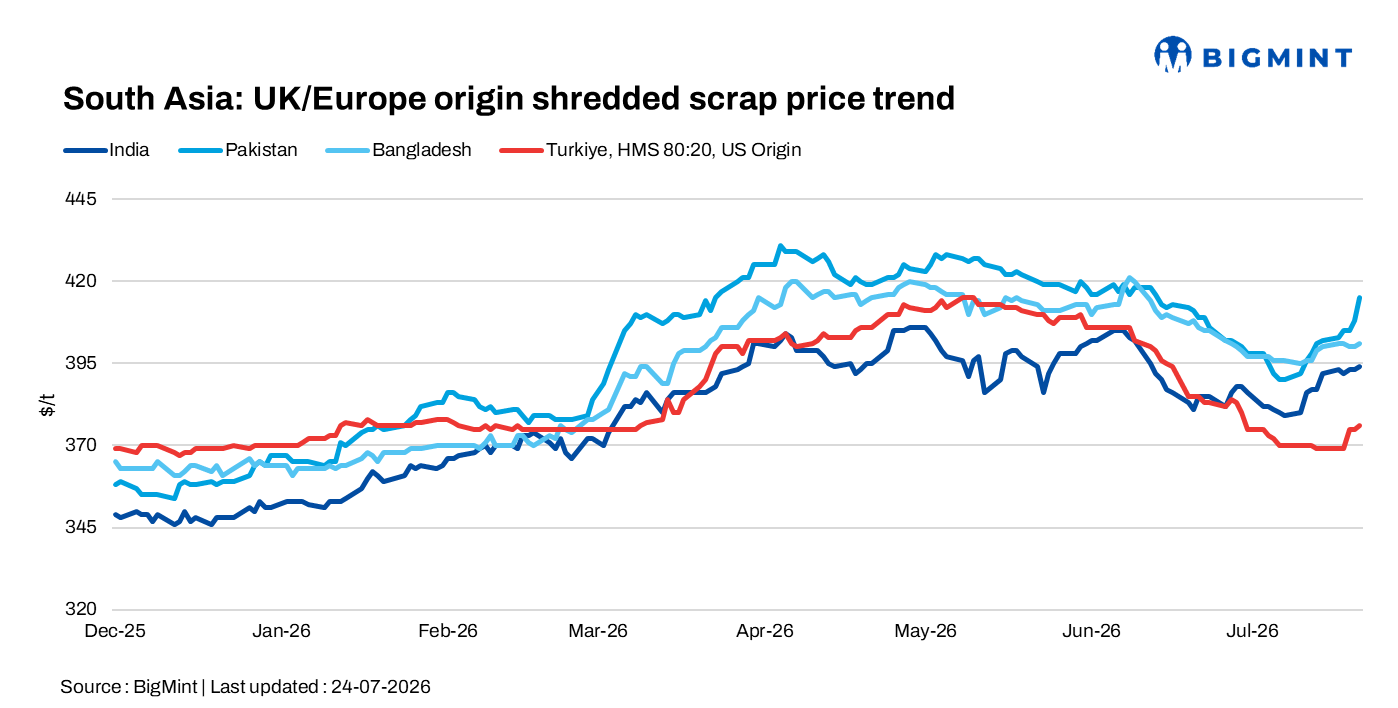
- Higher freights lift Pakistan’s prices by $5-7/t d-o-d
- Weak steel demand limits aggressive mill procurement
South Asia’s imported ferrous scrap markets remained mixed d-o-d on 24 July 2026, with weak steel demand, seasonal disruptions, and cautious mill procurement keeping trading activity subdued in India and Bangladesh. Pakistan recorded firmer import prices on higher freight costs and tighter scrap availability, while Turkiye’s deep-sea scrap market strengthened on renewed mill buying, constrained supply, and improving domestic rebar sentiment.
India
Imported ferrous scrap trading remained subdued as weak downstream steel demand, the ongoing monsoon season, a weaker rupee, and geopolitical uncertainties continued to discourage fresh bookings.
Only limited containerised volumes were heard booked, with buyers unwilling to secure HMS 80:20 below $330/t CFR. UK-origin shredded scrap offers were heard around $400/t CFR, while material from older UK yards was offered at $395/t CFR. Africa-origin HMS 80:20 was heard at $343-345/t CFR. No confirmed bids or fresh trades were reported during the week.
Market participants said import activity is likely to remain slow until the monsoon ends, with demand expected to recover thereafter. The weak rupee continued to reduce import competitiveness, while pellet-based domestic DRI remained a cheaper alternative to imported scrap. Domestic rebar prices also stayed largely stable amid sluggish construction activity.
Pakistan
Pakistan has recently emerged as one of the strongest containerised scrap buyers globally, while most other Asian markets remain cautious. Prices rose $5-7/t d-o-d today. UK/EU-origin shredded offers were at $415-420/t CFR Qasim, with deals heard at $408-415/t CFR. Malaysian busheling was offered at $430-435/t CFR, while PNS was around $425/t CFR. Buyers indicated workable levels of $390-395/t CFR, but suppliers remained firm.
Higher freight costs, tighter summer scrap availability in Europe, and uncertainty over the Strait of Hormuz continued to support prices. Unlike other markets, Pakistani buyers have been concluding deals at higher levels.
The domestic market remained slow due to the monsoon, but local scrap prices increased by PKR 8,000-10,000/t ($28-36/t) over the past week. Buying interest is expected to improve as importers adapt to the new documentation and tax requirements.
Bangladesh
Imported ferrous scrap activity remained extremely weak as mills continued to reduce production due to letter of credit (LC) constraints, weak finished steel demand, and tight cash flows. No fresh import deals were reported during the week.
Tradable values for containerised shredded scrap were heard at $365-370/t CFR Chattogram, while offers remained around $400/t CFR. Bids for Central America-origin HMS 80:20 were heard at $350/t CFR.
Market participants said imported scrap prices had declined by around $10/t w-o-w, with Australia/US-origin HMS 90:10 now heard around $380/t CFR, as subdued buying interest and need-based procurement continued to weigh on market activity.

Turkiye
Imported deep-sea ferrous scrap prices remained firm on 24 July, with US-origin HMS 80:20 assessed at $376/t CFR, inching up by $1/t d-o-d. Market participants expect prices to strengthen further as tight scrap availability, higher freights, and renewed mill buying for August-September shipments continue to support sentiment. Low Rhine River water levels also constrained European scrap supply.
Freights remained elevated at $36-40/t from the US East Coast and $34-35/t from Rotterdam to Turkiye, supporting offers. Traders indicated prices could soon exceed $380/t CFR if buying momentum persists. Meanwhile, Turkish rebar export offers increased to $575-585/t FOB, reflecting firmer scrap sentiment.

Leave a Reply