- Leading cement producers currently using domestic coal
- Freights, rather than demand, support global petcoke prices
Rising freight costs, geopolitical uncertainty, and firmer international prices are supporting the global petroleum coke market. Yet in India — the world’s largest importer of fuel-grade petcoke — buyers remain reluctant to chase higher prices, opting instead for domestic coal and premium thermal coal while waiting for better purchasing opportunities.
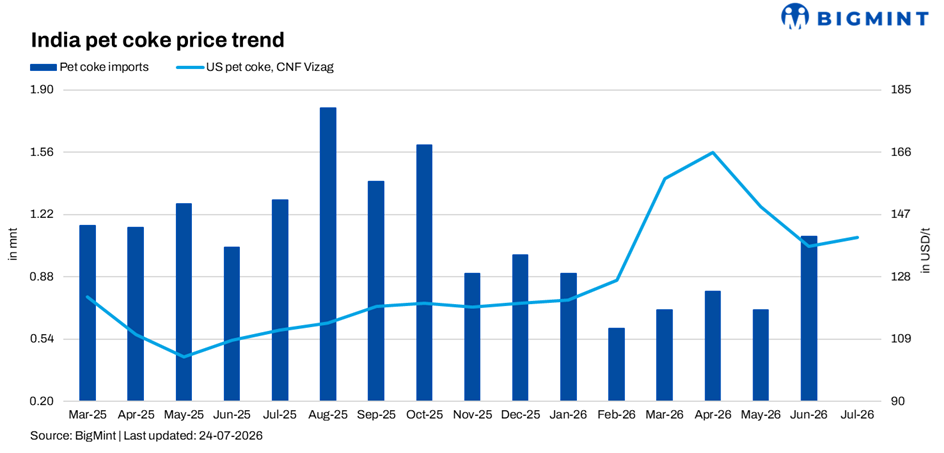
The global petroleum coke (petcoke) market has entered a phase of gradual recovery after a prolonged correction during the second quarter of 2026. International suppliers have steadily raised offers over recent weeks, supported by stronger freights, tighter export availability, and renewed geopolitical uncertainty affecting shipping markets.
However, the Indian market is telling a different story.
Despite firmer international sentiment, purchasing activity remains subdued as cement manufacturers — the country’s largest petcoke consumers — continue to delay fresh imports, relying instead on comfortable inventories and increasingly competitive domestic coal and imported US thermal coal. Rather than signalling the beginning of another bullish cycle, the current market reflects a widening disconnect between sellers attempting to push prices higher and buyers who remain unconvinced that the fundamentals justify a sustained rally.
International market supported by freight rather than demand
Unlike previous rallies driven by strong industrial demand, the latest recovery in international petcoke prices appears to be largely cost-led.
Freight rates have strengthened across several trade routes while geopolitical tensions in the Middle East have added uncertainty to shipping schedules and insurance costs. These developments have encouraged suppliers in the US Gulf and Saudi Arabia to gradually lift export offers despite a relatively modest improvement in underlying consumption.
Consequently, offers into India have steadily moved higher through July after bottoming out during June.
The broader energy complex has also contributed to firmer sentiment. International thermal coal prices have stabilised following months of declines, providing additional support to petcoke values and reducing the pricing pressure that prevailed earlier this year.
Nevertheless, global demand remains far from robust. Buyers across Asia continue to procure only on a need basis, limiting the extent to which suppliers have been able to successfully pass through higher offers.
Indian buyers refuse to chase rising prices
India’s import market has responded cautiously.
Weekly market assessments indicate that while suppliers have consistently increased offers throughout July, actual buying interest has remained weak. Indian cement producers continue to view current import prices as uneconomical, particularly given comfortable fuel inventories and the availability of alternative fuels.
Market participants reported US high-sulphur petcoke offers around $136-142/t CFR west coast India during early July, while Saudi-origin cargoes were offered even higher, near $142/t CFR, with arrivals largely expected only towards late August or early September.
As July progressed, offers moved further upward. Buyers increasingly reported imported petcoke offers between $141-145/t CFR, although very few transactions were concluded at these levels.
Rather than accepting these higher prices, many consumers have simply postponed procurement.
Cement companies increasingly rely on domestic coal
Feedback collected from major cement producers illustrates a remarkably consistent theme across the industry.
Ramco Cement indicated that it was postponing purchases while waiting for prices to soften, instead consuming domestic coal sourced from MCL and Singareni. MyHome Industries similarly reported that it had temporarily stopped using imported petcoke altogether in favour of domestic coal. JK Lakshmi stated that although offers below prevailing market levels had been received, they were still not considered economically viable, leading the company to continue operating with a blend of domestic coal and US coal.
Even traders described the market as exceptionally quiet.
Adani Enterprises characterised the petcoke market as “very dull” with limited buyer interest despite higher offers, while several trading houses reported little change in physical activity despite the strengthening price environment.
The message from the market is clear: suppliers may be raising prices, but Indian buyers are unwilling to follow.
Inventory comfort reduces procurement urgency
Another important factor suppressing imports is inventory.
Several market participants indicated that cement producers currently hold approximately 1.5-2 months of fuel stocks, allowing them to delay procurement decisions without disrupting operations. This inventory cushion provides buyers with considerable flexibility to wait for either freight costs or international prices to moderate before returning to the market.
Unlike previous years, procurement strategies have become increasingly tactical.
Instead of maintaining fixed purchasing programmes, many companies are actively managing inventories while switching between petcoke, imported coal, and domestic coal depending on relative delivered energy costs.
Fuel competition has intensified
Perhaps the most significant structural change is the growing competition between petcoke and alternative fuels.
Earlier this year, falling petcoke prices made the fuel particularly attractive for cement producers seeking lower heat costs. However, the recent rebound has narrowed this advantage considerably.
Premium US NAPP thermal coal has regained competitiveness, while abundant domestic coal availability has further reduced the urgency to secure imported petcoke cargoes.
For many producers, fuel procurement is no longer a simple price comparison.
Instead, procurement teams evaluate delivered heat value, ash characteristics, kiln efficiency, logistics, inventory holding costs, and expected price direction before making purchasing decisions. This increasingly sophisticated approach has reduced dependence on any single fuel and improved operational flexibility.
Cement sector fundamentals remain supportive
Ironically, the subdued petcoke procurement environment does not reflect weakness in the cement industry itself.
According to JM Financial, cement demand during the first quarter of FY’27 is expected to have grown in the high single digits y-o-y, with several major producers — including UltraTech, Shree Cement, JK Cement, and JSW Cement — likely to outperform industry growth. Pan-India cement prices also improved sequentially during the quarter, supporting revenue realisations. However, higher fuel costs are expected to weigh on margins during the coming quarter before any benefits from earlier declines in petcoke prices are fully reflected in production costs.
This explains why procurement teams remain highly disciplined despite healthy operating conditions.
Protecting fuel costs has become as important as securing volumes.
Outlook
The global petcoke market appears to be transitioning from the sharp correction witnessed during the second quarter towards a more balanced pricing environment. Rising freight costs and geopolitical uncertainty are likely to continue providing support to international offers over the near term.
However, the Indian market is unlikely to mirror this recovery immediately.
Comfortable inventories, improved domestic coal availability and the renewed competitiveness of premium imported thermal coal are giving cement producers the flexibility to delay purchases until clearer value emerges. Unless international suppliers moderate offer levels or freight costs ease, Indian buying is expected to remain selective and largely requirement-driven rather than speculative.
In the coming weeks, market direction will depend less on supplier pricing ambitions and more on whether end-users perceive imported petcoke as offering a meaningful economic advantage over competing fuels. Until that differential widens, India’s cement industry is expected to remain disciplined, keeping procurement activity subdued even as the global market firms.

Leave a Reply