- Cheaper domestic scrap results in cautious buying in India
- Turkiye price rise drives buyers into wait-and-see mode
South Asia’s imported scrap markets experienced mixed dynamics across key regions, influenced by global price movements, supply constraints, and local economic factors. In India, demand remained moderate despite rising offers, as buyers preferred domestic scrap. Pakistan’s market was sluggish due to Ramadan and cautious buying, while Bangladesh saw limited interest in the UK/Europe-origin scrap, with buyers favouring regional suppliers.
Turkiye’s market edged up slightly, with mills engaging cautiously amid controlled price hikes. Freight costs, currency fluctuations, and global trends, particularly in the US and Turkiye, continued to shape sentiment, while traders in South Asia anticipated a post-Eid revival in demand.
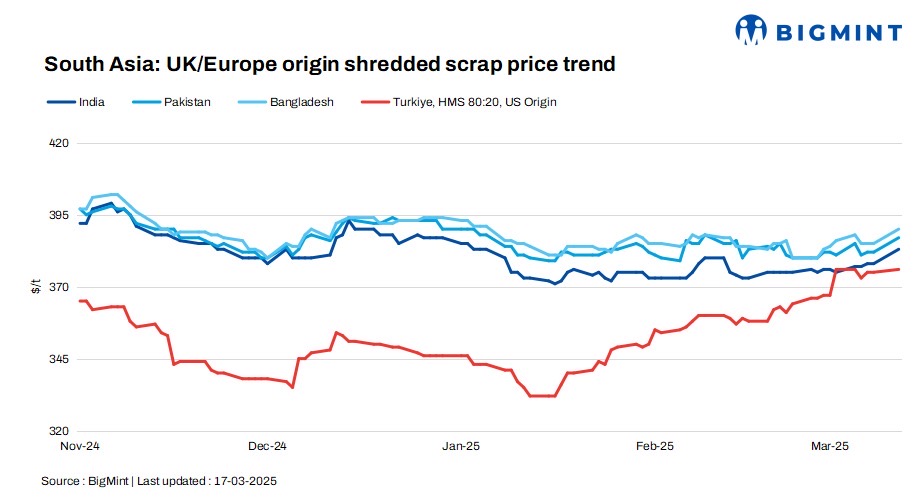
The UK-origin shredded scrap offers edged up by $5/t across India, Pakistan and Bangladesh, while US-origin bulk HMS 80:20 offers to Turkiye edged up by $1/t compared to the last closing before the Holi break in India.
Overview
India: India’s imported scrap demand remained moderate as offers surged due to global shortages and unviability from the US following Trump’s tariff imposition. However, buyer reluctance led to bid-offer mismatches, with many preferring domestic scrap for its cost-effectiveness, slowing down bookings. Shredded scrap offers from the UK/Europe were heard at $382-387/t CFR Nhava Sheva, with deals concluded at $384-387/t CFR, while some buyers targeted $375-380/t CFR. HMS 80:20 from the UK/Europe remained unviable, with indicative offers at $355-360/t CFR, while buyer bids were around $345-350/t CFR.
Pakistan: Pakistan’s imported scrap market remained subdued due to Ramadan, with mills operating at reduced capacity and focusing on maintenance. While some demand still persisted, the major buyers stayed cautious. The UK/EU-origin shredded scrap offers ranged between $385-388/t CFR Qasim, but bids lagged at $378-385/t. UAE shredded was quoted at $385-390/t CFR with no counter bids.
Payment delays, local scrap availability, and high taxes kept sentiment weak. Traders anticipate demand revival post-Eid, with increased bookings likely in April-May. Rising freight costs and currency volatility added uncertainty, while global market trends, particularly in Turkiye, remained key drivers.
Bangladesh: Bangladesh’s imported scrap market remained slow as buyers exercised caution amid high offers and Ramadan-driven sluggishness. Interest in UK/Europe material was limited, with buyers favouring nearby origins like Australia, Hong Kong, Singapore, and Malaysia. Australian shredded was offered at $375-380/t CFR Chattogram, HMS 90:10 at $362-365/t CFR, and GI bundles from the Philippines at $330-335/t CFR.
Bulk HMS 50:50 from Japan was booked at $364/t CFR by a primary mill, while UAE HMS 1 at $390/t CFR was deemed unworkable.
The larger mills in Chattogram remained active in securing material, while smaller mills in Dhaka held back. Market movement remains uncertain, with US market trends and export volumes playing a crucial role in shaping Bangladesh’s scrap demand.
Turkiye: The Turkish imported scrap market edged up slightly following a couple of fresh deals. US/Baltic-origin HMS 80:20 hovered at $378-$381/t CFR, while EU/UK-origin offers stood at $373-375/t CFR. Mills engaged cautiously, aiming to control price hikes. Meanwhile, Turkiye scrap futures maintained a contango, signalling expectations of near-term price increases before flattening for June.

Price assessments
India: UK-origin shredded indicatives were assessed at $383/t CFR Nhava Sheva, up by $5/t compared 13 March.
Pakistan: UK-origin shredded indicatives stood at $387/t CFR Qasim, up by $5/t compared to 13 March.
Bangladesh: UK-origin shredded indicatives stood at $390/t CFR Chattogram, up by $5/t versus 13 March.
Turkiye: US-origin HMS (80:20) bulk scrap prices were assessed $376/t CFR Turkiye, up by $1/t compared to last close on 13 March.
Leave a Reply