- Richards Bay decline outweighs stable Saldanha Bay flows
- Transnet rail recovery continues, but operational constraints remain
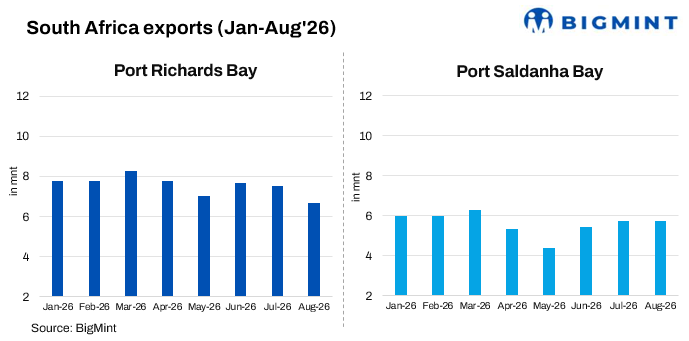
South Africa’s shipments from key bulk export ports fell 6% m-o-m to 12.41 million tonnes (mnt) in August 2026, from 13.25 mnt in July. The decline was driven by weaker Richards Bay volumes, while Saldanha Bay shipments remained stable. Despite the monthly dip, Transnet’s bulk rail performance continued to show improvement, with coal railings to Richards Bay and improving locomotive availability supporting exports.
Port-wise performance
- Saldanha Bay stable: Shipments remained broadly unchanged at 5.75 mnt, as improving rail and equipment availability on the Ore Export Corridor supported steady iron ore flows. However, ongoing corridor capacity constraints continued to limit a stronger recovery.
- Richards Bay weakens: Shipments fell significantly by 11% m-o-m to 6.66 mnt, from 7.50 mnt in July 2026, accounting for most of the overall decline. The port’s coal flows remained sensitive to rail capacity and operational constraints, despite broader improvement in Transnet’s coal corridor performance.
Lower coal offers, rising vessel availability weigh on RBCT-Paradip freight rates
RBCT-Paradip freight sentiment remained soft, as lower coal offers and no bookings reported so far this week have increased vessel availability. Higher bunker prices and limited price clarity among Charterers for October loading cargoes are further weighing on booking activity.
Outlook
Bulk exports are likely to remain supported by the ongoing Transnet rail recovery, but month-to-month volumes may remain volatile. Further improvement in locomotive availability and rail reliability could support Richards Bay shipments, while maintenance and infrastructure constraints remain key downside risks.
Leave a Reply