- Atlantic Capesize routes strengthen as tighter tonnage supports freight
- Higher bunker costs and geopolitical risks add pressure to voyage economics
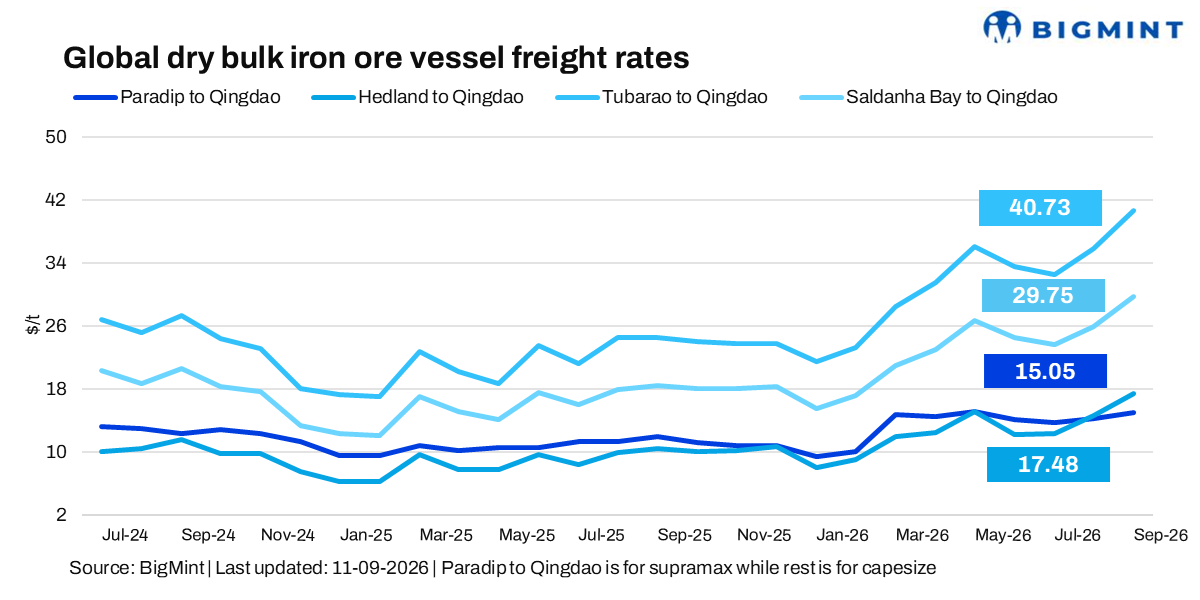
Dry bulk iron ore freight rates remained diverse overall in the week ended 10 September, with the Atlantic Capesize market showing stronger momentum than the Pacific. Sentiment on Brazilian routes was supported by healthy cargo activity, tightening prompt tonnage and stronger owner confidence, while Australia-China rates remained broadly stable amid balanced fundamentals. India-China freight rates edged lower, reflecting softer enquiry and balanced tonnage availability, although the broader market remains relatively stable.
The Atlantic market continues to be the key source of support, with firm miner activity and limited vessel availability underpinning freight sentiment. Pacific markets remained comparatively steady, with sufficient tonnage availability keeping rate gains contained.
A shipowner informed BigMint, “Capesize appears softer, while Panamax remains broadly firm with some improvement in rates, supported by steady but limited enquiry. Supramax activity is relatively stronger in terms of enquiries, although rates are slightly softer despite firm time-charter (TC) levels. Handymax remains largely flat, with limited enquiry and little change in rates.”
Overall dry bulk sentiment remains cautiously bullish, although recent volatility suggests the market is becoming more sensitive to changes in cargo flow and vessel positioning. Higher bunker costs and geopolitical risks are adding support to freight levels, while cautious Chinese mill buying and mixed steel margins could limit further upside.
Route-wise update

Factors influencing freight rates
- Baltic Dry Index rises 0.9% w-o-w: The BDI increased by 33 points (0.9%) to 3,521, from 3,488, led by a 1.3% rise in BCI to 6,122 and a 2.7% gain in BSI to 1,713, while BPI declined 2.0% to 2,409. Weekly gains were supported by firm Capesize cargo activity, particularly across Atlantic-Pacific routes, tighter prompt vessel availability and resilient iron ore and coal demand.
- Brent crude futures surge w-o-w: Brent crude futures rose by $8.70/barrel (bbl) (9.1%) w-o-w to $103.85/bbl on 11 September, from $95.15/bbl. The sharp increase was driven by escalating US-Iran tensions, intensified attacks on shipping and continued disruptions to oil flows through the Strait of Hormuz, with additional risks from threats to Red Sea and Saudi energy infrastructure.
- Bunker prices rise w-o-w: Singapore VLSFO bunker prices increased by $60/tonne (t) (7.1%) w-o-w to $903/t on 11 September, from $843/t. The rise tracked the sharp rebound in crude prices, while ongoing disruptions around the Strait of Hormuz and tighter fuel-oil availability added further upward pressure.
- DCE iron ore futures ease w-o-w: The benchmark DCE iron ore contract declined by RMB 1.5/t (0.2%) w-o-w to RMB 718/t on 11 September, from RMB 719.5/t. The marginal decline reflects cautious Chinese mill buying and concerns over steel demand and margins, offsetting support from supply-side disruptions and relatively firm raw-material costs.

Outlook
Dry bulk iron ore freight is expected to remain firm in the near term, with Atlantic Capesize routes likely to outperform Pacific trades. Strong Brazilian cargo flows, limited prompt tonnage and higher bunker costs should continue to support freight levels. However, elevated fuel costs, cautious Chinese mill demand and recent volatility in Capesize rates could limit the upside. The sustainability of the freight rally will depend largely on Chinese steel demand, miner activity and vessel availability across the Atlantic and Pacific basins.
Leave a Reply