- Indonesian prices rise on reduced cargo supply, firm Chinese buying
- Low power-plant stocks, firm replacement costs continue to lift prices
Indian portside prices of Indonesian thermal coal increased sharply w-o-w, with the 4200 GAR and 5000 GAR prices reaching four-year highs in the assessment week ended 11 September 2026, supported by tightening Indonesian supply, reduced cargo availability, and active Chinese buying interest. The supply-side constraints strengthened sellers’ bargaining power, while elevated replacement costs and firm freight rates provided additional support to Indian prices.
Lower Indonesian exports tighten availability
Indonesia’s non-coking coal exports declined sharply to 26.95 mnt in August 2026, down 16.1% y-o-y from 32.11 mnt and 5.7% m-o-m from 28.59 mnt in July, according to BigMint’s vessel line-up data. The decline followed relatively stable monthly exports of around 28-29 mnt during April-July and reflects tighter production controls and stricter export oversight. The reduced export availability has supported producer offers and limited prompt cargo availability in the seaborne market.
Indonesian coal prices reach multi-year highs amid tightening supply
Against this backdrop, 5,000 GAR prices increased by INR 300/t w-o-w to around INR 11,900/t at Kandla and INR 11,800/t at Vizag, reaching four-year highs, supported by tightening Indonesian supply and limited prompt cargo availability. 4,200 GAR prices rose by a sharper INR 400/t to around INR 10,000/t at Kandla and INR 9,900/t at Vizag, also reaching around four-year highs.
Meanwhile, 3,400 GAR prices at Navlakhi increased by INR 250/t to around INR 8,000/t, marking an all-time high since the inception of the assessment, driven by strong demand for the cost-competitive grade amid constrained Indonesian supply.
Market participants noted that 3,400 GAR remains the preferred grade due to its cost competitiveness, with buying reportedly running at around 7,000-8,000 t/day. Expectations of relatively stable demand ahead of China’s October Golden Week also provided some support to market sentiment.
Power-plant stock drawdown keeps fundamentals firm
India’s thermal coal inventories at major ports edged up 0.6% w-o-w to 13.48 mnt in week 36 from 13.40 mnt in week 35. However, the marginal increase largely reflected stock accumulation at Mundra, Dhamra and Tuticorin, while several other ports recorded drawdowns. Meanwhile, cautious buying at elevated price levels has prevented a stronger build-up in port inventories.
More importantly, domestic thermal power-plant stocks fell around 7% w-o-w to 25.8 mnt as of 9 September, equivalent to only around eight days of consumption, with nearly 59 plants reporting critical inventory levels. Tighter domestic coal availability is therefore keeping imported coal replacement costs elevated despite relatively cautious spot buying.
Global Indonesian benchmarks reinforce upward bias
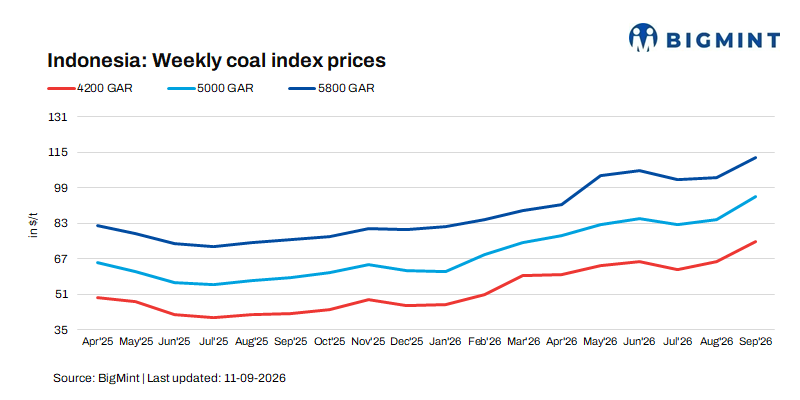
The broader Indonesian market also remained supportive. 4,200 GAR FOB prices recorded the strongest weekly increase of around $5-6/t, while 3,400 GAR gained around $1-2/t. Meanwhile, 5,800 GAR prices remained broadly stable. The firmness in key Indonesian benchmarks, coupled with lower export availability, indicates continued supply-side support for Indian portside prices.
Outlook
Indonesian thermal coal prices at Indian ports are expected to remain firm with a moderate upward bias in the near term, supported by constrained Indonesian supply, limited prompt cargo availability, low domestic power-plant inventories and firm replacement costs. Continued Chinese buying could further tighten seaborne availability.
However, high prevailing price levels are beginning to limit buyer participation, with market participants reporting fewer spot trades and resistance from buyers to purchasing at elevated prices. Accordingly, while supply constraints should prevent a significant price correction, limited buying interest and affordability concerns are likely to cap the extent of further gains.
Leave a Reply