- OMC auction bids climb despite subdued fines participation
- Lower dispatches support prices, while cautious steel demand limits gains
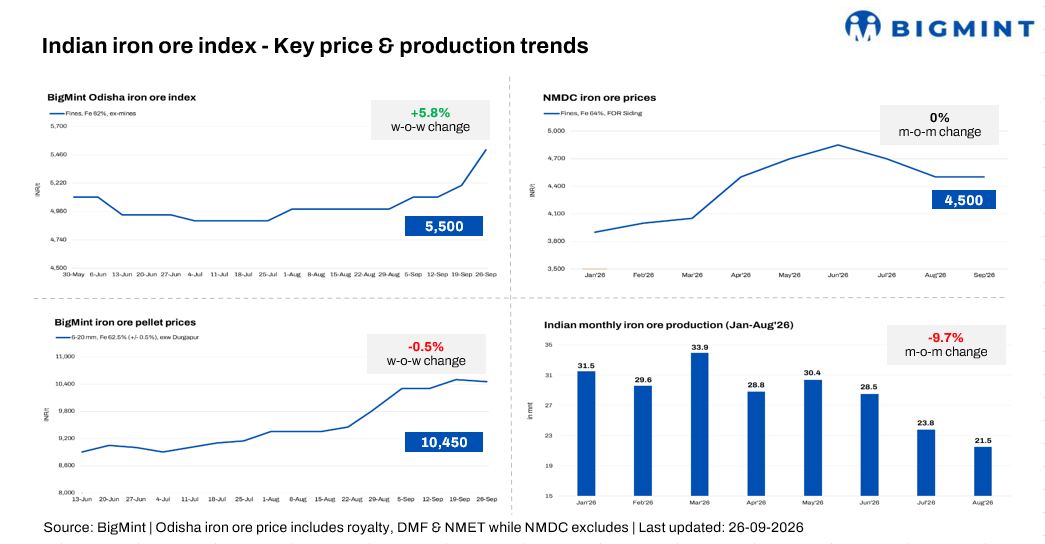
BigMint’s Odisha Fe 62% iron ore fines assessment increased by INR 300/tonne (t) ($3/t) w-o-w to around INR 5,500/t ($57/t) ex-mines, hitting over four-month high in the week ending 26 September 2026.
The increase followed a hike in Odisha Mining Corporation’s (OMC) iron ore base prices for its auction on 19 September 2026, prompting miners to raise their offers. However, trading activity remained subdued, as buyers turned cautious amid concerns over weakening demand for semi-finished steel.
“Though we have raised prices, deals are unlikely to happen, as concerns over the fading semi-finished steel market have made buyers cautious,” an Odisha-based miner said. Another market participant said that subdued downstream steel demand was restricting iron ore procurement.
“OMC’s fines auction did not receive an active response this time, impacting overall market activity. While higher base prices lifted lump offers, there were no active trades, and fines did not see similar gains,” traders highlighted.
OMC’s 19 September iron ore fines auction saw 6.39 lakh tonnes booked against 12.05 lakh tonnes offered, translating into a booking rate of around 53%. Despite relatively weak volume absorption, winning bids rose by INR 350-950/t ($4-10/t) over August levels, with Jilling Fe 60-62% fines recording the sharpest increase of INR 950/t ($10/t) to INR 5,400/t ($56/t). Gandhamardan-A, Daitari and Gandhamardan-B also saw notable gains. On a booked-quantity-weighted basis, winning bids increased by around INR 729/t ($8/t), pointing to a clear divergence between subdued auction participation and higher price levels.
In contrast, OMC’s iron ore CLO auction recorded stronger volume absorption, with 490,000 t booked out of 612,000 t offered, or around 80%, leaving 122,000 t unsold. Weighted average bid prices rose by INR 1,250/t (13/t) m-o-m, with premiums of up to INR 1,600/t ($17/t) over base prices. Khandbandh recorded the sharpest increase, followed by Dubna-Sekradihi, Roida ‘C’, Jilling, Banspani and Gandhamardhan. However, gains remained selective, as around 206,000 t of booked material, mainly from Apahatu and Guali, was sold at base prices, indicating stronger demand for specific grades rather than broad-based willingness to pay higher premiums.
Few major iron ore players’ told BigMint, “Supply availability could provide some underlying support. OMC and Tata Steel volumes to the market have lowered, hence there is a shortage. The market seems likely to remain at these levels for the next 1-2 months”.
Odisha iron ore dispatches declined further to 11.1 million tonnes (mnt) (10%) in August 2026, from 12.3 mnt in July, amid persistent rainfall that disrupted mining operations, loading activities and material movement across facilities. OMC dispatches fell to 2.4 mnt (-23%), while Tata Steel’s shipments remained relatively stable at 2.3 mnt.
However, some sellers appear to have raised offers beyond what current fundamentals justify as one of the source mentioned, “Offers have increased, but a few offers were raised unnecessarily to create pressure in the market.”
Rationale:
- T1: Zero (0) deal for Fe 62% fines was recorded during the publishing window and assigned 0% weightage in the index calculation.
- T2: BigMint received eighteen (18) offers and indicative prices under the T2 category (offers, indicative, and bids) in this publishing window. Sixteen (16) were taken into consideration and given 100% weightage. To check BigMint’s iron ore assessment, pricing methodology, document,click here.
However, BigMint noted that auction buying remained stronger than direct sales during the week. SAIL’s Odisha iron ore auctions held during 18-25 September saw 223,980 t fully booked, reflecting strong end-user participation. At Bolani Mines, CLO (10-40 mm, Fe 62%) was sold at INR 6,975/t ($73/t), a premium of INR 700/t ($7/t) over the INR 6,275/t ($65/t) base price, while fresh fines (Fe 61%) were booked at INR 5,875/t ($61/t), INR 350/t ($4/t) above the INR 5,525/t ($58/t) base. At Barsua, CLO (10-40 mm, Fe 60%) was booked at INR 5,600/t ($58/t) and fresh fines (Fe 59.5%) at INR 5,150/t ($54/t).
In the 25 September auction, Bolani dump fines (Fe 62.20%) sold at INR 5,620/t ($59/t) after receiving no bids earlier, while Barsua tailings (Fe 60.66%) were booked at INR 5,155/t ($54/t). However, 16,000 t of Bolani dump fines (Fe 60.22%) remained unsold at INR 5,350/t ($56/t) in the 22 September auction, indicating selective buying interest across material types and grades.
Eastern steel market sentiment remains cautious amid weak downstream demand
- Eastern pellet market sees mixed sentiment as prices diverge: Pellet prices showed mixed movement in the eastern market during the week ended 26 September 2026. Odisha’s Barbil Fe 62.5% (6–20 mm) pellet prices remained unchanged at INR 9,500/t ($99/t) LTW, owing to weak enquiries post OMC auction and limited willingness among sellers to lower offers. In contrast, Durgapur pellet prices declined marginally by INR 50/t ($1/t) w-o-w to INR 10,450/t ($109/t) ex-works, as cautious buying and pressure from weaker downstream steel realisations weighed on market sentiment.
- Rourkela C-DRI prices slide as weak steel demand weighs on market: Rourkela C-DRI prices fell sharply by INR 1,100/t ($11/t) w-o-w to INR 29,500/t ($308/t) on 26 September, from INR 30,600/t ($319/t) previously. The decline reflected weak buying interest and pressure from softer finished steel realisations, with buyers adopting a cautious, need-based procurement approach. Lower sponge iron and billet prices also weighed on seller price ideas and market sentiment.
- Rourkela rebar prices hold steady amid cautious market sentiment: Rourkela IF-route rebar (12-25 mm) prices remained unchanged w-o-w at INR 54,000/t ($564/t) on 26 September 2026. Muted trading activity and cautious downstream demand kept the market subdued, although sellers largely maintained offers amid limited willingness to reduce prices further. The stability reflects a balance between weak buying interest and resistance to lower price levels.

Outlook
Odisha iron ore prices are likely to remain firm but range-bound in the near term, supported by tightening availability as persistent rainfall continues to disrupt mining, loading and material movement. Lower OMC and overall state dispatches, along with reduced market availability from major producers, could provide a floor to prices.
However, upside may remain capped by cautious buying, with subdued downstream steel and semi-finished steel demand limiting procurement appetite. Higher miner offers and recent OMC auction premiums may support price levels, but sustained gains are likely to require an improvement in steel demand and broader transaction activity.
Leave a Reply