- Saudi pipeline restarts but capacity recovery may take weeks
- Asian naphtha remains around $900/t
Disruptions around the Strait of Hormuz continue to pressure Gulf energy logistics and Asian petrochemical feedstock costs, despite Saudi Arabia restarting its East-West pipeline. For Indian buyers, elevated freight, insurance and rerouting costs are adding to landed costs and supply-chain risks.
Hormuz traffic remains disrupted
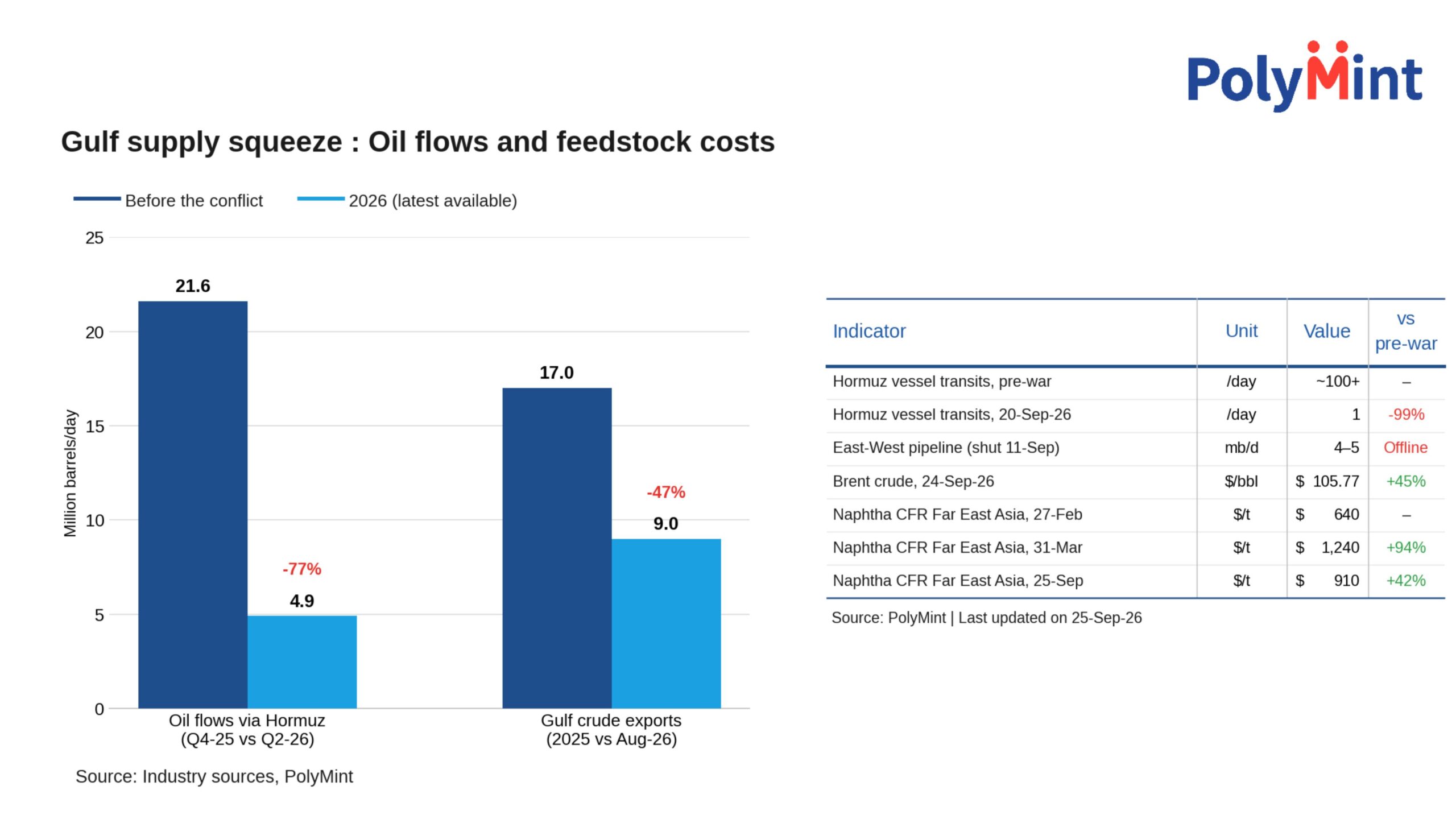
Commercial shipping through the Strait of Hormuz remains sharply below normal levels. Only 17 commodity vessels transited the chokepoint over the 19-20 September weekend, compared with a pre-war average of 125 vessels a day, according to Reuters shipping data.
The US Energy Information Administration (EIA) reported that oil flows through Hormuz fell from 21.6 million bpd in Q4 2025 to 4.9 million bpd in Q2 2026, highlighting the scale of the disruption.
Saudi bypass route resumes
Saudi Arabia restarted its 1,200km East-West pipeline on 22 September after a shutdown following a drone attack. Pumping has resumed at reduced rates, while restoring full capacity could take 6-8 weeks because three pumping stations were damaged, according to Reuters.
Saudi Arabia has also increased exports from Ras Tanura, with around 14 million barrels loaded onto seven VLCCs on 20 September. This provides some additional export capacity, but does not immediately restore the logistics flexibility available before the disruption.
Feedstock costs stay elevated
Shipping costs remain a major concern. War-risk premiums have reached as much as 10% of cargo value, while insurance costs can account for up to 6%, according to an ENOC executive cited by Reuters.
Asian naphtha prices remain around $900/t, with a 24 September Japan CFR assessment at about $912/t. This keeps feedstock costs significantly above pre-conflict levels despite the correction from earlier peaks.
For India, which imports around 60% of its LPG requirement, higher freight, insurance and rerouting costs can further increase landed costs for imported energy and petrochemical feedstocks.
Outlook
Feedstock costs are likely to remain sensitive to the pace of Saudi pipeline capacity recovery and the volume of shipping returning through Hormuz. Red Sea security will also remain important for alternative routes. A sustained recovery in Hormuz traffic would be required for freight and insurance costs to ease materially.
Leave a Reply