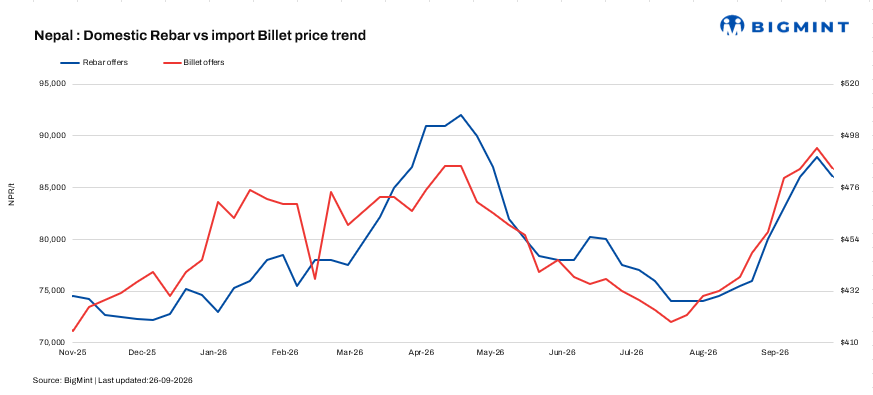
- Sponge iron, billet prices decrease by $5-7/t w-o-w
- Strong demand, production cuts limit price correction
Nepal’s cash rebar prices declined by NPR 2,000/t ($14/t) w-o-w to around NPR 86,000/t ($618/t) on 26 September 2026, according to BigMint’s assessment. The decline came despite relatively good underlying demand, as active monsoon conditions disrupted logistics and lower raw material costs exerted downward pressure on finished steel prices.
Bank-guarantee (BG) rebar prices were assessed at around NPR 88,000-90,000/t, maintaining a premium of NPR 2,000-4,000/t over cash-market prices.
Monsoon disrupts logistics and supply
Heavy monsoon activity continued to affect transportation and material movement across Nepal. Logistics disruptions have made it difficult for mills and traders to maintain regular supplies, while power-related issues have also resulted in production cuts at some steelmakers.
Despite these supply constraints, the market has not seen a corresponding sharp increase in prices, as lower raw material costs have reduced mills’ production-cost pressure.
Market participants reported that demand remains good, but buying activity has been influenced by the monsoon season and logistical difficulties. The combination of production cuts and transportation disruptions has resulted in some shortage of rebar in the market.
Raw material prices decline
Raw material prices weakened during the week, providing some relief to steel producers but also putting pressure on finished steel prices. Sponge iron prices declined by $7/t w-o-w to around $360/t CPT Raxaul. Billet prices also fell by $5/t w-o-w to around $484/t CNF Raxaul.
Meanwhile, IF-EAF wire rod prices decreased by $5/t w-o-w to around $570/t CNF Raxaul, reflecting softer regional pricing.
The decline in sponge iron, billet, and wire rod prices reduced input-cost pressure on Nepalese steel producers, contributing to the recent correction in rebar prices.
Production cuts limit availability
Power-related disruptions have forced some producers to reduce production, keeping market availability relatively tight. As a result, the price decline has been limited despite the fall in raw material costs.
Market participants noted that supply remains constrained in some areas, while logistical disruptions during the monsoon are adding to delivery challenges.
Outlook
Nepal’s rebar market is currently being influenced by two opposing factors. Good underlying demand and production cuts are supporting availability and preventing a sharper price correction, while lower raw material prices and monsoon-related logistics disruptions are weighing on finished steel prices.
In the near term, market direction is likely to depend on the extent of monsoon-related disruptions, power availability, raw material movements, and the pace of construction activity as weather conditions improve.

Leave a Reply