- Crop loan ceilings raised across major crops under revised credit programme
- Lower interest rates, machinery financing aim to ease rising input cost burden
Myanmar has expanded its agricultural credit programme under the 100-Day Action Plan, increasing loan ceilings for a wide range of crops and introducing concessional financing for farm machinery through the Myanmar Agricultural Development Bank (MADB). The initiative aims to improve farmers’ access to working capital amid rising fuel and fertiliser costs ahead of the FY 2026-27 crop season.
Loan ceilings increased across major crops
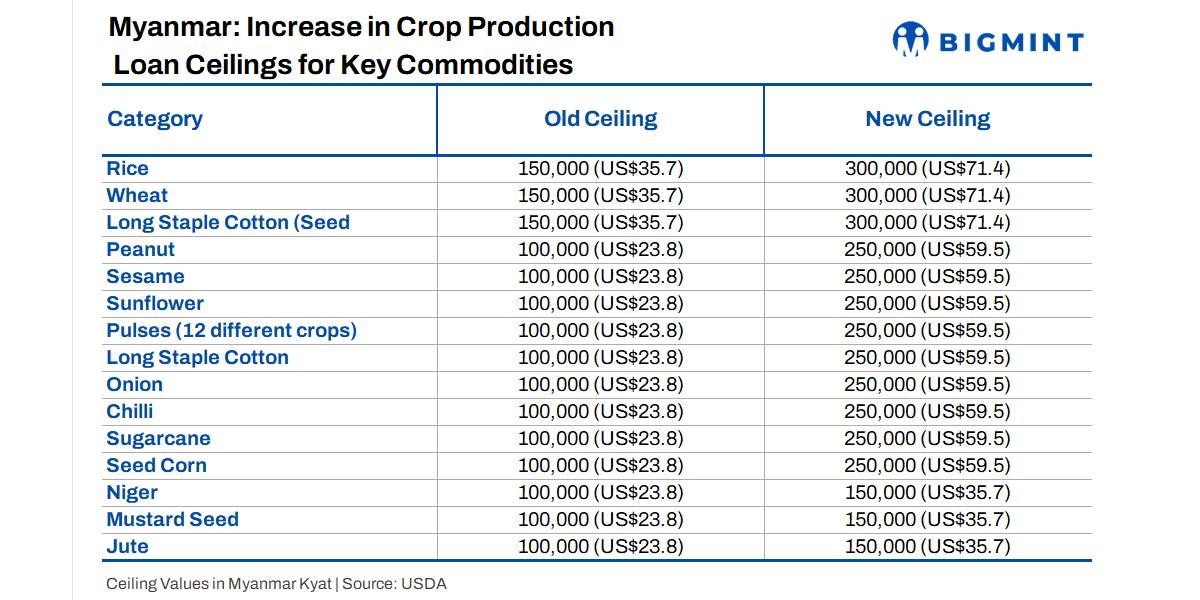
Beginning FY 2026-27 (April 2026-March 2027), MADB has doubled crop production loan ceilings for rice, wheat and long-staple cotton seed production from 150,000 Myanmar Kyat (MMK) to MMK 300,000 per eligible farmer. Loan ceilings for groundnut, sesame, sunflower, pulses, onion, chilli, sugarcane, seed corn and long-staple cotton have been increased from MMK 100,000 to MMK 250,000, while farmers cultivating niger, mustard seed and jute are now eligible for loans of up to MMK 150,000. The revised loan structure is intended to help farmers manage higher cultivation expenses, particularly rising fertiliser and fuel costs.
Lower interest rates, phased loan disbursement
The annual interest rate on crop production loans has been fixed at 5%, compared with lending rates of 8-13% offered by other government banks and 12-18% charged by private banks. Loan disbursement for monsoon crops began in May 2026 and will continue through September 2026, followed by winter crop financing from October 2026 to February 2027 and pre-monsoon crop loans during January-March 2027. However, only farmers without outstanding loans from previous years are eligible to participate in the programme.
Machinery loans introduced to support farm mechanisation
Alongside production loans, MADB has introduced agricultural machinery loans ranging from MMK 10 million to MMK 500 million at an annual interest rate of 6%. The loans are available with repayment periods of one, three or five years, with priority given to farmers and cooperative members possessing valid land-use rights documentation. Machinery loan disbursement has already commenced in selected regions, including Mon State, Bago Region, and Ayeyarwady Region.
Outlook
The expanded credit programme is expected to improve farmers’ access to production finance and help sustain agricultural activity during the upcoming crop season. However, rising input costs, relatively low government price support, weak global commodity prices and the exclusion of indebted farmers from the programme may limit its effectiveness in improving farm incomes over the longer term.
Leave a Reply