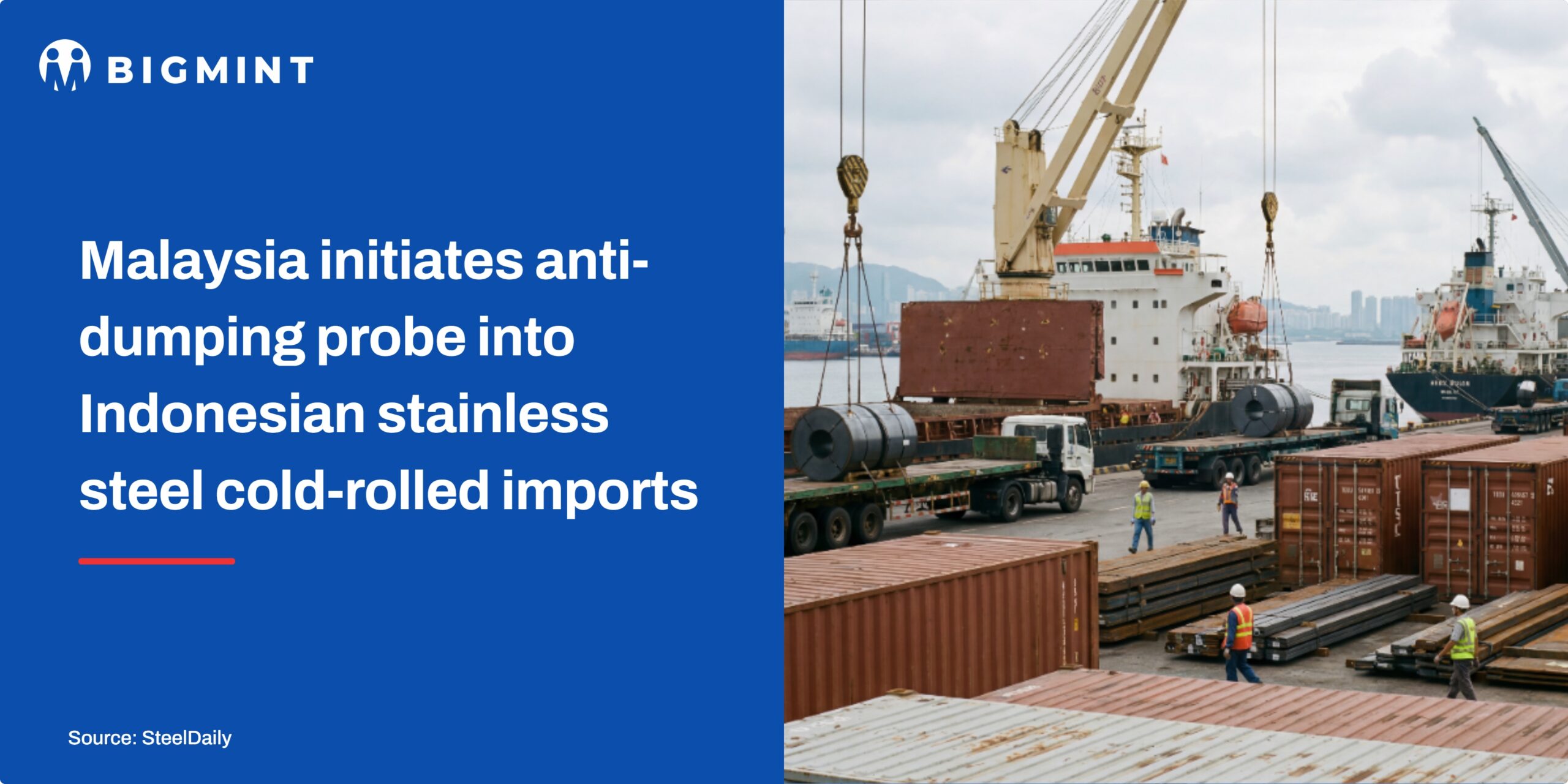
- Investigation covers cold-rolled coils, sheets, other forms
- Hot-rolled products remain outside scope of investigation
Malaysia’s Ministry of Investment, Trade and Industry (MITI) initiated an anti-dumping (AD) investigation on 9 September 2026, covering stainless steel cold-rolled coils, sheets and other forms imported from Indonesia. The investigation, filed by Malaysian stainless steel producer Bahru Stainless, is registered under case number AD03/26.
The investigation covers products under several HS/AHTN codes, including 7219.31.00, 7219.32.00, 7219.33.00, 7219.34.00, 7219.35.00, 7219.90.00, 7220.20.10, and 7220.20.90.
The preliminary determination is scheduled for 7 January 2027, while the final determination is expected on 7 May 2027.
Indonesia gains market share in Malaysia
The investigation follows a sharp increase in Indonesian stainless steel cold-rolled imports into Malaysia. According to UN Comtrade-based WITS data, Malaysia imported around 107,447 t of the four major cold-rolled stainless steel products covered under HS codes 721932-721935 in 2024.
Of this, Indonesian-origin material accounted for approximately 56,352 t, or 52.4% of total imports, compared with around 26,090 t, or 37.3%, in 2023. Indonesian shipments therefore increased by around 116% y-o-y, while market share rose by more than 15 percentage points.
Indonesia accounted for around 59% of Malaysia’s HS 721933 imports and approximately 75.9% of HS 721932 imports in 2024.
Bahru Stainless has reportedly alleged that the increase in Indonesian imports affected domestic producers through lower market share, price pressure, weaker sales, reduced operating rates and higher inventories.
Limited impact on Indonesia’s overall exports
Despite Indonesia’s strong position in the Malaysian market, Malaysia remains a relatively small destination for Indonesian stainless steel cold-rolled exports.
Indonesia exported around 1.06 mnt of products under HS 721932-721935 globally in 2024, of which shipments to Malaysia were approximately 57,000 t, accounting for only 5.4% of total exports.
For HS 721933, Indonesia exported around 612,624 t globally, with China accounting for approximately 471,281 t, while Malaysia received only around 32,692 t, or 5.3%.
Therefore, any future restriction on Indonesian cold-rolled stainless steel in Malaysia could have a more significant impact on Malaysia’s sourcing pattern than on Indonesia’s overall export volumes.
Hot-rolled stainless steel excluded
The investigation is limited to cold-rolled stainless steel, while hot-rolled products have been excluded.
This could limit the immediate impact on the broader stainless steel supply relationship between Malaysia and Indonesia, as Indonesian hot-rolled stainless steel can continue to be supplied to Malaysian processors using hot-rolled material as feedstock for cold rolling.
Potential shift in regional trade flows
Market participants expect the immediate impact on overall Southeast Asian stainless steel supply-demand to remain limited. However, the investigation could result in changes in regional trade flows if Malaysian buyers become more cautious about Indonesian cold-rolled material.
Some Indonesian volumes could potentially be redirected to other Southeast Asian or international markets. At the same time, suppliers from Vietnam and Thailand could gain opportunities to replace part of Indonesia’s share in Malaysia.
Malaysia had previously imposed AD duties of 8.80-34.82% on Indonesian cold-rolled stainless steel from April 2021 until 23 April 2026. The latest investigation comes around four and a half months after those measures expired.
Note: This article is published as part of a content exchange agreement between SteelDaily and BigMint.
Leave a Reply