- RKEF utilisation declines amid feedstock shortages
- El Nino threatens hydropower-dependent smelter operations
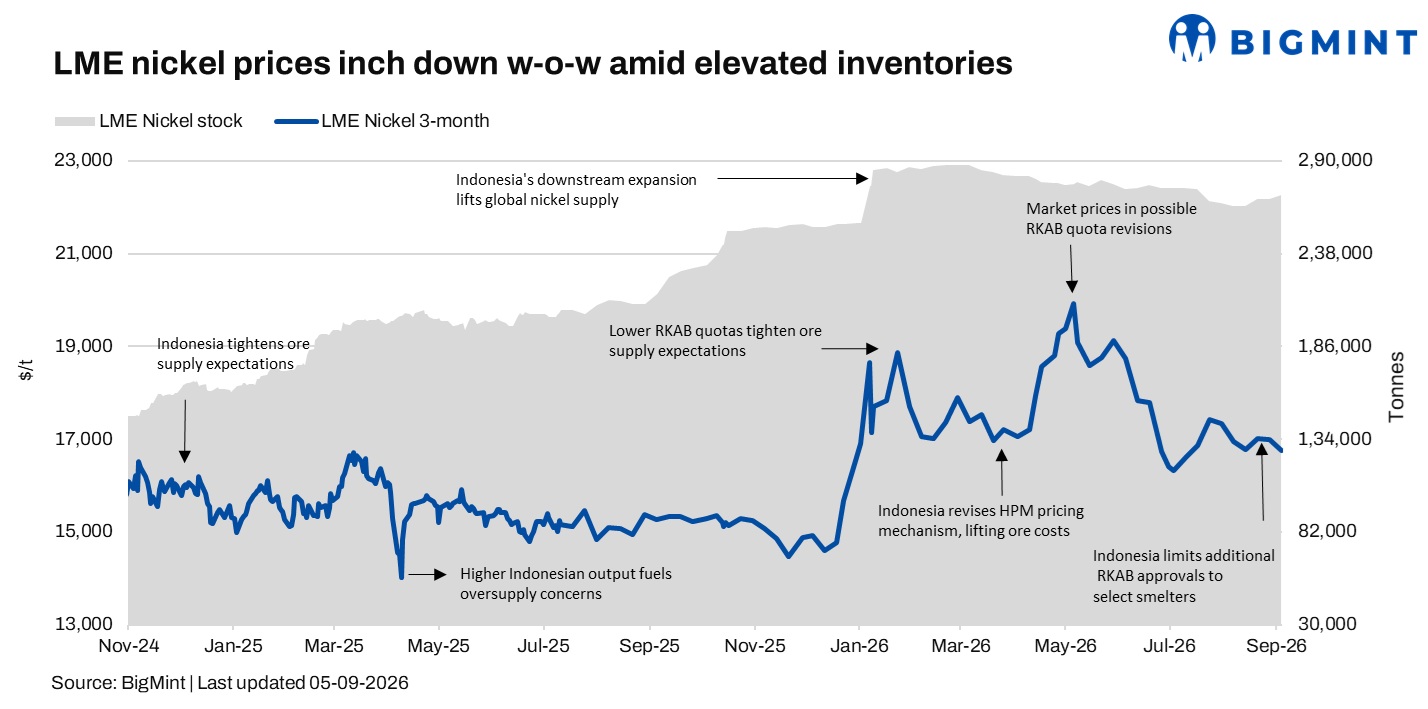
LME three-month nickel prices remained broadly stable at around $16,760/t as of 3 September 2026, compared with $17,000/t a week earlier. Prices found some support from a weaker US dollar, but gains were limited by elevated refined nickel inventories and cautious downstream demand.
LME nickel inventories rose to 270,768 t on 4 September from around 268,362 t on 28 August, indicating an increase of approximately 0.9%. Elevated exchange stocks continue to weigh on the market by limiting expectations of near-term supply tightness.
Indonesia remains central to supply outlook
Indonesia’s 2026 nickel ore quota remains at around 260-270 mnt, significantly below the 379 mnt approved in 2025. While the lower quota has tightened domestic ore availability, the impact on refined nickel supply has been partly offset by higher imports of Philippine ore.
Indonesia imported around 11.4 mnt of Philippine nickel ore during January-July, up 67% y-o-y, helping Indonesian smelters maintain feedstock availability despite tighter domestic mining allocations. However, RKEF utilisation declined to around 76% from 84% a year earlier, indicating increasing pressure on processors.
2027 RKAB adds supply uncertainty
Indonesia will begin accepting 2027 RKAB applications from 1 October, with industry groups seeking greater transparency around quota calculations and approval timelines.
The scale of next year’s allocations will remain a key factor for the global nickel market. A tighter-than-expected quota could support nickel prices and raise costs for NPI and stainless steel producers, while higher allocations could ease supply concerns and weigh on market sentiment.
El Nino poses additional smelter risks
Indonesia’s nickel industry also faces potential power-supply disruptions as El Nino-driven dry conditions threaten hydropower generation. Operations at PT Bumi Mineral Sulawesi in South Sulawesi have reportedly been affected by lower hydropower availability, with RKEF production reduced and around 570 workers placed on temporary furlough.
If dry conditions persist, further disruption to hydropower-dependent RKEF facilities could affect ferronickel and NPI output, providing an additional supply-side support factor for nickel.
HPAL producers weigh production cuts
Chinese-backed nickel producers in Indonesia are reportedly considering up to 30% output cuts at HPAL plants as weak nickel prices, higher ore costs and surging sulphur prices squeeze margins.
Any significant reduction in MHP production could tighten global nickel supply, although weaker Chinese battery-sector demand and elevated inventories continue to offset some of the bullish impact.
Nickel Industries expands downstream exposure
Nickel Industries reported stronger H1FY’26 (January-June) performance, with revenue, EBITDA and net profit increasing alongside 62,019 t of combined nickel production from NPI and MHP operations.
The company continues to expand into Class 1 nickel and battery materials, targeting applications across electric vehicles, energy storage and the broader battery supply chain. Its downstream expansion highlights Indonesia’s continued shift towards higher-value nickel products.
Outlook
LME nickel is expected to move within a narrow range. Elevated inventories and cautious downstream demand remain the primary bearish factors, while Indonesian quota restrictions, potential HPAL production cuts and weather-related smelter disruptions could provide intermittent supply-side support.
Leave a Reply