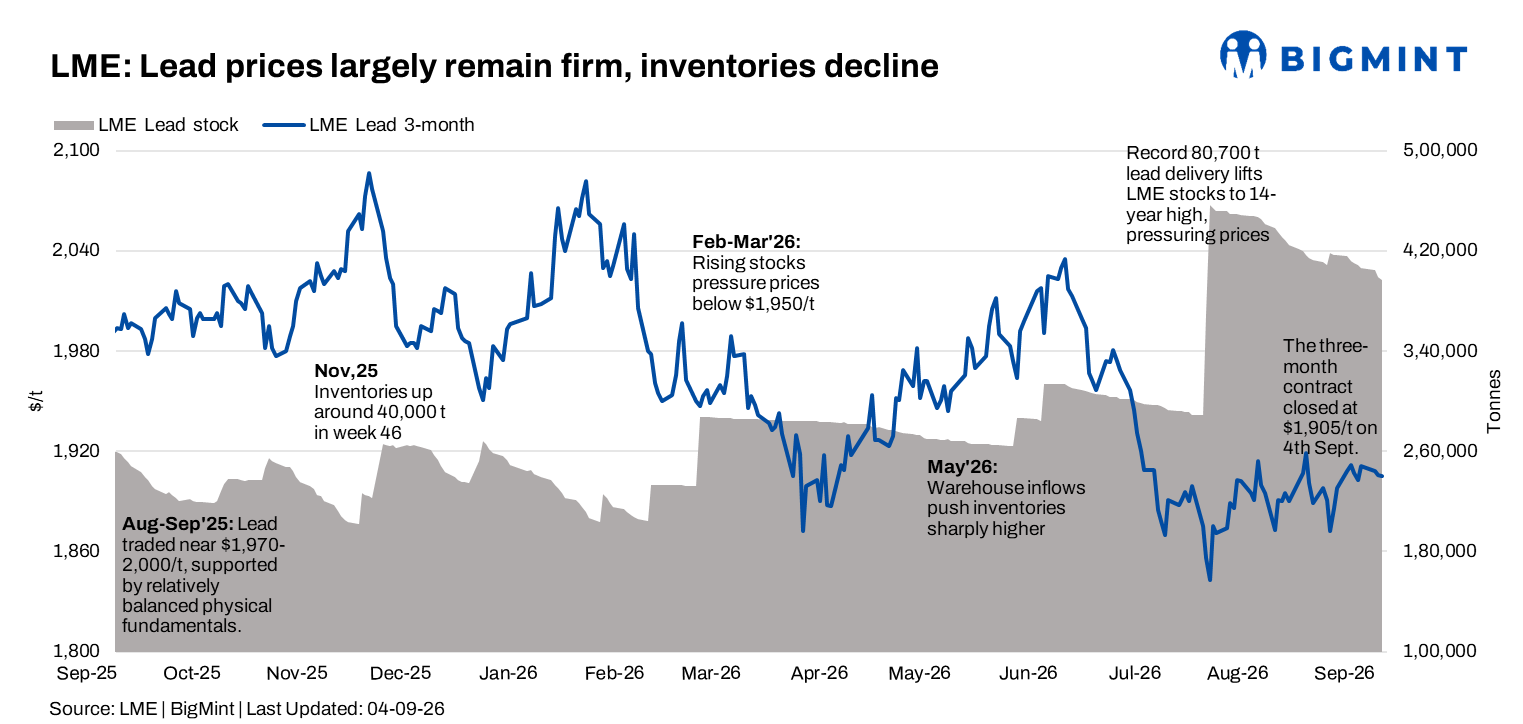
- LME lead inventories fall below 400,000 t, but softer prices reflect continued caution in physical demand
- Battery operating rates improve entering September, while MCX lead weakens amid rising open interest
London Metal Exchange (LME) lead prices moved lower during the latest week despite a continued drawdown in exchange inventories, as subdued physical demand and cautious downstream procurement limited the market’s upside.
LME lead cash-settlement prices declined 0.5% to $1,870/t on 3 September, from $1,880/t on 28 August. The three-month contract fell 0.3% to $1,905/t from $1,911/t.
Meanwhile, LME lead inventories declined by 9,425 t, or 2.3%, during the period to 396,825 t from 406,250 t on 28 August. Stocks fell below the 400,000-t mark, extending the broader inventory drawdown seen since mid-August.
Compared with 21 August, when LME stocks stood at 416,850 t, inventories have declined by 20,025 t, or 4.8%. However, the continued inventory reduction has so far failed to trigger a sustained price rally, highlighting the continued weakness in underlying physical demand.
LME inventory drawdown provides support
LME lead inventories have continued to decline steadily over the past two weeks. Stocks fell from 416,850 t on 21 August to 406,250 t by 28 August before declining further to 396,825 t on 3 September.
The fall in exchange stocks has provided underlying support to lead prices. However, the latest week’s correction indicates that tighter exchange availability alone is insufficient to trigger a sustained rally in the absence of stronger physical consumption.
Over the broader period from 21 August to 3 September, LME cash lead increased by 0.7%, while the three-month contract gained 0.4%, indicating that prices remained relatively resilient despite the latest weekly correction.
The cash-to-three-month spread also narrowed during the period, with the backwardation contracting from $41/t on 21 August to $35/t on 3 September. While the market remains in backwardation, the moderation in the spread suggests that immediate tightness has eased compared with the previous period.
Battery output improves, but end-use demand remains uneven
Lead-acid battery production showed signs of seasonal improvement entering September, with the comprehensive operating rate of battery producers across key producing regions rising to 69.64%, up 2.22 percentage points w-o-w.
Improved production conditions and better order flows supported operating rates as the market entered the traditional peak consumption period. Battery manufacturers also benefited from inventory movement through the supply chain following promotional activities in August.
However, the improvement in battery production has not been matched by a meaningful recovery in end-use consumption.
Demand from both the e-bike and automotive battery segments remained relatively subdued, while dealer inventories continued to remain elevated. Continued promotional activity in certain markets also reflected ongoing competition and weaker-than-expected consumption.
As a result, battery manufacturers have largely maintained production in line with sales and remained cautious in refined-lead procurement. Spot lead transactions therefore remained moderate, limiting immediate demand-side support for prices.
While seasonal factors could continue supporting battery production in September, further improvement in operating rates may remain limited unless end-user consumption strengthens meaningfully.
MCX lead weakens as open interest rises
MCX lead moved lower during the latest week, diverging from the broader resilience seen in LME lead prices over the two-week period.
The September lead contract declined to INR 196.35/kg on 4 September from INR 197.75/kg on 28 August, down 0.7%.
Meanwhile, open interest increased from 585 lots on 28 August to 768 lots on 4 September, representing a rise of 31.3%.
The decline in prices alongside rising open interest suggests fresh selling interest in the domestic futures market, indicating relatively cautious sentiment among market participants.
MCX lead remained under pressure despite the continued drawdown in LME inventories, reflecting the absence of strong domestic demand momentum and volatility in international lead prices.
HZL lead benchmark sees mixed revisions
Hindustan Zinc Ltd (HZL) revised its domestic lead benchmark twice during the latest period.
The company increased its lead benchmark by INR 800/t on 31 August to INR 214,600/t. However, it subsequently reduced the benchmark by INR 1,200/t on 3 September to INR 213,400/t.
The latest revision left HZL’s lead benchmark INR 400/t lower compared with the level following the 31 August increase, reflecting the lack of sustained upward momentum in domestic lead prices.
Outlook
BigMint expects LME lead prices to remain range-bound in the near term as the market balances continued exchange inventory drawdowns and improving battery production against subdued end-use consumption and cautious downstream procurement.
The fall in LME inventories below 400,000 t could provide downside support, particularly if the drawdown continues. Improving lead-acid battery operating rates during the seasonal demand period could also support refined-lead consumption.
However, elevated dealer inventories, uneven demand from the e-bike and automotive battery segments, and procurement based largely on immediate requirements are likely to limit the potential for a sustained rally.
In India, the decline in MCX lead prices alongside rising open interest indicates cautious market sentiment, while HZL’s latest price revisions also point to continued volatility in the domestic market.
Market participants will closely monitor the pace of LME inventory movements, battery-sector production and end-use demand, domestic price trends and the availability of secondary lead raw materials.
Unless physical consumption improves meaningfully, lower exchange inventories are likely to provide support to lead prices rather than trigger a sustained upward move.
Leave a Reply