- LME stocks dip; global nickel surplus to narrow in 2027
- Weak stainless steel demand limits price recovery
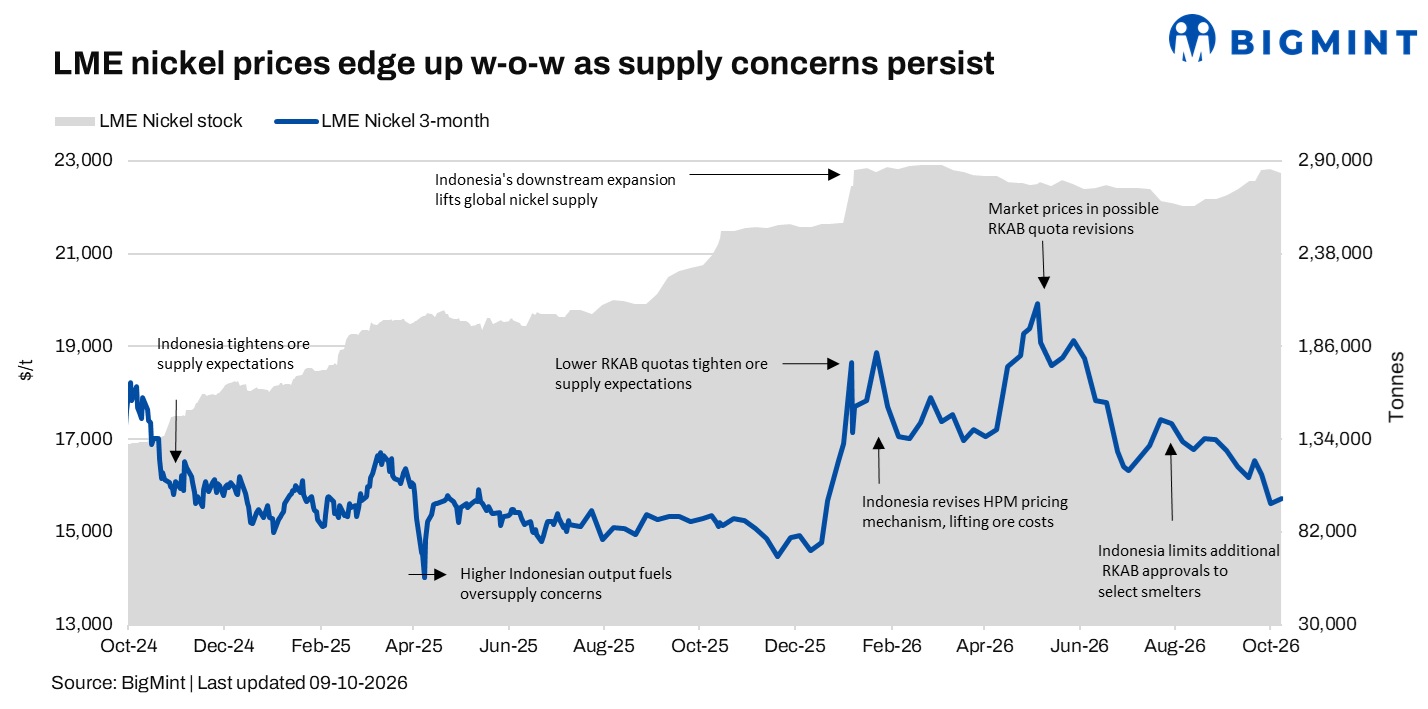
London Metal Exchange (LME) three-month nickel prices edged up w-o-w to $15,720/t on 9 October 2026, from $15,625/t a week earlier, driven by concerns over limited supply despite subdued demand from the stainless steel sector. Meanwhile, LME nickel inventories declined to 282,864 t from 285,168 t over the same period, offering some support to market sentiment.
Global nickel market surplus to narrow in 2027
Sumitomo Metal Mining expects the global nickel market surplus to narrow to 34,000 t in 2027 from an estimated 38,000 t in 2026. Global nickel supply is projected to increase by 5.8% y-o-y to 3.96 mnt in 2027, while demand is forecast to rise by 6% to 3.92 mnt. Indonesia’s NPI production is expected to rebound by 11.9% to 1.88 mnt, potentially adding to supply pressure. Although demand from stainless steel, electric vehicle batteries, and AI data centres is expected to grow, Indonesia’s mining quotas, production policies and potential restrictions on new processing capacity will remain key factors influencing the market.
Indonesian nickel ore prices decline sharply
Indonesia’s nickel ore prices weakened in early October, with the Nickel Reference Price (HMA) falling 2.25% to $16,322.67/t for the first half of the month. The reference price for 1.4% nickel saprolite ore declined by around 4% to $51.66/wet t, while 1.5% and 1.6% grades fell to $56.22/wet t and $61/wet t, respectively. Spot saprolite prices dropped by around 6-7% in a single day amid improved mining and shipping conditions, dry weather and additional mining quota approvals.
However, the decline in ore prices has not translated proportionately into lower nickel pig iron (NPI) prices, a key raw material for stainless steel production. Indonesian 1.6% nickel ore prices fell 18.4% from their May peak of $79.50/wet t to $64.88/wet t at the end of September, while NPI prices declined by only 8.1% from $148 to $136 per nickel unit. NPI prices remained largely stable between June and August before correcting in September.
The delayed response reflects the influence of smelter operating rates, inventory levels, and stainless steel mill demand. Water shortages at some NPI production lines in Indonesia’s Morowali Industrial Park also constrained output, limiting further downside in NPI prices. Consequently, stainless steel manufacturers continue to face relatively high nickel-based raw material costs despite the recent easing in ore prices.
Chinese stainless steel futures under pressure
In China, stainless steel futures declined on 8 October, the first trading day after the National Day holiday, as weakness in Shanghai Futures Exchange (SHFE) nickel weighed on sentiment. The most-traded stainless steel futures contract settled at RMB 13,455/t, equivalent to approximately $1,895/t, while the intraday quote of RMB 13,530/t was around $1,906/t.
Spot prices recorded limited declines amid improved post-holiday restocking activity. Lower nickel and chromium raw material prices eased production costs and supported steel mill profitability. However, weak end-use demand and renewed social inventory accumulation continued to limit price recovery.
Outlook
LME nickel prices are likely to remain sensitive to global supply developments, Indonesian ore and NPI production, and demand from stainless steel manufacturers. Although falling ore prices could eventually ease production costs, the delayed pass-through to NPI prices may limit near-term cost relief for stainless steel producers. Sumitomo’s forecast of a smaller but persistent global surplus in 2027 also highlights the continuing pressure from supply growth, while demand recovery and Indonesia’s production policies remain key variables for the market.
Leave a Reply