- LME aluminium drops 2.19% while copper falls by 1.68%
- Brent near $104/bbl as Middle East tensions raise market volatility
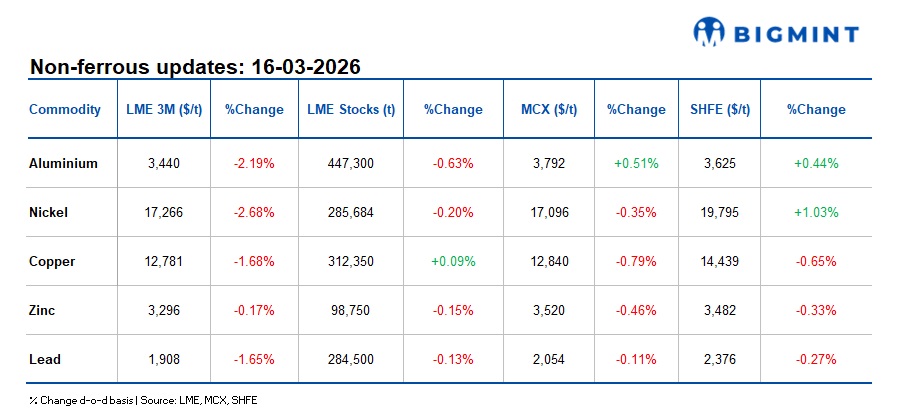
Base metals on the London Metal Exchange (LME) traded lower d-o-d on 16 March 2026, weighed down by weak market sentiment and profit-taking. Aluminium declined 2.19% to $3,440/t, while zinc slipped 0.17% to $3,296/t. Lead fell 1.65% to $1,908/t, and nickel dropped 2.68% to $17,266/t, whereas copper decreased by 1.68% to $12,781/t.
Warehouse inventory levels were largely lower. Aluminium stocks fell 0.63% to 447,300 t, while zinc inventories dipped 0.15% to 98,750 t. Nickel stocks decreased 0.20% to 285,684 t, and lead inventories slipped 0.13% to 284,500 t. In contrast, copper stocks edged up 0.09% to 312,350 t.
Domestic market overview
Domestic non-ferrous scrap prices in India showed mixed trends, reflecting cautious market sentiment. Aluminium tense scrap (loose), ex-Delhi, increased by INR 6,000 or 2.6% to INR 239,000/t from INR 233,000/t, while ex-Chennai prices rose by INR 4,500 or 1.9% to INR 243,000/t from INR 238,500/t.
Meanwhile, copper armature scrap (Cu 99%), ex-Delhi, declined by INR 14,000 or 1.2% to INR 1,120,000/t from INR 1,134,000/t, indicating weak buying sentiment in the market.

Other updates
EU moves to curb energy costs as Iran war disrupts markets
European Union governments are exploring emergency measures to limit rising energy costs after the Iran conflict disrupted global oil and gas supplies, pushing prices higher and increasing pressure on households and industries.
The disruption to energy flows-particularly around the Strait of Hormuz, a key route for global oil and LNG trade-has already driven European gas prices up by more than 50%, intensifying inflation concerns and market volatility.
EU policymakers are considering options such as state aid for energy-intensive industries, tax relief measures, and possible reforms to the EU carbon market, as the region seeks to shield its economy from the ongoing energy shock.
Vietnam seeks Japan, Korea support to secure crude oil supplies
Vietnam has asked Japan and South Korea to help improve its access to crude oil amid global supply disruptions caused by the ongoing Iran conflict. The request was made by Deputy Minister of Industry and Trade Nguyen Hoang Long during an energy security summit in Tokyo.
Vietnam operates two refineries that meet about 70% of domestic fuel demand, with a significant portion of crude sourced from the Middle East. Rising geopolitical tensions and disruptions around the Strait of Hormuz have heightened concerns over the country’s energy security.
The move underscores growing pressure on Asian economies to secure alternative energy supplies as tightening global crude markets continue to drive volatility in energy and commodity markets.
Global markets cautious as Middle East tensions lift oil prices
Global financial markets remained cautious as escalating tensions around the Strait of Hormuz continued to drive energy prices higher, raising concerns over inflation and economic growth. Brent crude climbed to around $104/bbl, reflecting supply risks from disruptions in one of the world’s most critical oil transit routes.
The energy shock has increased volatility across equities, currencies, and bond markets, while central banks in major economies including the US, UK, and Japan prepare for key policy meetings amid persistent inflation pressures.
Analysts note that prolonged disruptions to oil and LNG shipments through the strait could intensify inflation risks and complicate monetary policy decisions globally, keeping financial and commodity markets on edge.
Trump urges allies to help secure strait of Hormuz
US President Donald Trump has urged major economies to help secure the Strait of Hormuz, a key oil shipping route, amid rising tensions with Iran and disruptions to maritime trade.
However, key allies Japan and Australia said they currently have no plans to deploy naval forces, citing legal and operational constraints. The strait typically handles around 20% of global oil and LNG trade, making it a critical chokepoint for energy flows.
The continued disruption has heightened geopolitical risk premiums in global energy markets, pushing oil prices higher and adding volatility across commodity markets.
Leave a Reply