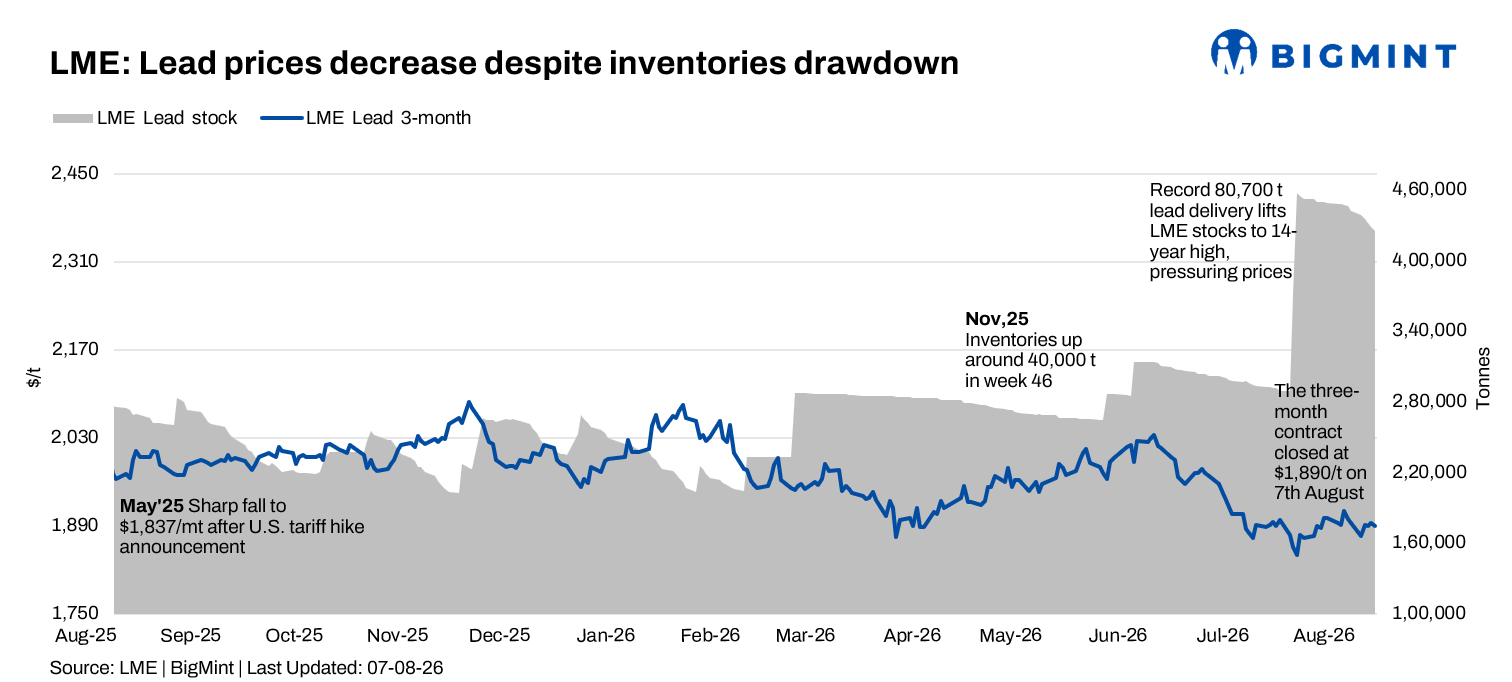
- LME lead stocks fall 16,700 t w-o-w to 424,575 t, but prices decline 0.6%
- Weak lead-acid battery demand and rising Chinese social inventories keep physical sentiment subdued
London Metal Exchange (LME) lead prices edged lower during the week ended 7 August 2026, despite a sharp drawdown in exchange inventories. The divergence highlights persistent weakness in physical demand, with cautious procurement by lead-acid battery manufacturers and rising Chinese social inventories offsetting the support from tightening LME stocks.
LME lead cash-settlement prices declined 0.6% w-o-w to $1,840.5/t on 7 August, from $1,851.5/t on 31 July. The three-month contract eased 0.3% to $1,890/t from $1,895/t.
Meanwhile, LME lead inventories fell by 16,700 t, or 3.8%, during the week to 424,575 t, from 441,275 t on 31 July. Stocks declined on every trading day, extending the recent drawdown trend. However, the continued fall in exchange stocks failed to generate sustained upward momentum in prices, pointing to weak underlying consumption.
Sharp LME drawdown fails to lift prices
The latest inventory movement marked a significant acceleration from the previous week’s 7,575-t decline. LME stocks fell by 2,825 t on 3 August, followed by further drawdowns of 3,575 t, 3,325 t, 3,125 t and 3,850 t through 7 August.
Despite the rapid depletion, lead prices remained under pressure as market participants focused on weak downstream demand. The inability of tightening exchange inventories to trigger a sustained price recovery suggests that the current drawdown may be driven more by warehouse movements and supply-chain positioning than by a broad-based improvement in consumption.
Battery-sector demand remains cautious
The physical market remained subdued during the week, particularly in China, as lead-acid battery manufacturers maintained a strong risk-averse stance. According to an industry source, downstream enterprises remained cautious in procurement, while lead ingot transactions remained poor despite some interest in buying on price dips.
Primary lead suppliers showed divergent selling strategies, with some planning warehouse deliveries while others continued selling at prevailing market levels. Secondary lead smelters remained reluctant to sell at lower prices, limiting spot availability.
The cautious demand environment was also reflected in inventories. The sources’s data showed social lead ingot inventories across five major regions in China at 72,100 t on 3 August, up 3,700 t from 27 July and 3,600 t from 30 July. The increase contrasts with the sharp decline in LME stocks and highlights the difference between exchange and physical-market inventory trends.
SHFE lead remains volatile
SHFE lead also reflected weak demand sentiment during the week. The benchmark contract declined from 2,352 on 3 August to 2,292 on 6 August, before recovering to 2,342 on 7 August.
The decline came amid continued concerns over sluggish downstream consumption. However, expectations of additional maintenance at both primary and secondary lead smelters could slow refined lead supply and provide some downside protection to prices.
Outlook
BigMint expects LME lead prices to remain range-bound in the near term as the market balances the sharp decline in exchange inventories against weak physical demand.
While continued LME stock drawdowns and potential smelter maintenance provide underlying support, rising Chinese social inventories and cautious lead-acid battery procurement could limit the upside. Market participants will closely monitor the pace of LME inventory withdrawals, Chinese social stocks, battery-sector buying activity and refined-lead supply disruptions.
Unless downstream demand improves meaningfully, the latest inventory drawdown alone is unlikely to trigger a sustained rally in LME lead prices.

Leave a Reply