- ICSG projects higher refined copper surplus in 2027 despite concentrate shortages
- Indian cathode prices fall as subdued buying and weaker sentiment weigh on trade
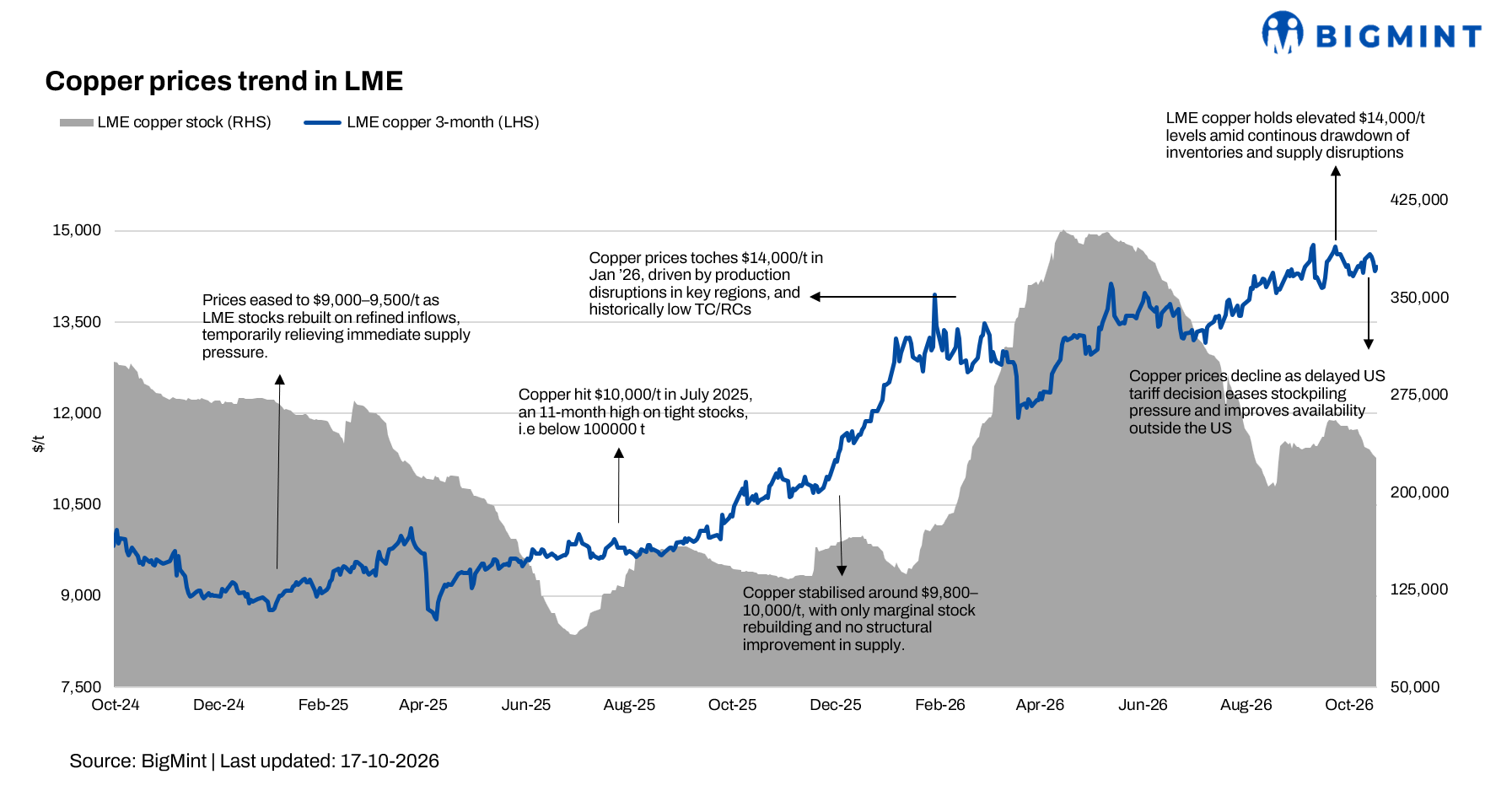
Global copper markets faced mixed signals during the week ended 16 October 2026. London Metal Exchange (LME) three-month copper fell 0.91% w-o-w to $14,407.50/t from $14,540/t in the previous week. Meanwhile, LME inventories declined 3.67% to 226,600 t from 235,225 t, indicating tighter availability of exchange-registered metal. However, weaker investor sentiment, a stronger US dollar and expectations of higher refined production weighed on prices, despite persistent concentrate shortages and labour-related supply risks in Chile.
Meanwhile, the International Copper Study Group (ICSG) projected a larger refined copper surplus in 2027. In India, cathode prices declined as buyers limited purchases amid volatile futures and elevated replacement costs. Copper scrap trading remained subdued, while weak demand continued to pressure brass honey scrap prices and export offers.
Domestic prices under pressure as buyers remain cautious
According to BigMint’s assessment, ex-Ahmedabad copper cathode prices fell by INR 27,000/t (1.9% w-o-w) to INR 1,400,000/t in the week ended 15 October. Ex-Mumbai prices declined by INR 28,000/t (2% w-o-w) to INR 1,397,000/t. Primary copper CC wire rod (CCR) prices, ex-Delhi, also decreased by INR 10,000/t to INR 1,455,000/t.
Subdued investor sentiment and declining MCX copper futures weighed on domestic prices. Sellers also remained reluctant to release inventories at lower realisations, particularly for material purchased at higher levels. This widened bid-offer gaps and restricted spot availability, while buyers continued to prioritise immediate requirements over inventory building.
Copper scrap markets remained volatile as participants tracked international price movements. Domestic copper armature scrap prices stood at INR 1,347,000/t, ex-Gujarat, on 14 October, down 0.15% w-o-w. Import economics remained unfavourable, with Western-origin copper meatballs offered at $2,950-2,975/t in Thailand against around $2,850/t in India. Stronger competing bids limited India’s access to imported material.
Trading also remained restricted by differences in price expectations. Buyers offered 95% of LME for Candy Berry scrap against sellers’ expectations of 98%. Birch/Cliff bids stood at 91.5-92% of LME, while sellers quoted 93%. Millberry offers remained at flat LME or LME plus premiums.
Brass honey scrap prices in Jamnagar stood at around INR 940,000/t, while northern Indian prices ranged between INR 915,000/t and INR 920,000/t. Demand had remained weak for around six weeks, prompting sellers to offer discounts of INR 7,000-8,000/t against normal prices. Meanwhile, Indian brass ingot export offers to China declined to around 61% of LME copper from 63-64% previously, as weak buying and high exporter inventories pressured sellers.
Global Concentrate shortages contrast with surplus outlook
Global copper markets continued to face a mismatch between tight near-term concentrate supply and expectations of improving refined production. Chinese spot copper concentrate treatment charges remained deeply negative at around $235-240/t, reflecting competition among smelters for limited feedstock. LME inventories also declined, with stocks reported at around 228,000 t on 14 October in the latest market assessment, reinforcing concerns over readily available metal.
However, the International Copper Study Group’s forecast presented a more balanced medium-term outlook. Issued on 14 October, the forecast projects global mine production growth of 1.3% in 2026 and 3.1% in 2027. Refined copper production is expected to rise by just 0.4% in 2026 before accelerating by 3.4% in 2027.
ICSG expects the refined copper market to record a surplus of around 104,000 t in 2026, widening to 368,000 t in 2027. New smelting and refining capacity in Indonesia, India and the European Union should support the recovery. Higher secondary production from scrap and improved operating rates at existing facilities are also expected to contribute.
Nevertheless, the outlook remains sensitive to mine performance and concentrate availability. Operational constraints at Grasberg and Kamoa-Kakula, alongside lower expected output from Chile, could limit near-term supply growth. Asia is expected to remain the main driver of refined copper demand, supported by manufacturing, electrification, digitalisation and data-centre investment. However, uncertainty over global economic growth and technology-sector spending continues to cloud the demand outlook.
Chilean labour disputes keep supply risks in focus
Labour disruptions remained a key source of uncertainty during the week. Workers at Antofagasta’s Centinela copper mine had been on strike since 7 October, with negotiations initially failing to produce a breakthrough. The dispute involved more than 700 workers and raised concerns about potential supply disruption.
Separately, supervisors at BHP’s Escondida mine reached a preliminary agreement with the company on 14 October, averting a potential strike. Around 64% of union members approved the proposal, easing an immediate supply risk at the world’s largest copper mine. The development reduced one source of disruption risk, although Centinela’s dispute continued to attract market attention.
On 17 October, Centinela’s striking unions also reached a preliminary agreement on a new collective contract, potentially ending the strike pending a vote by members. Antofagasta said production had remained normal during the dispute. The agreement could ease immediate concerns, although the final outcome depends on workers’ approval.
Outlook
Copper markets are expected to remain volatile as tight concentrate availability and declining LME inventories compete with weaker investor sentiment and expectations of higher refined output. The preliminary agreement at Centinela and the settlement at Escondida have eased immediate labour risks, although operational disruptions in Chile and the Codelco accident remain relevant supply-side concerns.
In India, cathode and scrap trading may remain subdued as high replacement costs and uncertain price direction limit fresh buying. Brass honey scrap could receive support from firmer international benchmarks, but weak consumption and elevated inventories may cap gains. Market direction will depend on Chinese demand, mine supply developments, inventory movements and domestic restocking.
Leave a Reply