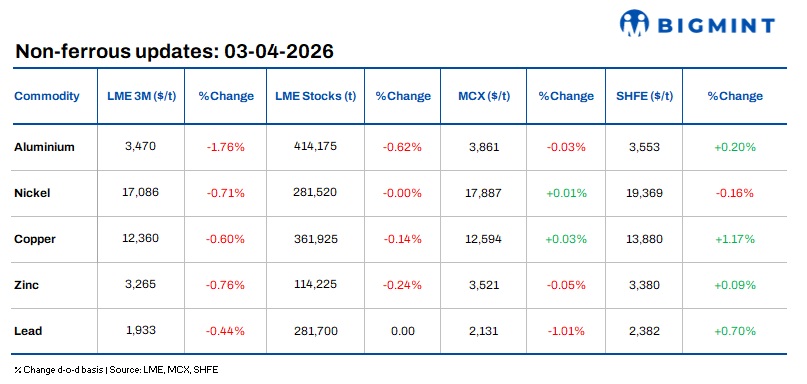
- LME weakness persists despite tightening inventories across metals
- Macro uncertainty from tariffs and oil routes weighs on outlook

US revises duties on metal derivatives; retains 50% tariff on base metals
The US has revised its Section 232 tariff structure, lowering duties on steel, aluminium and copper derivative products while retaining a 50% tariff on primary metal imports.
Under the new framework, products with >15% metal content will attract around 25% duty, while those with <15% content are exempt. Certain categories may see reduced rates of around 15% until 2027.
The tariff will now be calculated on the final sale price instead of declared import value, aimed at curbing under-invoicing. The move simplifies compliance while continuing to protect domestic metal producers.
Century Aluminum valuation rises on JV, restart plans and strong earnings outlook
Century Aluminum has seen a sharp increase in valuation, with its stock rising around 60% since Dec’25, supported by strong earnings visibility and supply-side tailwinds.
A key driver is its JV with Emirates Global Aluminium(EGA) to build around 750,000 tpa smelter in the US, where Century holds a 40% stake.
Operationally, the company is restarting around 50,000 t capacity at its Mt. Holly smelter by Q2’26-end, alongside asset monetisation efforts.
Financial performance remains robust, with Q4’25 adjusted net income at around $128.2 Mn and Q1’26 EBITDA guidance around $215–235 Mn, supported by higher LME prices and regional premiums.
Trump downplays Hormuz reliance, but global oil risks remain elevated
US President Donald Trump has stated that the US no longer depends on the Strait of Hormuz, citing its transition to a net oil exporter and rising domestic production. He urged other nations reliant on the route to take responsibility for securing it.
Despite this, the Strait remains a critical global chokepoint, handling a significant share of international oil flows, linking Middle East producers with major consumers across Asia and Europe. Any disruption continues to have a direct impact on global oil prices and energy security.
Analysts caution that while US direct dependence has reduced, it cannot remain insulated from global price shocks, as supply disruptions in Hormuz still influence international markets and inflation.
Overall, the development highlights a structural shift in US energy positioning, but also underscores the continued systemic importance of Hormuz in shaping global commodity markets.
Leave a Reply