- GCC disruptions keep aluminium market firm
- Large oil reserves ease supply fears in China
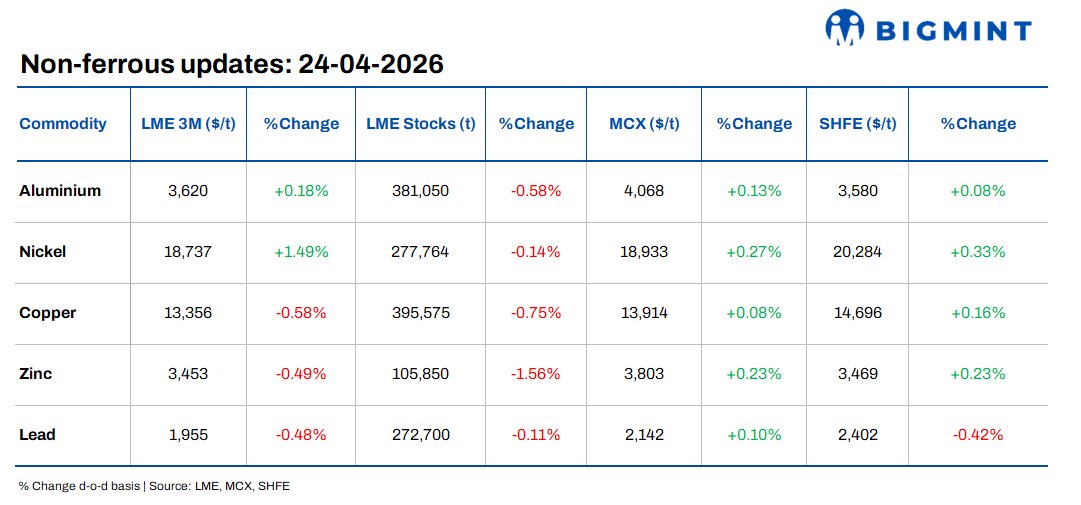
Base metals on the London Metal Exchange (LME) traded mixed to lower d-o-d on 23 April 2026, with nickel and aluminium posting gains, while copper, zinc, and lead closed in the red. Nickel recorded the sharpest rise of 1.49% to $18,737/t, followed by aluminium, which edged higher by 0.18% to $3,620/t. On the downside, copper declined 0.58% to $13,356/t, while zinc fell 0.49% to $3,453/t, and lead slipped 0.48% to $1,955/t.
On the inventory front, stock movements remained largely on the downside, indicating continued tightening in near-term supply conditions. Zinc inventories registered the steepest fall of 1.56% to 105,850 t, followed by copper, which declined 0.75% to 395,575 t. Aluminium stocks dropped 0.58% to 381,050 t, while nickel inventories eased 0.14% to 277,764 t. Lead stocks edged lower by 0.11% to 272,700 t, reflecting broad-based drawdowns across major base metals.
Domestic market overview
India’s non-ferrous scrap prices traded mixed to higher d-o-d. Aluminium tense scrap (loose), ex-Delhi, remained unchanged at INR 290,500/t compared with the previous session. Meanwhile, ex-Chennai prices increased by INR 500/t or 0.2% to INR 305,500/t from INR 305,000/t earlier.
In the copper segment, sentiment remained firm. Copper armature scrap (Cu 99%), ex-Delhi, rose by INR 3,000/t or 0.3% to INR 1,135,000/t from INR 1,132,000/t previously, indicating steady buying interest in the domestic market.

Other market updates
Base metals trade mixed amid US-Iran uncertainty
Base metals traded mixed as geopolitical uncertainty around the US-Iran conflict and ongoing disruptions in the Strait of Hormuz kept sentiment volatile. Copper and aluminium remained supported by tightening supply concerns, while zinc faced pressure from softer demand cues.
The supply outlook remains constructive for aluminium, with Middle East disruptions affecting a region that contributes nearly 9% of global aluminium output. Tight inventories and elevated physical premiums continue to underpin prices, while copper is also drawing support from constrained stocks and structural demand trends.
Near term, base metals are expected to stay firm, with market direction hinging on geopolitical developments, shipping flows through Hormuz, Chinese demand recovery, and broader macro sentiment. Copper and aluminium may outperform if supply risks persist.
Global aluminium output rises in March despite GCC disruptions
Global aluminium production reached 6.302 million tonnes (mnt) in March 2026, up 0.9% y-o-y, according to International Aluminium Institute data, despite supply disruptions in the Gulf region. However, average daily output declined 0.3% m-o-m to 203,300 t/day, indicating softer momentum during the month.
Production in the GCC region fell 6% to 495,000 t, as conflict-related disruptions impacted raw material availability and operations. The closure of the Strait of Hormuz also constrained movements of bauxite, alumina, and finished metal.
Higher production in China and Europe partly offset regional losses, while reduced output in North America and Africa highlighted ongoing global supply imbalances.
China’s oil stockpiling before Iran war eases supply fears
China significantly expanded its crude oil stockpiles ahead of the Iran conflict, creating a major strategic buffer as global supply disruptions intensified. US Energy Information Administration (EIA) estimates show that China held nearly 1.4 billion barrels of oil by end-2025, exceeding the combined reserves of the 32 IEA member nations at around 1.2 billion barrels.
China reportedly added an average 1.1 million bpd of crude into storage during 2025, helping shield the world’s largest importer from the recent supply shock linked to the Strait of Hormuz crisis. Strong reserve levels may also reduce China’s urgency to chase spot cargoes in the near term.
The buildup highlights China’s long-term energy security strategy and could provide a competitive advantage over import-dependent economies facing higher crude prices and tighter availability.
Crude oil tops $100/bbl as Middle East tensions push prices higher
Crude oil prices surged above $100/bbl as renewed Middle East tensions and continued disruptions in the Strait of Hormuz intensified global supply concerns. The rally reflects fears over constrained crude flows through one of the world’s most critical energy transit routes.
Brent crude recently moved near $106/bbl, while WTI climbed above $96/bbl, supported by escalating geopolitical risks and tight near-term supply balances. Markets remain highly sensitive to any further military developments or delays in restoring shipping movement.
Higher crude prices are expected to keep inflationary pressures elevated and raise freight, fuel, and industrial input costs globally, particularly for energy-importing economies.
Leave a Reply