- LME aluminium drops 4% amid broad market weakness
- Rio Tinto halts bauxite mining, Guinea plans export curbs
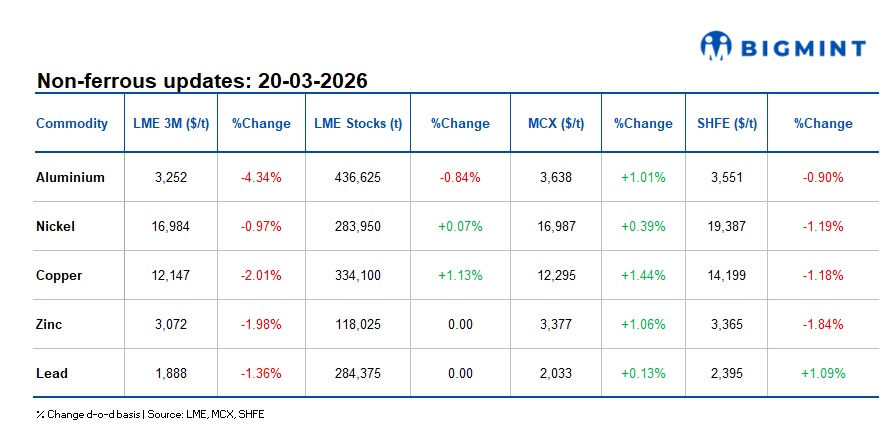
Base metals on the London Metal Exchange (LME) extended losses d-o-d on 20 March 2026, weighed down by weak market sentiment. Aluminium declined sharply by 4.34% to $3,252/t, while zinc fell 1.98% to $3,072/t. Lead dropped 1.36% to $1,888/t, and nickel eased 0.97% to $16,984/t, whereas copper slipped 2.01% to $12,147/t.
Warehouse inventory trends were mixed. Aluminium stocks decreased 0.84% to 436,625 t, while zinc inventories remained unchanged at 118,025 t. Nickel stocks edged up 0.07% to 283,950 t, and lead inventories held steady at 284,375 t. Meanwhile, copper stocks rose 1.13% to 334,100 t.
Domestic market overview
India’s non-ferrous scrap market witnessed mixed movements, driven by cautious sentiment. Aluminium tense scrap (loose), ex-Delhi, increased by INR 3,000 or 1.3% to INR 243,000/t from INR 240,000/t, while ex-Chennai prices rose by INR 1,000 or 0.4% to INR 245,000/t from INR 244,000/t.
However, copper armature scrap (Cu 99%), ex-Delhi, fell sharply by INR 42,000 or 3.8% to INR 1,060,000/t from INR 1,102,000/t, highlighting soft market demand.

Other updates
Middle East shipping disruptions divert alumina cargoes to China
Ongoing shipping disruptions in the Middle East, particularly around the Strait of Hormuz, are forcing a redirection of alumina cargoes toward China, reshaping global trade flows. The disruption has constrained shipments to Gulf-based smelters, which rely heavily on imported alumina.
With limited alternative routes and rising freight costs, suppliers are increasingly diverting cargoes to China, where logistics remain relatively stable, and demand is strong. This shift is creating regional imbalances in alumina availability, easing supply in China while tightening feedstock access in the Middle East.
Hormuz crisis disrupts operations at Bandar Abbas, straining global supply chains
The ongoing Strait of Hormuz crisis has severely disrupted operations at Bandar Abbas, Iran’s largest port, creating significant bottlenecks in global trade flows. The port is a critical hub for container traffic and bulk cargo, and disruptions have impacted the movement of key commodities across international markets.
With maritime traffic sharply reduced and vessels avoiding the region, logistics delays, cargo congestion, and rising freight costs have intensified. The Strait of Hormuz typically handles around 20% of global oil and LNG trade, making the disruption a major choke point for energy and commodity supply chains.
Iran war leaves lasting impact on global energy supply chains
The ongoing Iran conflict is inflicting a deep and prolonged disruption on Middle East energy infrastructure, tightening global supply and pushing oil prices above $100/bbl. Damage to key energy assets, coupled with shipping disruptions and rising insurance costs, has forced rerouting of crude and refined products, increasing freight costs and delivery delays. The situation has exposed structural vulnerabilities in global energy supply chains, particularly for regions heavily dependent on Middle Eastern imports.
Rio Tinto suspends bauxite operations amid cyclone impact
Rio Tinto has temporarily suspended operations at its Amrun and Andoom bauxite mines in northern Queensland after Tropical Cyclone Narelle hit Australia’s northeast coast with severe winds and flooding.
The two mines have a combined capacity of around 30 million tonnes (mnt) per annum, making them a significant source of global bauxite supply used in aluminium production.
Guinea plans bauxite export curbs amid price pressure
Guinea, the world’s largest bauxite producer, plans to curb export volumes by early April 2026 to stabilise falling prices and support smaller mining companies. The move follows a sharp rise in shipments to around 183 mnt in 2025, which contributed to oversupply and price pressure, particularly amid weak Chinese demand.
Rising freight costs, driven by Middle East disruptions, have further squeezed producer margins, increasing risks to jobs, government revenue, and mining operations. Authorities are engaging with miners to align production with original investment and infrastructure commitments, while reviewing future output plans.
Given that Guinea accounts for over 40% of global bauxite supply, any export curbs could tighten raw material availability and add upward pressure on alumina and aluminium markets.
Leave a Reply