- Oil flows resume gradually, easing supply tightness in global markets
- Recovery fragile amid geopolitical risks, high freight costs, bottlenecks
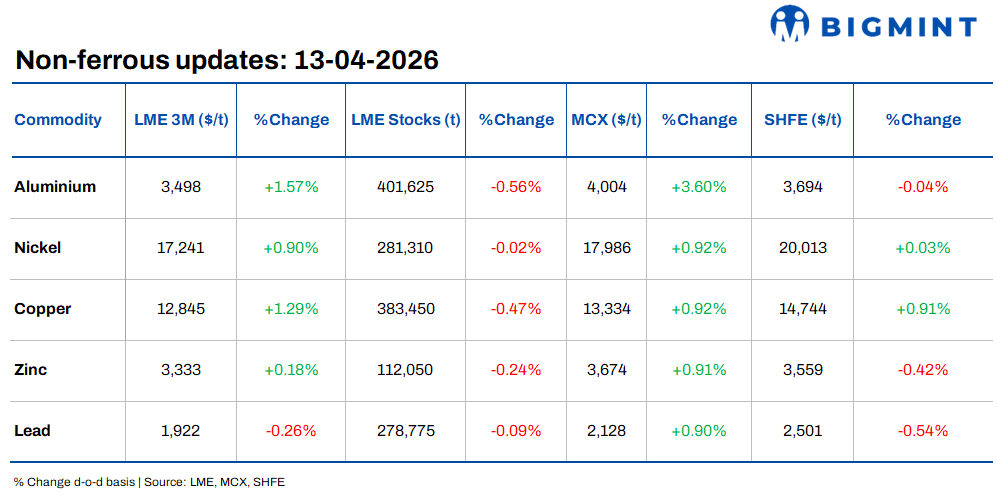
Base metals prices on the London Metal Exchange (LME) closed largely higher d-o-d on 10 April 2026, supported by fears of a supply crunch, with most metals prices posting gains except lead. Aluminium increased 1.57% to $3,498/t, nickel rose 0.90% to $17,241/t, copper gained 1.29% to $12,845/t, and zinc edged up 0.18% to $3,333/t. In contrast, lead was the only laggard, declining 0.26% to $1,922/t.
Inventory trends remained broadly on the lower side across base metals, indicating relatively tighter exchange availability. Aluminium stocks declined 0.56% to 401,625 t, nickel inventories slipped 0.02% to 281,310 t, copper stocks fell 0.47% to 383,450 t, zinc inventories dropped 0.24% to 112,050 t, and lead stocks decreased 0.09% to 278,775 t.
Domestic market overview
India’s non-ferrous scrap market witnessed an upward movement d-o-d, supported by improved demand conditions. Aluminium tense scrap (loose), ex-Delhi, increased to INR 280,000/t, up by 1.45% from the previous day. Similarly, ex-Chennai prices rose to INR 291,000/t, registering a 3.19% gain d-o-d, indicating stronger regional buying activity.
Meanwhile, copper armature scrap (Cu 99%), ex-Delhi, edged higher to INR 1,129,000/t, reflecting a 0.53% increase compared to the previous day, pointing to steady demand momentum in the copper scrap segment.

Other market updtaes
Oil prices surge sharply on strong momentum
Oil prices witnessed a strong upward movement, supported by bullish market sentiment and tightening supply expectations. Brent crude rose by 5.40% to $102.11/bbl, while WTI crude surged 5.45% to $103.90/bbl, also natural gas prices increased marginally by 0.34% to $2.67/MMBtu, reflecting robust buying interest in the energy market.
Energy-intensive sectors face pressure amid Middle East tensions
European chemical companies are expected to report weaker first-quarter performance, highlighting the deepening impact of ongoing geopolitical tensions in the Middle East. The U.S.-Israel-Iran conflict has significantly disrupted fuel and feedstock markets, driving up input costs for the highly energy-intensive chemical sector.
Industry participants indicate that the sharp rise in oil and gas prices, key raw materials for chemical production, has disproportionately affected the sector compared to others. Elevated energy costs and supply uncertainties continue to pressure margins, reflecting the broader ripple effects of geopolitical instability on downstream industries.
Global oil flows show early signs of recovery
Global oil markets are beginning to stabilise as crude shipments gradually resume following recent geopolitical disruptions in the Middle East. Increased tanker activity and renewed vessel bookings indicate a slow normalization of supply, easing the tightness seen in global markets. Key transit routes, including the Strait of Hormuz, are witnessing improving movement after earlier security-related disruptions.
However, the recovery remains cautious, with challenges such as elevated freight rates, logistical bottlenecks, and lingering geopolitical risks. Market participants continue to closely monitor the situation, as any disruption to the fragile stability could quickly impact global oil supply and prices.

Leave a Reply