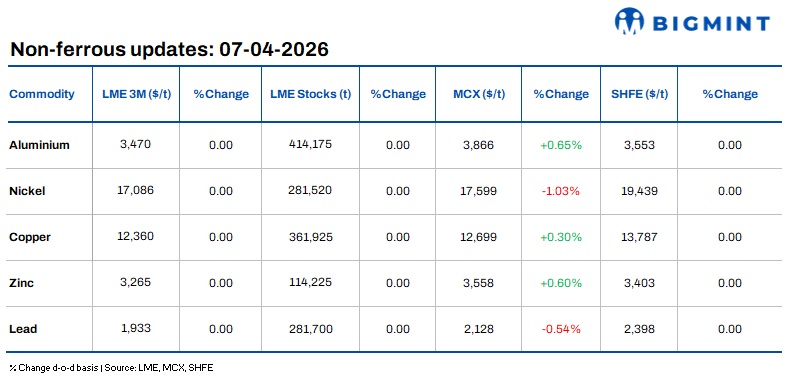
- LME inventory levels of all metals remain unchanged
- Global oil flows diverge amid export strength, regional constraints
Base metals on the London Metal Exchange (LME) remained unchanged, as the exchange was closed on 6 April due to the Easter holiday. Aluminium held steady at $3,470/t, copper at $12,360/t, nickel at $17,086/t, zinc at $3,265/t, and lead at $1,933/t.
On the inventory front, stock levels also showed no change. Aluminium inventories stood at 414,175 t, copper at 361,925 t, nickel at 281,520 t, zinc at 114,225 t, and lead at 281,700 t.
Domestic market overview
India’s non-ferrous scrap market showed a mixed trend, reflecting selective buying activity across regions. Aluminium tense scrap (loose), ex-Delhi, increased by INR 3,000/t or 1.1% to INR 275,000/t from INR 272,000/t. Similarly, ex-Chennai prices rose by INR 10,000/t or 3.7% to INR 280,000/t from INR 270,000/t.
Meanwhile, copper armature scrap (Cu 99%), ex-Delhi, edged lower by INR 2,000/t or 0.2% to INR 1,120,000/t from INR 1,122,000/t, indicating slight weakness in the copper segment.

Other updates
Oil prices rise over 1% amid escalating US-Iran tensions
Global crude oil prices firmed up, with US WTI futures rising over 1% amid escalating geopolitical tensions after US President Donald Trump intensified rhetoric against Iran. The upside was primarily driven by supply-side concerns linked to the continued closure of the Strait of Hormuz, a critical transit route handling around 20% of global oil flows.
Brent crude traded around $111.5/bbl, while WTI hovered near $115.8/bbl, supported by tightening prompt availability and strong spot demand. Market structure remained in steep backwardation, with spot premiums for US crude hitting record highs amid aggressive buying from Asia and Europe to replace disrupted Middle East supplies.
The risk premium remained elevated as Iran rejected ceasefire proposals, raising fears of prolonged supply disruptions despite (Organization of the Petroleum Exporting Countries and allied producers) OPEC+ output hike signals, which are seen as largely ineffective under current logistical constraints.
US shipping waiver fails to boost domestic oil flows
The US shipping waiver (Jones Act relaxation) has had limited impact on domestic oil movements, with coastal shipments largely unchanged at around 1.37 million barrels per day in March.
Instead, US fuel exports surged to record highs, as refiners diverted volumes to Asia and Europe to capitalise on stronger global margins amid supply disruptions linked to the Iran conflict.
Higher international arbitrage and tight tanker availability have further incentivised exports over domestic distribution, limiting the intended impact of the waiver on US fuel supply.
Hormuz disruption splits fortunes of Middle East oil producers
The closure of the Strait of Hormuz has created uneven impacts across Middle Eastern producers, disrupting nearly 20% of global oil flows and driving prices sharply higher.
Countries with alternative export routes-such as Saudi Arabia and the UAE-continue to sustain shipments and benefit from higher prices, while Iraq, Kuwait and Qatar face export constraints and revenue losses due to heavy reliance on the strait.
The situation highlights the growing importance of diversified export infrastructure amid prolonged geopolitical disruptions.
Leave a Reply