- Trade slows amid tight cash flow, cheaper domestic scrap
- Wide bid-offer gaps of $30-50/t seen for imported material
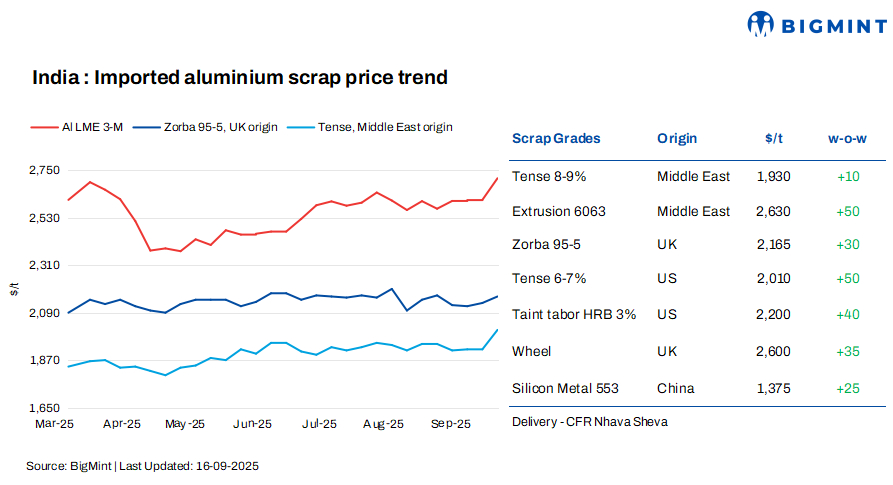
India’s imported aluminium scrap prices saw an increase of $40-50/tonne (t) w-o-w, following an uptrend in the London Metal Exchange (LME) prices. LME aluminium prices climbed up to around $2,700/t, marking a six-month high, last seen in March.
Global aluminium prices have surged on the back of a rare supply squeeze, firm demand, and US tariffs imposed by President Donald Trump. The US Midwest premium has jumped 177% this year, while the LME benchmark is up 17% since April.
The rally is being fuelled by production curbs in China and declining global inventories, particularly at LME and Shanghai warehouses. With demand continuing to rise and supply remaining constrained, prices are expected to stay elevated, with the possibility of further gains. A global aluminium deficit is anticipated by 2026, with prices projected to approach $3,000/t if supply constraints persist.
Price assessments
BigMint assessed US-origin Tense scrap at $2,010/t, reflecting a w-o-w rise of $50/t, while US Taint Tabor HRB (2-3%) was up by $40/t at $2,200/t. Extrusion 6063 prices also strengthened by $50/t w-o-w, whereas Tense scrap from the Middle East registered a modest increase of $10/t. Meanwhile, UK-origin Zorba 95/5 recorded a $30/t w-o-w gain.
LME prices inch up w-o-w despite inventory inflows
At the time of reporting, LME aluminium prices stood at $2,715/t, up by around $98/t as compared to $2,617/t last week.
Meanwhile, aluminium inventories at registered warehouses posted a slight gain of 2,700 t to 485,275t from 482,575 t in the previous week.
Market insights
Imported aluminium scrap prices rose w-o-w, in line with LME tags touching $2,700/t. However, the market remained cautious, with buying activity slowing due to tight cash flow and a persistent price gap between imported and domestic scrap.
Domestic Tense scrap prices rose by INR 1,000/t w-o-w to INR 196,000/t ex-Delhi, while ex-Chennai prices held steady at INR 198,000/t as local demand remained firm. With a wide gap between domestic and import prices, overseas purchases remained unviable for buyers.
In Tense, market activity remains slow despite the rise in LME prices. Taint Tabor has seen price increases, but fresh import buying is absent as participants wait for the market to stabilise. Import deals remain limited as exporters continue to demand higher prices in line with the recent LME uptrend.
Although aluminium scrap offers firmed up, bids were comparatively lower, reflecting a notable bid-offer disparity in the market. Bid-offer gaps in imported grades such as Taint Tabor, Tense, and Extrusion ranged between $30-50/t, making negotiations difficult. However, there was significant pushback from buyers when it came to booking.
In northern India, a firm local market kept domestic Taint Tabor at INR 195,000-196,000/t, while Extrusion 6063 strengthened to INR 213,000-215,000/t ex-Delhi.
India’s aluminium ADC12 alloy ingot prices saw a slight m-o-m decline in September 2025, across both northern and southern regions, according to BigMint’s benchmark assessments.
BigMint’s monthly assessment for the OEM grade of ADC12 stood at INR 229,000/tonne (t) in Delhi and INR 231,000/t in Chennai, both down by INR 1,000/t m-o-m.
The recent GST rate cut on vehicles is expected to boost demand in the automotive sector, increasing consumption of ADC12 used in die-casting, especially as aluminium gradually replaces steel. Higher sales, particularly in entry-level cars, will support prices, while smoother GST implementation and improved affordability may further stabilise or even raise ADC12 prices amid steady demand.

Silicon price trends
According to BigMint’s assessment, silicon 553 prices from China declined by $25/t w-o-w to $1,375/t CFR Mundra.
Outlook
Aluminium prices are expected to stay firm in the near term, supported by global supply tightness, strong demand, and US tariffs, while LME levels hovering near $2,700/t could drive further gains. However, muted buying interest in imported scrap, a wide bid-offer gap, and the sharp rise in the USD-INR exchange rate may keep trade activity subdued. In the domestic market, steady demand and the recent GST cut on vehicles are likely to support ADC12 consumption in the automotive sector, which could lend stability to prices despite global volatility.
Leave a Reply