- India services PMI slips to 58.1 in Feb as business growth slows
- Rising input costs may soften demand outlook for base metals, including aluminium
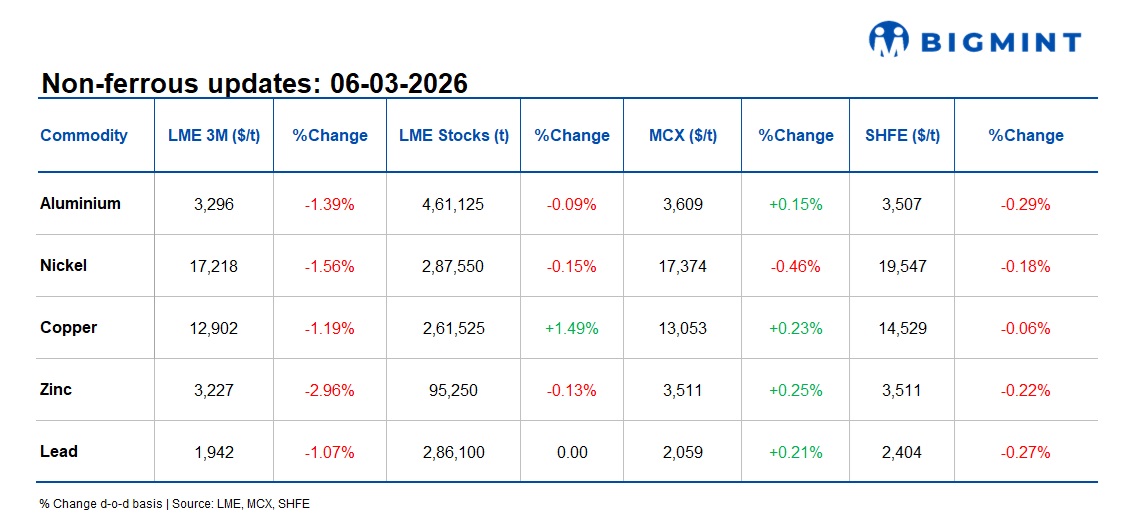
Base metal prices on the London Metal Exchange (LME) closed lower on 5 March 2026. Aluminium fell 1.39% to $3,296/t, while inventories edged down 0.09% to 461,125 t. Nickel declined 1.56% to $17,218/t, with stocks slipping 0.15% to 287,550 t.
Copper dropped 1.19% to $12,902/t, even as inventories rose 1.49% to 261,525 t. Zinc recorded the sharpest decline, falling 2.96% to $3,227/t, with stocks easing 0.13% to 95,250 t. Lead also weakened 1.07% to $1,942/t, while inventories remained steady at 286,100 t.
Domestic market overview
Domestic non-ferrous scrap prices in India increased across major markets, supported by steady buying interest and firm downstream demand. Aluminium tense scrap (loose), ex-Delhi, rose by INR 1,000/t or 0.4% to INR 224,000/t, up from INR 223,000/t. Similarly, aluminium tense scrap (loose), ex-Chennai, gained INR 1,500/t or 0.7% to INR 230,000/t, compared with INR 228,500/t previously.
Meanwhile, copper armature scrap (Cu 99%), ex-Delhi, remained stable at INR 1,145,000/t, reflecting balanced market sentiment.

Other market updates
Rio Tinto advances Amrun bauxite expansion to support future supply
Global mining major Rio Tinto is advancing expansion at its Amrun Bauxite Project in Queensland, aiming to strengthen long-term bauxite supply for the aluminium value chain. The project is expected to unlock additional high-grade reserves and support sustained output from the company’s Weipa operations.
The development could improve raw material availability for alumina refining and aluminium production, potentially supporting higher global supply over the long term. However, the near-term impact on aluminium prices is expected to remain limited as the additional supply is likely to enter the market gradually.
India services growth moderates in Feb amid rising cost pressures: PMI
India’s services sector growth moderated slightly in February, with the HSBC Services PMI easing to 58.1 from 58.4 in January, as new business expansion slowed to its weakest pace in over a year amid rising competition and softer demand conditions.
Meanwhile, service providers faced the sharpest increase in operating costs in nearly 2.5 years, driven mainly by higher food, energy, and labour expenses. Firms passed on part of these costs to customers, pushing output prices higher. Slower service-sector momentum could signal softer domestic demand conditions, which may weigh on consumption-driven industrial activity and limit upside in base metal demand, including aluminium.
Middle East conflict lifts aluminium price outlook; forecasts seen up to $4,000/t
Aluminium price forecasts have surged amid escalating conflict in the Middle East, with some analysts projecting prices could reach up to $4,000/t if supply disruptions persist. The conflict has disrupted shipments from regional producers and raised concerns over logistics through the Strait of Hormuz, a critical route for global aluminium and raw material trade.
Supply risks have already pushed LME aluminium prices to a four-year high near $3,372/t, while production and delivery disruptions from major Gulf producers such as Qatalum and Aluminium Bahrain have tightened market availability. Analysts note that prolonged disruptions could further lift global premiums and reinforce upward pressure on aluminium prices.
Leave a Reply