- Japanese manufacturers’ sentiment hits 3-year high
- Mitsui OSK explores shipbuilding partnerships in India
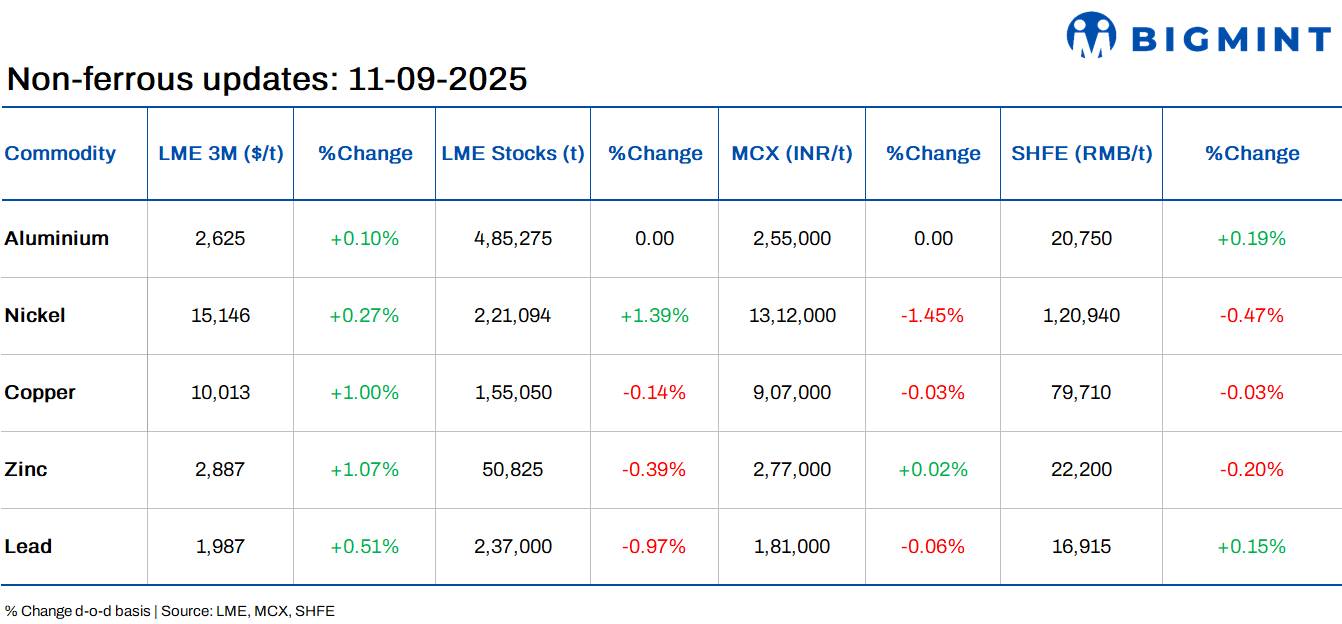
Base metals prices on the London Metal Exchange (LME) saw positive trends d-o-d, with zinc increasing by 1.07% to $2,887/tonne (t). Meanwhile, inventories at LME-registered warehouses saw negative trends d-o-d, with nickel recording the steepest fall of 1.45%.
Domestic market overview
In India’s non-ferrous metals markets, BigMint assessed domestic copper armature scrap prices at INR 806,000/t ex-Delhi, up by INR 6,000/t d-o-d. Aluminium Tense scrap prices remained stable d-o-d, with ex-Delhi at INR 195,000/t and ex-Chennai at INR 198,000/t.

Other market updates
Japanese manufacturers’ sentiment hits 3-year high after US tariff deal
Japanese business confidence improved in September, with the Reuters Tankan index for manufacturers rising to +13 from +9 in August, its highest in three years. The boost came after a US-Japan tariff deal that reduced duties on key exports such as cars. Six of nine manufacturing sectors, led by autos and transport machinery, witnessed stronger orders. However, some industries, such as textiles and precision machinery, continued to face weak demand and the effects of earlier tariffs.
Looking ahead, manufacturers expect sentiment to ease slightly to +11 by December, citing inflation, higher costs, and a weak domestic economy. Meanwhile, non-manufacturers’ confidence rebounded to +27, supported by steady consumer spending in areas such as real estate, retail, and transport.
Japan’s Mitsui OSK explores shipbuilding partnerships in India
Mitsui OSK Lines (MOL), Japan’s second-largest shipping firm, plans to partner with Indian companies to build tankers locally, supporting India’s push to expand shipbuilding and cut reliance on foreign fleets. CEO Takeshi Hashimoto said MOL aims to work closely with Indian shipyards as New Delhi modernises maritime laws and sets up an INR 250 billion ($2.84 billion) development fund to strengthen the sector. The move aligns with India’s broader goal of boosting domestic manufacturing and reducing freight outgoings by 2047.
Leave a Reply