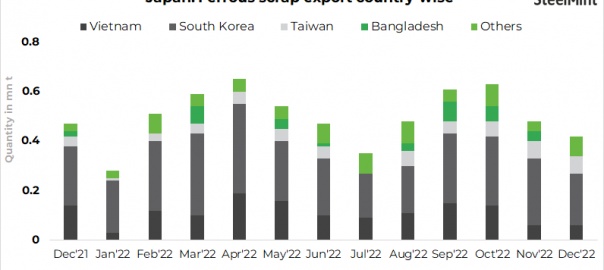
Japan’s ferrous scrap exports in Calendar Year 2022 (CY’22) stood at 7,023,417 t, a decline of 14% from 6,071,626 t in CY’21 was recorded. Similarly, m-o-m exports were also down by 12% to 424,545 t in December 2022 as compared to 480,617 t in November 2022.
Japanese ferrous scrap exports fell in 2022 due to decreased shipments of different grades to a number of countries and pricing disparities between local and overseas markets. South Korea continued to be the largest importer followed by Taiwan and Vietnam, respectively.
The country’s ferrous scrap exports fell by 10% y-o-y from 473,244 t in December 2021 as compared to December 2022.
- Exports to South Korea up in CY’22: The export volume from Japan stood at 3,055,446 t in CY’22, a marginal increase of 3% as compared to CY’21. South Korea imported 205,336 t in December 2022, lower as compared against 265,725 t in November 2022. Steel producers and buyers increased their interest in Japanese scrap during the second part of the year as local supplies became constrained, but they reduced their purchases when Japanese scrap prices rose.
- Exports to Taiwan in CY’22 increase: Japan’s export to Taiwan were at 595,996 t in CY’22 from 518,385 t in CY’21, a rise of 15% recorded. Similarly, m-o-m exports went up by 4% to 70,442 t in December 2022 from 67,486 t in November.
- Exports to Vietnam down in CY’22: The export volume of Japan was at 1,313,612 t in CY’22, down by 42% as compared to CY’21. Vietnamese buyers were less active in the first half of the year and later became active . However, the m-o-m import volumes were up by 8% to 64,012 t in December 2022 from 59,138 t in November 2022.
Japanese H2 scrap prices drastically up: The monthly average price stood at JPY 48,000/t FOB in December, up by JPY 2,800/t against the previous month.
Outlook
As per market participants, the Japanese scrap prices might be up as it is anticipated that Japanese scrap exports in 2023 might bounce back from China’s reopening from tight Covid-19 restrictions in December 2022, as well as recovering demand from Vietnam.
Leave a Reply