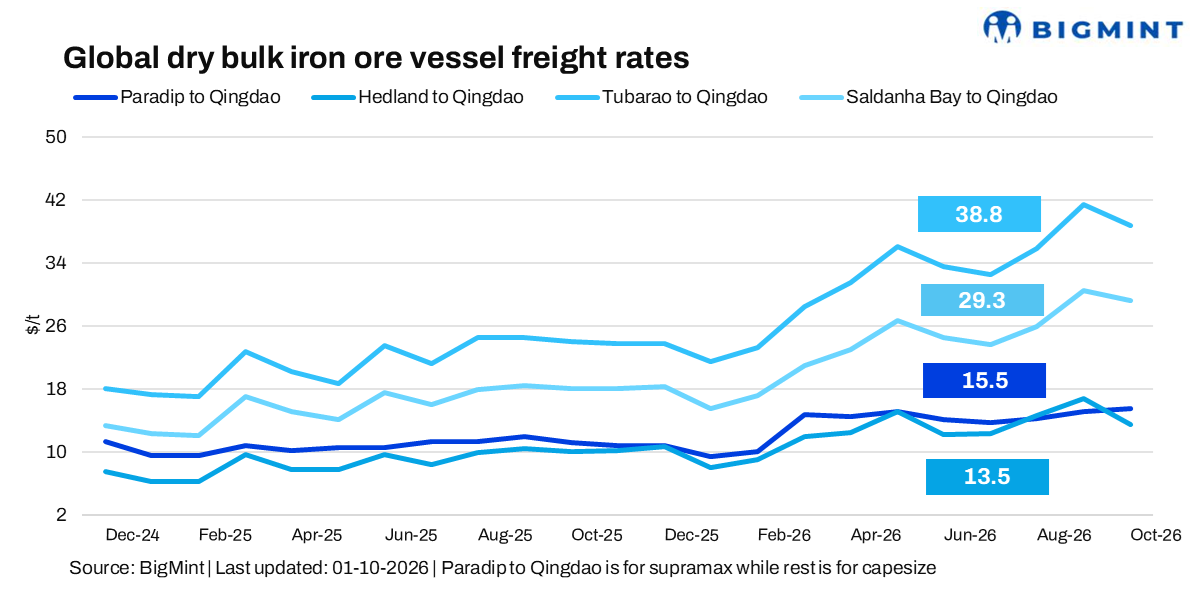
- Australia-India rates hit 1.5-month low
- Capesize rates drop across Atlantic, Pacific routes
Dry bulk iron ore freight sentiment weakened in the week ended 1 October, with Capesize rates declining across both Atlantic and Pacific routes. Australia-China, Brazil-China and South Africa-China rates softened amid slower fresh cargo enquiries, reduced fixture activity and rising vessel availability, with Australia-China rates falling to a more than 1.5-month low. China’s ongoing Golden Week holiday further subdued near-term fixing activity, while weaker steel margins and cautious mill buying weighed on China-bound demand.
Pacific routes remained particularly under pressure as ample prompt tonnage outpaced fresh cargo demand, while Atlantic rates also corrected after the stronger activity seen earlier in September. Supramax sentiment remained comparatively resilient, although holiday-related disruptions and slower Pacific activity limited upside.
A shipbroker stated, “Exporters expected to focus on need-based bookings rather than aggressive spot sales in the coming time.”
Route-wise update

Freight and commodity indicators weaken ahead of China’s holiday
- Baltic Dry Index declines: The Baltic Dry Index (BDI) declined by 360 points, or 10%, to 3,113, from 3,473 on 24 September, reflecting broad-based weakness led by a sharp correction in the Capesize segment. The BCI fell by 1,011 points, or 17%, to 4,928, while the BSI increased by 15 points, or 1%, to 1,797. The sharp decline in Capesize rates reflects softer China-bound cargo activity and reduced fixture volumes ahead of China’s Golden Week holiday, while smaller vessel segments remained relatively resilient.
- Bunker prices decline w-o-w: Singapore Very Low Sulfur Fuel Oil (VLSFO) fell 6.5% ($59/tonne (t)) w-o-w to $845/t as of 1 October, from $904/t on 25 September. The decline indicates some easing in bunker market pressure, although fuel-oil supply dynamics, crude price volatility and Middle East-related uncertainty continue to influence bunker costs and voyage economics.
- Brent crude futures decline w-o-w: December Brent crude futures fell 4.2% ($4.40/barrel (bbl) w-o-w to $100.54/bbl as of 1 October, from $104.94/bbl on 25 September. The decline indicates some easing in crude price pressures, although ongoing Middle East tensions and disruption risks around the Strait of Hormuz continue to keep crude markets and marine fuel costs volatile, with implications for voyage economics.
- DCE iron ore futures decline sharply: The benchmark DCE iron ore contract fell by RMB 11/t ($1.6/t), or 1.5% w-o-w, to RMB 702.5/t ($104.8/t) on 1 October, from RMB 713.5/t ($106.4/t) on 25 September. Prices remained under pressure from weak steel margins, subdued downstream demand and cautious mill buying, while China’s upcoming holiday period and expectations of post-holiday restocking provided some downside support.
Outlook
Iron ore freight rates are likely to remain under pressure in the near term, with China’s Golden Week holiday expected to keep cargo enquiries and fixture activity subdued. Ample prompt tonnage, cautious mill buying and weaker steel margins could continue to weigh on Capesize rates. However, post-holiday restocking, renewed cargo enquiries and tighter vessel availability could provide some support to freight rates if Chinese buying activity improves.
Leave a Reply