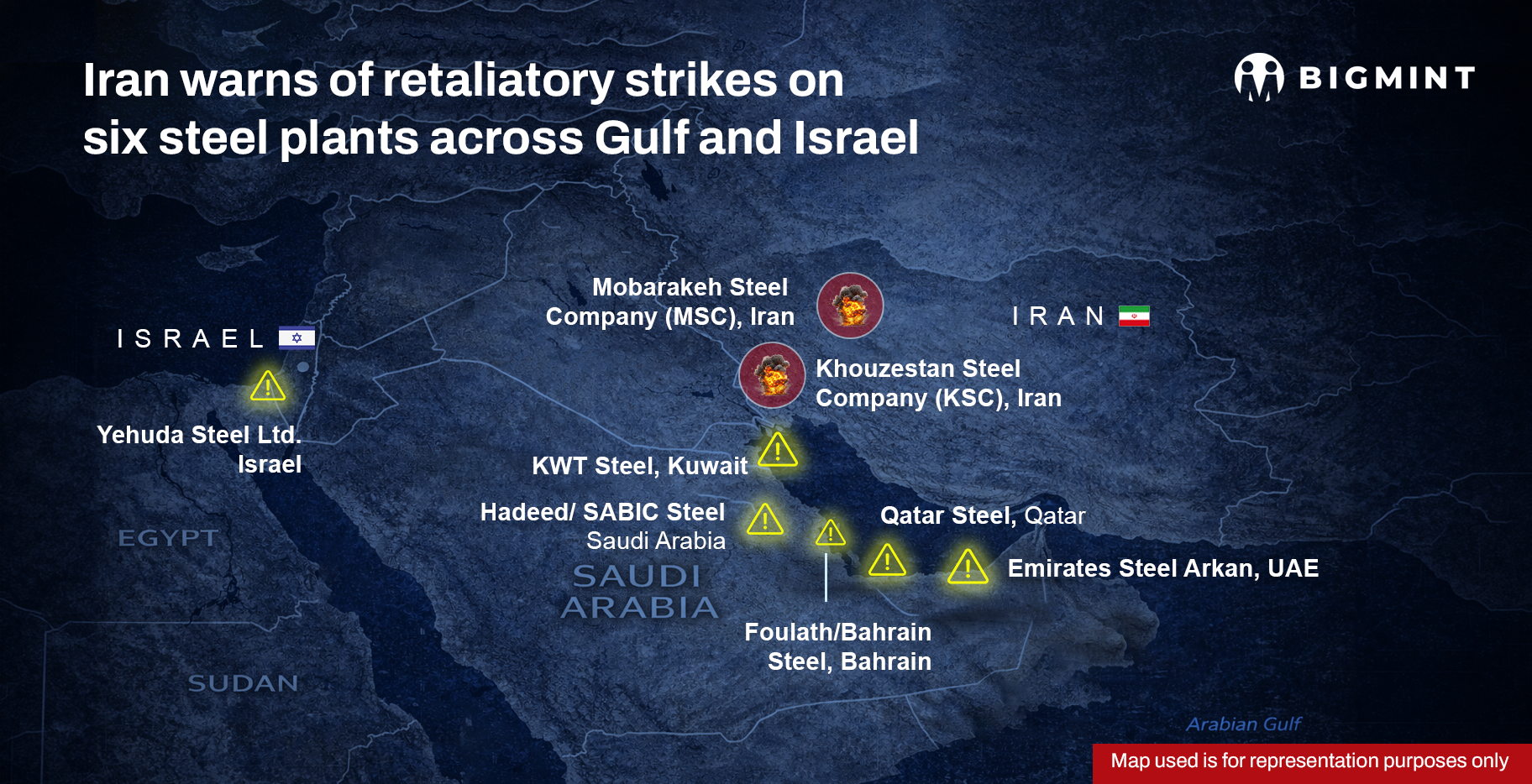
- Six steel facilities have combined capacity of 16 mnt
- Two of Iran’s largest steel plants damaged in attacks
Adding another layer of uncertainty for the global markets to deal with, the Iranian authorities have issued a dire warning to Israel and the US that it will strike steel plants in Israel and five other Gulf countries in retaliation for recent attacks on its own steel facilities, Mobarakeh Steel and Khouzestan Steel, two of the largest steel plants in Iran.
Khouzestan was Iran’s second-largest steelmaker in 2025, with crude steel output of 4.2 million tonnes (mnt). Esfahan-based Mobarakeh, which produced 7.1 mnt of steel in 2025, suffered damage to a substation, an alloy steel line, and a power plant, according to reports. Mobarakeh’s production was upwards of 10 mnt in 2024, as per worldsteel data.
Iranian officials said that damage to these plants would seriously impede the post-war reconstruction work. In a knee-jerk retaliation, Iranian drone strikes at Alba’s aluminium facility was reported by BigMint on 28 March, which may disrupt around 8-9% of global aluminium supplies.
Iran’s warning
Iran has issued an evacuation order for these steel plants in Israel and the GCC: Saudi Hadeed Steel, Emirates Steel Arkan, Qatar Steel, Bahraini Foulath, Kuwaiti United Steel Industrial Co., and Israeli Yehuda Steel.
 Located in Saudi Arabia, the UAE, Qatar, Bahrain, Kuwait and Israel, BigMint data show that these six plants have a combined steelmaking capacity of 16 mnt, producing mainly billets, rebars, structural sections, hot plates, etc.
Apart from Iran which produced around 32 mnt of crude steel in 2025, Saudi Arabia was the leading steel producer in the Middle East. As per wordsteel data, the country produced 10.78 mnt of crude steel in 2025.
In the event of an Iranian retaliation on the GCC steel facilities mentioned, it can be assumed that around 16 mnt of annual crude steelmaking infrastructure would be affected, thereby throwing the region into fresh turmoil.

Situation on the ground
BigMint came to learn from its sources in Iran that at Mobarakeh Steel Company, official reports indicate damage to the 914 MW combined-cycle power plant, the older 250 MW power plant, parts of the direct reduction modules, and sections of the steelmaking unit. This facility is also the only one so far where human casualties have been officially quantified: according to an official statement, one person was killed and 16 others injured, with several of the injured transferred to medical centers for treatment.
At Khouzestan Steel Company, some key units–including parts of the direct reduction plants, Zamzam 3 module, and the steelmaking unit–have also sustained damage, leading to the temporary shutdown of portions of production lines. However, no fatalities have been confirmed at this site.
At both complexes, emergency and technical teams were immediately deployed to contain the situation, secure the facilities, and assess the damage. Company management has emphasised continuity of operations, stating that all technical and managerial capacities are being mobilised to restore production lines as quickly as possible.
Overall, official sources suggest that these attacks have targeted critical segments of the country’s steel production chain. A comprehensive evaluation of the operational, economic, and temporal impacts will depend on further disclosures in the coming days.

Leave a Reply