- China shipments fell 21% m-o-m, despite 9% y-o-y growth in Jan-Jul
- Post-monsoon restocking could support exports
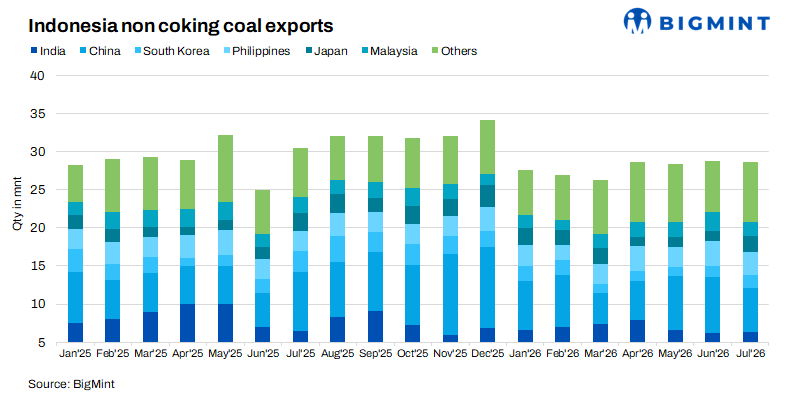
Indonesia’s non-coking coal exports remained under pressure in July 2026, with total shipments declining to 28.59 mnt, down 0.6% m-o-m from 28.77 mnt in June and 6% y-o-y from 30.43 mnt in July 2025. The decline was primarily driven by Indonesia’s increased focus on securing domestic coal supplies amid power-sector constraints and electricity supply concerns, which has limited near-term export availability. During Jan-Jul 2026, Indonesia exported around 195.12 mnt, compared with 202.59 mnt during the corresponding period of 2025, registering a 3.7% y-o-y decline.
Domestic power security takes priority as coal availability tightens
Indonesia’s coal market is facing growing pressure from domestic power-sector requirements. Under the Domestic Market Obligation (DMO) framework, miners are required to allocate 25% of production to the domestic market at a capped price of around $70/t, below prevailing international market levels. The price differential has reportedly discouraged some producers from prioritising domestic sales, with certain miners preferring to bear non-compliance penalties rather than supply at the regulated price.
The situation has been further compounded by Indonesia’s 2026 coal production quota of around 600 mnt, significantly below the 790 mnt produced in 2025. Tighter production availability, coupled with domestic power-sector requirements, has contributed to coal supply constraints and power disruptions affecting households and businesses. Against this backdrop, the government’s priority remains ensuring adequate domestic coal availability before allowing greater volumes for exports.
China shipments plunge in July after strong first-half buying
China remained a major destination for Indonesian non-coking coal; however, shipments declined sharply in July. Exports to China fell to 5.76 mnt, down 21% m-o-m and 24.8% y-o-y, amid weaker spot buying, adequate domestic coal availability and cautious procurement by Chinese buyers.
Despite the sharp July decline, cumulative exports to China during Jan-Jul 2026 reached 42.47 mnt, up 9.1% y-o-y, supported by stronger purchases during the earlier months. The recent slowdown therefore points to a moderation in Chinese import demand rather than a sustained deterioration in the year-to-date trend. A recovery in Chinese thermal power demand and utility restocking could provide a significant upside to Indonesian exports.
India remains the largest market, but imports stay subdued
India continued to be Indonesia’s largest export destination during Jan-Jul 2026, accounting for around 25% of total Indonesian non-coking coal exports. However, shipments remained below year-ago levels, with July exports declining to 6.33 mnt, down 1.2% m-o-m and 2.8% y-o-y.
On a cumulative basis, exports to India fell 16.7% y-o-y to 48.28 mnt during Jan-Jul 2026, compared with 57.99 mnt in the corresponding period of 2025. The decline reflects comfortable domestic coal availability, subdued spot demand during the monsoon, adequate utility inventories and cautious procurement by industrial consumers. The relatively less competitive import economics of seaborne coal versus domestic supplies have further reduced Indian buyers’ urgency to procure Indonesian cargoes.
Japan and the Philippines offer selective support
Indonesia’s exports to Japan and the Philippines provided some offset to weaker shipments to India, South Korea and Malaysia. July shipments to Japan increased 48% m-o-m to 2.04 mnt, although they remained 10% below July 2025 levels. On a Jan-Jul basis, exports to Japan stood at 12 mnt, up 8.6% y-o-y, indicating comparatively resilient demand.
Exports to the Philippines declined 4.7% m-o-m to 3.06 mnt in July but increased 14.6% y-o-y. During Jan-Jul 2026, shipments were broadly stable at 19.65 mnt, down only 0.9% y-o-y. Resilient demand from these markets has partially cushioned the decline in shipments to other major destinations.
South Korea and Malaysia remain weak spots
Exports to South Korea remained under pressure, falling 40.1% y-o-y to 1.68 mnt in July, despite a 14.7% m-o-m recovery. Cumulative shipments during Jan-Jul declined 24.4% y-o-y to 10.78 mnt. Malaysia also recorded weaker buying, with July imports declining 18.8% m-o-m and 6.9% y-o-y, while Jan-Jul shipments fell 10.9% y-o-y to 13.11 mnt.
The weakness across these destinations reflects subdued import requirements, availability of alternative coal supplies and cautious procurement amid uncertain power-sector economics.
East Kalimantan retains dominance despite lower annual shipments
East Kalimantan remained Indonesia’s leading export hub, with July shipments rising 3.9% m-o-m to 13.82 mnt. However, volumes were still 10.4% lower y-o-y. During Jan-Jul 2026, exports from the region reached 91.18 mnt, down 5.6% y-o-y.
South Kalimantan shipments declined 3.9% m-o-m to 9.9 mnt in July but remained 5.2% higher y-o-y. Meanwhile, Sumatra shipments were broadly stable on a monthly basis but remained lower y-o-y. Overall, the regional trend suggests that Indonesia’s export weakness is being driven primarily by demand conditions and domestic supply prioritisation, rather than by a broad-based disruption in export-loading capacity.
Export momentum remains soft despite selective market resilience
Indonesia’s July export performance confirms a softer trend in 2026, with total shipments down 6% y-o-y and Jan-Jul exports declining 4% y-o-y. The combination of domestic coal supply requirements, power-sector concerns, lower production availability and uneven overseas demand is likely to keep export growth constrained in the near term.
While stronger shipments to China earlier in the year and resilient demand from Japan and the Philippines have provided some support, these gains have not fully offset weaker buying from India, South Korea and Malaysia. Export performance will remain closely linked to domestic coal availability, international coal prices, import parity, inventories and thermal power-sector demand across key Asian markets.
Outlook
Indonesia’s non-coking coal exports are expected to remain subdued in the near term, amid domestic supply prioritisation and uneven Asian demand. Post-monsoon Indian restocking and stronger Chinese buying could support a gradual recovery in Q4 CY2026, subject to improved domestic availability and competitive Indonesian pricing.

Leave a Reply