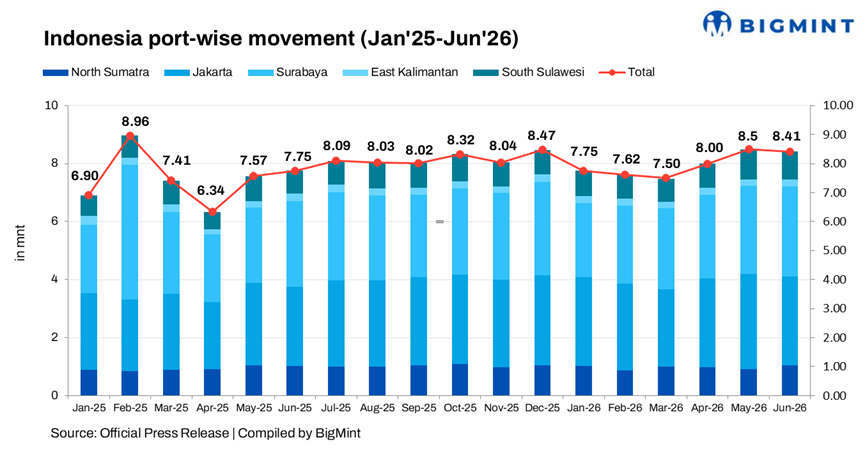
- North Sumatra posts strongest monthly increase
- Jakarta remains the biggest drag on overall volumes
Indonesia’s shipments across five major mining and industrial cargo hubs declined 1% m-o-m to 8.41 mnt in June 2026, from 8.50 mnt in May. The marginal decline was primarily due to lower volumes from Jakarta and South Sulawesi, which outweighed stronger shipments from North Sumatra, Surabaya and East Kalimantan.
Port-wise shipment trends
- Surabaya: Shipments increased 2% m-o-m to 3.10 mnt, maintaining its position among the largest contributors to the assessed volumes. The increase indicates relatively steady cargo movement through the port during the month.
- Jakarta: Shipments declined 7% m-o-m to 3.06 mnt, marking the sharpest contraction among the major-volume ports. Given Jakarta’s significant contribution to the total, the decline was the largest drag on overall shipments.
- North Sumatra: Shipments climbed 14% m-o-m to 1.05 mnt, recording the strongest growth among the five hubs. The increase points to improved cargo availability and higher dispatch activity during June.
- South Sulawesi: Shipments fell 5% m-o-m to 0.97 mnt, reversing part of the previous month’s increase. The decline indicates weaker cargo movement during the month, although mineral and metal-related trade continues to underpin activity in the region.
- East Kalimantan: Shipments rose 3% m-o-m to 0.24 mnt, suggesting relatively stable cargo flows despite mixed conditions in the coal market. Regional volumes continue to be influenced by domestic coal requirements and export-market conditions.
Market sentiment
Shipment performance remained mixed across Indonesia’s key hubs, with regional differences reflecting variations in cargo availability, production and export demand. The increase in North Sumatra provided the strongest positive contribution, while lower Jakarta volumes offset gains elsewhere.
Indonesia’s broader export activity remained resilient in June, although commodity performance was uneven. At the same time, lower seaborne coal shipments and changes in export administration added uncertainty to mining-related cargo flows.
The transition towards a centralised export system for coal, palm oil and ferroalloys from 1 June represents another factor that could influence shipment patterns as exporters adjust to the new administrative framework.
Outlook
Indonesia’s port shipments are likely to remain uneven in the coming months, with commodity-specific demand, regional production and export availability determining individual port performance. Resilient mineral and industrial cargo flows could support volumes at selected hubs, while softer coal shipments and evolving export procedures may limit growth elsewhere.

Leave a Reply