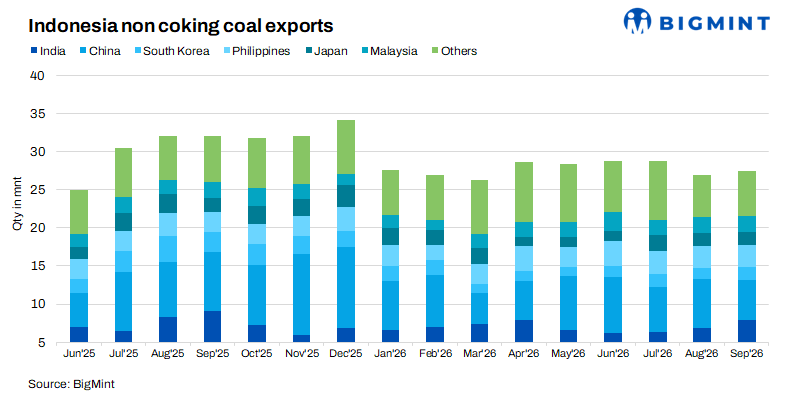
- Nine-month exports decline 9.8%; lignite records sharper contraction
- Kalimantan loadings weaken as Sumatra gains share towards quarter-end
Indonesia’s coal exports declined to 33.11 mnt in September 2026, down 21.6% from 42.25 mnt a year earlier and 0.9% from August. September was the weakest month of 2026, extending the decline from June’s 36.58 mnt.
January-September shipments fell 9.8% to 312.44 mnt. Production approval adjustments and domestic supply priorities formed the policy backdrop, while drought-related river constraints added pressure during July-September.
The loading data support a selective logistical impact: Taboneo and Balikpapan weakened sharply, while some other locations recovered. Consequently, neither policy nor weather alone explains the entire decline.

September weakness concentrated in lignite
Non-coking exports increased 2.2% month-on-month to 27.47 mnt, partly recovering from August. Lignite shipments, however, declined 17% to 5.42 mnt.
Lignite accounted for approximately 52% of September’s net year-on-year export reduction despite representing only 16% of current shipments. China received all recorded September lignite exports, making Chinese procurement particularly important to this segment.
Total exports declined year-on-year in eight of the first nine months. June was the exception. The contraction intensified in Q3: shipments fell 17.9%, compared with approximately 5.3% during Jan-Jun.
Production approvals, domestic priorities constrain availability
Indonesia’s government announced plans early in 2026 to revise miners’ RKAB production approvals to address oversupply and support prices. Its initial proposal envisaged reducing output from approximately 790 mnt in 2025 towards 600 mnt; that announcement should not be treated as confirmation of the final nationwide approved quota.
Domestic supply enforcement also affected exports. In June, the energy ministry confirmed that certain shipments had temporarily been held to secure suitable coal for PLN, but said exports had subsequently resumed normally. In July, it reinforced monitoring of domestic market obligations and PLN supply contracting.
These policies help explain the tighter export environment, but the shipment data cannot quantify how much of the decline resulted from quotas, domestic allocation, overseas demand or logistics.
Kalimantan’s September decline contrasts with Sumatra
Combining non-coking coal and lignite, East Kalimantan’s September shipments fell approximately 29% y-o-y to 15.25 mnt. South Kalimantan declined around 20% to 10.01 mnt.
Sumatra moved differently. Combined shipments reached 6.90 mnt, marginally above September 2025 and approximately 7% higher than August. Its share of these two export categories increased from around 16% to 21% y-o-y. This represents a late-period improvement rather than sustained annual growth: Sumatra’s corresponding nine-month shipments remained approximately 20% lower.
Loading-port movements support selective drought effect
Taboneo’s combined non-coking and lignite shipments declined from 6.12 mnt in July to 5.14 mnt in August and 4.82 mnt in September. September volumes were 38.4% below a year earlier.
Balikpapan showed an even sharper contraction, falling from 4.03 mnt in July to 2.65 mnt in August and 1.37 mnt in September — 68.5% below September 2025. Its lignite shipments fell to just 0.12 mnt.
These movements coincide with reported low-water constraints. In September, Indonesia’s mining professionals association described drought disrupting Barito deliveries from July and restricting Mahakam barge capacity. Reduced navigable depth limited loads and slowed coal movement.
Some routes remain resilient
Samarinda’s combined shipments recovered from 4.07 mnt in August to 4.77 mnt in September, although they remained 18.2% lower year-on-year. Muara Pantai’s non-coking shipments also increased. Tanjung Bara’s non-coking exports rose to 2.38 mnt, up 24% m-o-m.
Palembang’s combined non-coking and lignite shipments reached 4.57 mnt, against 2.98 mnt in July. This counter-pattern shows that drought did not constrain every loading route equally; supplier availability, coal quality and destination demand also mattered.
Trade flows change unevenly
Jan-Sep non-coking shipments to India declined 16.3% to 63.12 mnt, although September recovered to 7.89 mnt from 6.89 mnt in August.
China’s non-coking purchases remained broadly steady at 54.1 mnt, but its lignite receipts fell sharply. Combined shipments across those categories declined approximately 12% to 116.07 mnt. South Korean non-coking purchases fell 30.7%, while Vietnam and Bangladesh increased by approximately 15.9% and 14.4%, respectively.
BigMint assessment
Indonesia’s weaker export year reflects a combination of policy constraints, destination demand and increasingly difficult logistics. Q3’s sharper contraction suggests river disruptions compounded the earlier weakness.
Recovery will depend on rainfall restoring navigability, miners’ approved output and domestic commitments. Until then, buyers may place greater value on dependable loading routes, while a national export recovery could remain uneven across regions and grades.
Leave a Reply