- Nine-month imports grow 9.1%, led by Indonesian supplies
- Loading patterns suggest adaptation to Indonesian river transport constraints
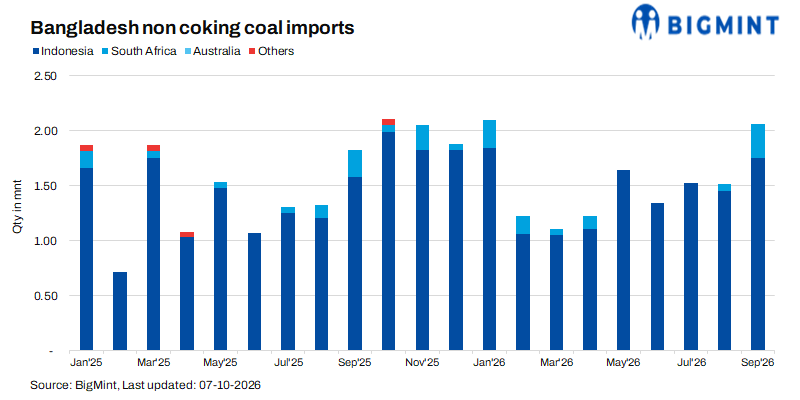
Bangladesh’s non-coking coal imports increased to 2.06 mnt in September 2026, up 13.2% from 1.82 mnt a year earlier and 36.4% from August.
September arrivals were the second highest of 2026, marginally below January’s 2.08 mnt. The recovery lifted January-September imports to 13.71 mnt, approximately 9.1% above the corresponding 2025 period.
The more significant change was in loading patterns. Tarahan and Tanjung Bara increased their contribution substantially, while shipments from Samarinda and Muara Berau declined. This is consistent with procurement shifting towards supply chains less exposed to river transport constraints, although the pattern is not uniform and cannot be attributed entirely to drought.
September recovery follows steady July-August arrivals
Imports stood at 1.52 mnt in July and 1.51 mnt in August before increasing by 0.55 mnt in September.
Indonesian supplies rose from 1.45 mnt in August to 1.75 mnt in September. South African arrivals increased from 0.06 mnt to 0.31 mnt, accounting for nearly half the monthly increase.
September’s loading profile was led by Tarahan at 0.65 mnt, followed by Tanjung Bara at 0.36 mnt, Richards Bay at 0.31 mnt and Palembang at 0.28 mnt. Together, these locations accounted for approximately 78% of arrivals.
July-September imports reached 5.09 mnt, up 14.6% from 4.44 mnt a year earlier. Bangladesh therefore increased receipts during the period when Indonesian river logistics faced disruption.
Nine-month growth remains Indonesia-led
Indonesia supplied 12.75 mnt during January-September, an increase of approximately 1.01 mnt. Its share remained dominant at 93%, broadly unchanged from a year earlier.
South African supplies increased by 0.29 mnt to 0.96 mnt, lifting their share from approximately 5.3% to 7%. The increase provided some additional sourcing diversity, particularly in September.
These volumes indicate stronger seaborne procurement. They do not independently establish consumption growth, since plant inventories, generation, industrial activity and shipment timing also affect imports.
Tarahan and Tanjung Bara gain substantially
Tarahan supplied 3.93 mnt during the nine months, already slightly exceeding its reported full-year 2025 volume of 3.87 mnt. Tanjung Bara shipments reached 2.29 mnt, also above the previous full-year total.
Their combined share of Bangladesh’s imports increased from approximately 29.2% to 45.4%.
The shift was particularly visible during July-September. Tarahan and Tanjung Bara together supplied 2.45 mnt, against 1.73 mnt a year earlier. Their combined contribution increased from 39% to 48% of quarterly imports.
There is a relevant logistical distinction. Tarahan is served by Bukit Asam’s rail transport network, while Kaltim Prima Coal’s Tanjung Bara terminal receives coal through an overland conveyor and has direct shiploading facilities. These routes offer alternatives to supply chains dependent on upstream river barging.
River-linked flows weaken during critical quarter
Combined shipments recorded from Samarinda and Muara Berau declined from approximately 0.99 mnt in July-September 2025 to 0.41 mnt in 2026, a reduction of around 59%.
Their quarterly share fell from approximately 22% to 8%. Over the full nine months, both locations also recorded substantial declines.
The timing is consistent with reported constraints on Kalimantan’s river transport. In September, industry accounts published by Indonesia’s mining professionals association described low water levels affecting both the Barito and Mahakam rivers, restricting barge loads and disrupting coal deliveries from July onwards.
Indonesia’s meteorological agency also confirmed very strong El Niño conditions in September and forecast a delayed rainy-season onset across much of the country. This supports the drought context behind the logistical disruption.
The Bangladesh loading data therefore support a plausible link between river constraints and changing procurement routes. They do not establish which individual cargoes were substituted or delayed.
Pattern selective rather than wholesale retreat
There are important counter-signals. Taboneo shipments increased over the nine months and reached 0.32 mnt in July and 0.24 mnt in August, before no arrivals were recorded in September.
Palembang shipments increased during July-September to approximately 0.61 mnt, against 0.20 mnt a year earlier. Muara Pantai also reappeared in September with 0.17 mnt after several months without recorded arrivals.
These variations show that river conditions did not affect every supplier equally. Loading-port labels also do not reveal the precise mine, feeder route or shipment date. Bangladesh’s arrival month may lag the actual Indonesian loading disruption.
BigMint assessment
Bangladesh maintained import growth despite Indonesian logistical constraints, with a larger contribution from Tarahan and Tanjung Bara and additional South African supplies in September.
The evidence suggests selective adaptation towards more dependable supply routes, rather than a broad withdrawal from Indonesia.
If river restrictions persist, rail-fed and direct-loading terminals could retain a stronger procurement role. A recovery in river levels could restore competing routes, but the timing and reliability of that recovery will remain important to Bangladesh’s sourcing decisions.
Leave a Reply