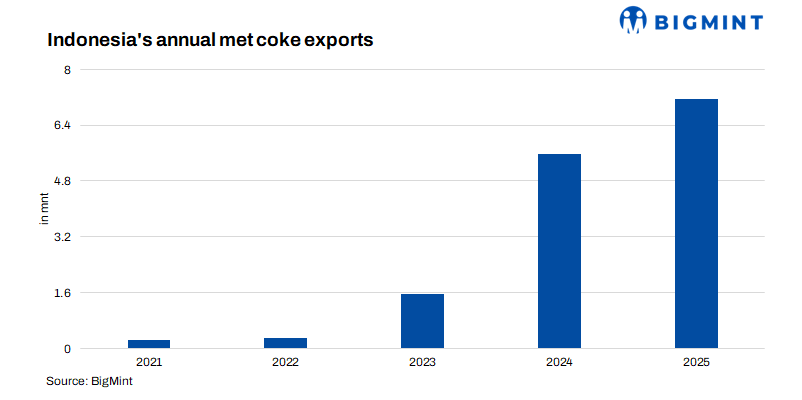
- Indonesia’s coke exports were 7.5 mnt in 2025
- Country gains influence over coke pricing, trade benchmarks
Mysteel Global: Indonesia has emerged as a leading exporter of metallurgical coke, supported by resource advantages, strategic location, and integrated industrial infrastructure, a development that is expected to enhance its influence over global pricing of the commodity, believes Gao Xuege, president of Risun Weishan New Energy (Indonesia) Co. Ltd.
Speaking at the 8th National Coal and Coke Procurement Conference held in Rizhao, East China on March 20, Gao noted that Indonesia’s coke exports reached a record 7.15 million tonnes in 2025, second only to China’s reported 7.94 million tonnes. However, after deducting around 3 million tonnes of semi-coke from China’s export figures, Indonesia effectively surpassed China to become the world’s largest supplier of met coke, he argued.

Indonesia’s coke production is highly concentrated in the Indonesia Morowali Industrial Park (IMIP) in Central Sulawesi, where the sector is dominated by Chinese-invested enterprises, including Risun. Output from IMIP surged to 8.2 million tonnes in 2025, up sharply from 6.47 million tonnes a year earlier. With total installed capacity already reaching 15.5 million tonnes per year by the end of 2025, significant room remains for further production and export growth, Gao told delegates.

In contrast, China – historically the world’s leading coke exporter for three decades – has seen its export volumes decline in recent years. Metallurgical coke exports fell to 3.8 million tonnes in 2025, down by 1.5 million tonnes year on year, following a decline of 1.26 million tonnes in 2024, Gao said, adding that the drop reflected intensifying competition from Indonesia.
Other traditional exporters have also lost ground. Poland’s coke exports declined to 5.65 million tonnes in 2025, and while it remains a key supplier to the European market – accounting for around 60% of regional supply – its relatively high production costs limit its competitiveness in other regions. Japan’s exports dropped sharply to just 44,000 tonnes in 2025, from 1.53 million tonnes a year earlier and nearly 3 million tonnes at its 2020 peak, as high costs eroded its position despite consistent product quality. Market participants expect Japan to become a net importer in coming years.
On the demand side, India remains the largest destination for Indonesian coke exports. Although India increased its domestic coke production to nearly 7 million tonnes in 2025, much of this output is characterized by relatively high ash content, which raises slag volumes and increases steelmaking costs. As a result, Indian steelmakers continue to rely on imported low-ash coke, with Indonesia well positioned to remain the dominant supplier.
Indonesia’s competitiveness is underpinned by multiple structural advantages. While the country is best known for its thermal coal reserves, it also possesses coking coal resources with relatively low ash and sulfur content, making them suitable for blending. In addition, the prevalence of open-cast mining keeps production costs among the lowest globally.

Geographically, Indonesia is well located near major coking coal suppliers such as Australia, enabling efficient sourcing of high-quality feedstock. Shipping times from northern Australian coal terminals Hay Point and Dalrymple Bay to Indonesia typically range from five to ten days, supporting stable raw material supply. Imports from Canada and the U.S. are also viable, further diversifying supply sources, Gaio suggested.
Furthermore, strong policy and financial support from the Indonesian government, combined with IMIP’s integrated infrastructure – including energy supply, logistics, and port facilities – has created a highly efficient industrial ecosystem for coke production.
Indonesia’s coke supply network now spans major coal-producing and steel-consuming regions globally, a scale unmatched by other suppliers, and its reach is expected to expand further,” Gao said.
Indonesia is the largest seaborne coke supplier and a key exporter to India, the world’s largest demand center for imported coke, with the result that Indonesia is increasingly shaping global pricing dynamics. Market participants noted that India’s domestic coke price index closely tracks Indonesia’s export prices, often moving in tandem.
With its growing supply share and strong linkage to key demand centers, Indonesia is poised to play a dominant role in the global metallurgical coke market, with its pricing increasingly serving as a benchmark for international trade, Gao added.
Note: This article has been written in accordance with a content exchange agreement between Mysteel Global and BigMint.
Leave a Reply