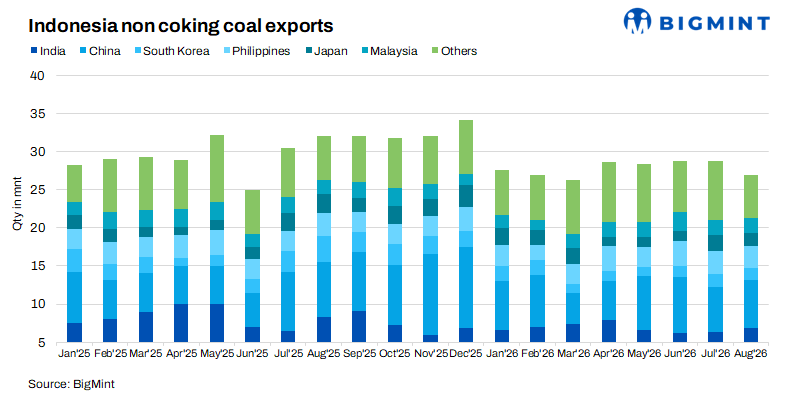
- Aug exports plunge 23% as Kalimantan logistics tighten
- Sep shipments recover after weak start to month
In Indonesia, an El Nino-induced drought has emerged as an additional constraint on coal exports, lowering river levels across Kalimantan and restricting the barges that connect inland mines with seaborne loading points.
BigMint data show the clearest deterioration in August, when exports fell 23% y-o-y and weakness was heavily concentrated in East and South Kalimantan. However, vessel movements through 25 September suggest exporters are adapting to the logistics disruption: shipments remained constrained early in September but accelerated later in the month.
El Nino is not the starting point
The distinction between Indonesia’s underlying export decline and the more recent weather disruption is important.
During January-August 2026, Indonesia exported 279.33 million tonnes (mnt) compared with 304.24 mnt in the same period of 2025, down around 8.2%. Exports had already declined sharply in February and March, well before the severe river disruption. June exports, conversely, rose 17.5% y-o-y to 36.58 mnt.

The first seven months therefore establish the baseline: Indonesia was already exporting less coal in 2026. El Nino did not cause that decline.
What changed from July-August was its magnitude and geographical concentration.
Aug exposes Kalimantan logistics constraint
East Kalimantan exports fell 29.4% y-o-y in August to 15.69 mnt, while South Kalimantan declined 18.1% to 10.67 mnt. Together, the two regions accounted for 8.89 mnt — almost 88% of Indonesia’s 10.12 mnt y-o-y August decline.
Port movements reinforced the pattern. Taboneo exports fell 41% y-o-y, Samarinda 34%, and Balikpapan 42%.
This coincided with falling river levels restricting barge movements. Lower draft reduces the amount of coal that can be carried per trip, slowing mine-to-port evacuation even where coal remains available for production.
Sep’26 starts weak, then gathers pace
The vessel line-up through 25 September provides the clearest indication of what happened next.

The progression is significant. Rather than deteriorating continuously, visible shipments strengthened through September. The 19-25 September run-rate was around 50% higher than during 1-4 September.
The first 15 days recorded about 11.87 mnt of visible shipments, but another 10.02 mnt moved during 16-25 September alone.
Kalimantan flows also recover
The regional vessel data show a similar pattern.

Consequently, September data suggests a supply chain initially struggling with the river disruption and then gradually restoring throughput.
Low river levels have not shut Kalimantan’s coal export system. Coal continued leaving Samarinda, Taboneo, Balikpapan, Tanjung Bara and other loading points throughout September.
The effect is primarily one of reduced logistics efficiency: lower barge payloads, navigation restrictions, and potentially longer turnaround times.
This also explains why substantial ocean-going cargoes can continue loading despite shallow rivers. Export vessels can still be assembled from multiple barge movements; it simply becomes harder to sustain normal throughput.
Outlook
The biggest risk for Q4 is the duration of the current water crisis. If river levels remain depressed, lower barge productivity will continue limiting how rapidly coal can be evacuated. Prolonged disruption could also cause mine stockpiles to accumulate and eventually feed back into production.
For now, however, September’s improving shipment trajectory suggests Indonesia’s coal logistics system is adapting even though it is operating under significantly more difficult river conditions than normal.
Leave a Reply