- Coal continues to anchor power system amid record demand
- Improved coal logistics strengthening grid reliability
Coal continues to generate nearly 70% of India’s electricity while supporting record peak demand amid a weak monsoon.
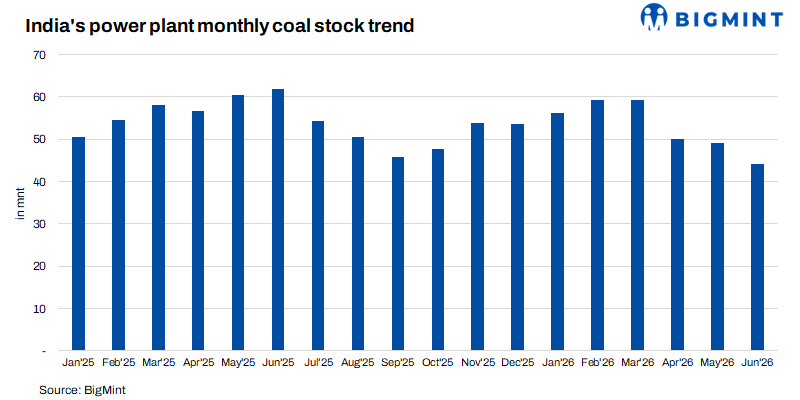
India’s thermal power sector entered the second half of July with coal inventories easing to around 41 million tonnes (mnt) after meeting a sharp increase in electricity demand. While stocks have declined steadily from the beginning of the month, they remain comfortably above the critically low levels witnessed during the power shortages of 2021 and 2022, underscoring the significant improvement in domestic coal production, logistics and supply chain management.
The Ministry of Power recently informed Parliament that thermal power plants held 42.8 mnt of coal stocks as on 12 July, sufficient for around 14 days of consumption at an 85% Plant Load Factor (PLF). Since then, Central Electricity Authority (CEA) data show inventories have moderated to 41 mnt by 19 July, reflecting higher coal consumption as thermal generation responded to rising electricity demand. At the same time, the number of power stations with critical coal stocks declined from 32 at the end of June to 26 by 19 July, indicating improved allocation of coal supplies despite the overall inventory drawdown.
The latest developments reinforce the government’s message that coal supplies continue to comfortably meet daily requirements, even as India’s electricity system experiences record demand.
Coal remains backbone of India’s power system
The government said India’s installed coal and lignite-fired generating capacity currently stands at 230.8 GW. Despite record renewable capacity additions, coal accounted for 69.54% of India’s electricity generation during April-June 2026, highlighting its continuing role as the foundation of the country’s power system.
Coal becomes even more critical during periods when renewable output declines. During non-solar peak hours, coal-based generating stations supplied 188.8 GW, accounting for nearly 75% of the national demand of 251.4 GW, demonstrating that thermal generation remains indispensable for maintaining grid stability during evening demand peaks.
Recent operating data further illustrate this dependence. During 1-19 July, India’s electricity demand climbed sharply, with peak demand reaching a record 270.2 GW on 16 July. Coal-fired generation increased by nearly 13% year-on-year, crossing 4,100 MU per day during the tightest phase of the month as thermal stations compensated for weaker-than-normal hydropower generation and rapidly rising electricity consumption.
Healthy inventories despite seasonal drawdown
Although thermal plant inventories have fallen by around 3.1 mnt since the end of June, the decline largely reflects seasonal consumption rather than any deterioration in fuel availability.
Coal stocks currently provide approximately 13 days of consumption cover, only marginally below the 14-day level reported by the Ministry earlier in the month.
More importantly, the reduction in critical stock situations demonstrates that coal distribution has become more efficient. Better coordination between the Ministries of Power, Coal and Railways has enabled available supplies to be directed towards plants facing the greatest operational risk.
The government attributed the stronger supply position to several ongoing measures, including:
- Daily monitoring of coal supplies through an inter-ministerial committee.
- Priority allocation of railway rakes for coal transportation.
- Regular coordination between the Ministries of Coal, Power and Railways to maintain uninterrupted supplies.
These initiatives have substantially improved coal logistics compared with previous years when transportation bottlenecks frequently constrained power generation.
Thermal capacity continues to expand
The Ministry also highlighted that 9,470 MW of thermal generating capacity was commissioned during FY2025-26, while another 2,260 MW has already been added during the current financial year.
Although renewable capacity continues to grow rapidly, these additions demonstrate that thermal generation remains an essential component of India’s long-term energy security strategy as electricity demand continues to expand.
Flexible coal plants increasingly complement renewables
The government reiterated that coal-fired generating units are progressively adopting the CEA Flexible Operation Regulations, 2023, enabling plants to safely operate down to 40% of rated capacity.
This operational flexibility allows thermal stations to reduce output during periods of high solar and wind generation before ramping up rapidly as renewable output declines.
The transition is also being supported by growing deployment of energy storage technologies. The government said India has commissioned:
- 2,669 MW of Battery Energy Storage Systems (BESS)
- 7,426 MW of Pumped Storage Projects (PSPs)
These assets store surplus renewable electricity during daylight hours before supplying power during evening demand peaks, complementing coal-fired generation and improving overall grid flexibility.
BigMint’s assessment
The latest government update, viewed alongside recent CEA operating data, demonstrates that India’s thermal power sector has entered a fundamentally different phase compared with the supply constraints experienced only a few years ago. While coal inventories have naturally declined during July in response to higher electricity demand, the drawdown reflects increased consumption rather than supply shortages.
The more important indicator is the continued decline in the number of critically stocked power stations despite lower aggregate inventories, highlighting significant improvements in coal logistics and supply chain management.
Recent market developments also reinforce coal’s evolving role within India’s energy transition. Renewable generation continues to expand rapidly, but weak hydropower during the current monsoon and record electricity demand have required coal-fired generation to provide the majority of incremental electricity. Rather than diminishing coal’s importance, the transition is changing how thermal plants operate — from conventional baseload generators towards increasingly flexible assets that support renewable integration while ensuring grid reliability.
Looking ahead, electricity demand is expected to remain structurally strong as economic growth, industrial activity and cooling requirements continue to expand. While seasonal fluctuations in coal inventories are likely to persist, sustained domestic production growth, efficient railway logistics and coordinated fuel management should enable the sector to maintain comfortable supply conditions through the remainder of FY2026-27.

Leave a Reply