- Crude steel production declines by 3% as profitability weakens
- Surge in semis exports offsets 6% drop in finished steel shipments
- Property investment falls 18% y-o-y, manufacturing dips by 1%
Morning Brief: China’s steel industry remained under sustained pressure in the first half of 2026 (H1CY’26), with crude steel output falling 3% y-o-y as the broader economy continued to shift away from traditional steel-intensive sectors.
China’s GDP growth slowed to a four-year low of 4.3% y-o-y in the second quarter, bringing H1 growth to 4.7%. Industrial and manufacturing value added still expanded by 5.4% and 5.5%, respectively, but the gains were driven largely by sectors such as electrical equipment, high-tech manufacturing, shipbuilding, and new energy vehicles, which are less steel intensive than property and infrastructure.
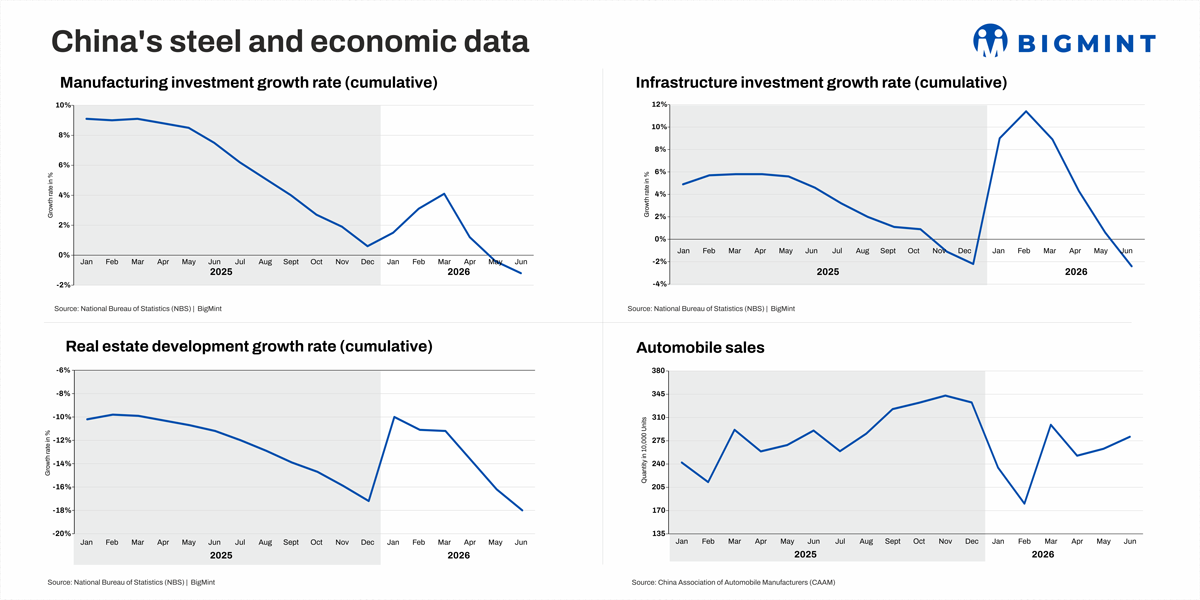
Property investment continued to shrink at its fastest pace in years, while both manufacturing and infrastructure investment turned negative by June. The simultaneous contraction in investment in all three major steel-consuming segments reflects one of the weakest demand environments for the industry in recent years.
Although exports of high-value manufactured goods surged, they provided only limited support for steel demand. Moreover, finished steel exports fell 5.6% y-o-y in H1 amid rising trade barriers and stricter export regulations.
Meanwhile, household demand also remained subdued, with retail sales growing only 1.3% y-o-y. Per capita consumption expenditure also rose 2.7% despite per capita disposable income increasing 4.2% (both in real terms), indicating cautious consumer sentiment.
Overall, the divergence between economic growth and steel demand widened further in H1CY’26, highlighting how China’s structural shift towards technology-led growth is reducing the steel intensity of its economy.
Highlights of China’s steel industry in H1CY’26

Production declines on demand pressures
China’s crude steel production fell 3% y-o-y, as demand remained subdued. Weak profitability, elevated inventories, higher raw material costs, and rising trade barriers drove mills to maintain production discipline. Finished steel production fell 0.9% too, when it had increased by 3.1% in CY’25 when crude steel output had fallen by 4.4%.
Although production rose marginally by 0.4% y-o-y in June (the first y-o-y growth since April 2025), supported by resilient exports of automobiles, machinery, and ships, the improvement was insufficient to reverse the broader downtrend.
Steel exports remain resilient despite 6% drop
Exports remained the brightest spot for Chinese steelmakers, with the y-o-y percentage drop steadily shrinking. Finished steel exports were down 5.6% y-o-y during January-June but improved from the 8.1% decline recorded during January-May and the 9.9% drop in Q1.
Chinese producers increasingly shifted towards semi-finished exports to preserve overseas sales, with volumes rising 62.8% y-o-y. Including semis, China’s total exports stood at 64.46 mnt, marginally higher than the year-ago period’s 63.99 mnt.
Competitive pricing continued to underpin exports, while the absence of Iranian steel due to the Middle East conflict and subdued domestic demand pushed Chinese steelmakers to increase exports.
However, the new export licensing system aimed at stalling VAT evasion and rising trade barriers across Europe, Asia, and Latin America limited export growth. Moreover, the appreciation of the yuan also encouraged steelmakers to focus on domestic sales.
Iron ore imports rise despite weaker steel output
China’s iron ore imports increased 6.3% y-o-y in H1CY’26, with arrivals rising 6.4% y-o-y in June. Australian and Brazilian miners accelerated quarter-end shipments and cargo clearances improved following the resolution of pricing negotiations between China Mineral Resources Group (CMRG) and major suppliers. Port inventories climbed up to around 162 mnt by the end of H1CY’26, but mills continued importing amid stable blast furnace utilisation levels and lower concentrate availability.
Coal imports rise post Shanxi accident
China’s coal imports rose 1.7% y-o-y in H1, while raw coal production fell 1.7% y-o-y. June imports surged 29.5% y-o-y and 28.6% m-o-m to 42.78 mnt, the highest monthly volume this year, largely compensating for the 9.7% drop in domestic output.
The rebound reflected stronger summer procurement by power utilities and increased coking coal purchases after a fatal mine accident in Shanxi triggered extensive safety inspections and the temporary suspension of numerous mines.
Meanwhile, thermal power generation increased 1.4% y-o-y during H1CY’26, although growth slowed to 0.5% in June as rising solar, hydro, and nuclear generation displaced part of coal-fired electricity output.
Investment slowdown continues in end-user segments
Rather than broad-based growth, China has been increasingly directing policy support towards high-end manufacturing, equipment upgrades, and strategic industries, while property, infrastructure, and traditional manufacturing continue to weaken.
Real estate development investment contracted 18% y-o-y in January-June, compared with a 16.2% decline during January-May. Manufacturing investment slipped further into negative territory, falling 1.2% in H1 after contracting 0.4% till May, while infrastructure investment also turned negative, declining 2.4% in H1 after slowing to 0.6% growth in January-May.
Property remains biggest drag, infrastructure provides limited support
The property sector remained the largest drag on steel consumption. Real estate developers continued to face funding constraints, new housing starts remained depressed, and land acquisitions showed little sign of recovery. While government programmes to complete unfinished housing projects and limited urban village redevelopment generated some incremental demand, they were insufficient to offset the collapse in new construction.
Infrastructure provided only a partial cushion. Continued issuance of special-purpose bonds and policy lending supported investment in railways, power grids, water conservancy, ultra-high-voltage transmission lines, and underground utility corridors. However, local government fiscal constraints and the lag between financing approvals and physical construction meant these projects merely stabilised demand rather than generating meaningful growth in long steel consumption.
Export-oriented manufacturing offers support
Manufacturing emerged as the industry’s main source of resilience, although demand was increasingly driven by export-oriented industries rather than domestic consumption. Production of new energy vehicles, shipbuilding, offshore wind equipment, and power equipment rose, driven by equipment upgrade programmes, green manufacturing incentives, and targeted central bank re-lending.
Total goods exports rose 13.4% y-o-y to RMB 14.73 trillion during H1CY’26. Exports of mechanical and electrical products increased 20.1% to RMB 9.36 trillion, accounting for 63.5% of total exports, while high-tech product exports surged 39% to RMB 3.26 trillion.
The automotive sector also highlighted the growing divergence between domestic and external demand. Sales of Chinese-made vehicles fell 4.1% y-o-y to 15.02 million units during H1CY’26, reversing an 11% increase a year earlier. Domestic sales dropped 21% to 9.92 million units as weaker consumer confidence, higher fuel costs, and reduced purchase incentives weighed on demand. Although Beijing extended its vehicle trade-in subsidy programme until the end of 2026 to support consumption, it simultaneously reduced the purchase tax incentive for new energy vehicles (NEVs) from a full exemption to a 50% discount, dampening buying interest.
Vehicle exports, meanwhile, surged more than 65% to 5.10 million units. Total NEV sales still increased 7.3% to 7.45 million units, driven by exports, which more than doubled to 2.36 million units, even as domestic NEV sales fell 13% to 5.09 million units.
Outlook
BigMint expects China’s steel production to slow further in the second half of 2026 as domestic demand continues to diverge between manufacturing and construction.
Manufacturing should continue to outperform construction, supported by policy incentives for equipment upgrades, technological transformation, shipbuilding, offshore wind, energy storage, and high-end industrial equipment. However, downside risks are emerging even within manufacturing.
China’s passenger vehicle market is now expected to record its weakest year since 2021. The China Passenger Car Association has cut its full-year sales forecast to 20.4 million vehicles, implying a 14% decline from the record 23.7 million units sold in 2025, indicating a slowdown in automobile production, one of the steel industry’s strongest demand drivers from the manufacturing segment.
Exports are also expected to provide limited support, as anti-dumping investigations continue to restrict market access. While Chinese steelmakers are expected to rely on semi-finished steel exports to bypass trade restrictions, the resumption of Iranian exports is likely to intensify competition in overseas markets and slow export growth.
Additionally, Beijing’s stricter capacity replacement rules, carbon market compliance, energy efficiency requirements, and seasonal environmental controls may keep crude steel production on a gradual downward trend.
Leave a Reply