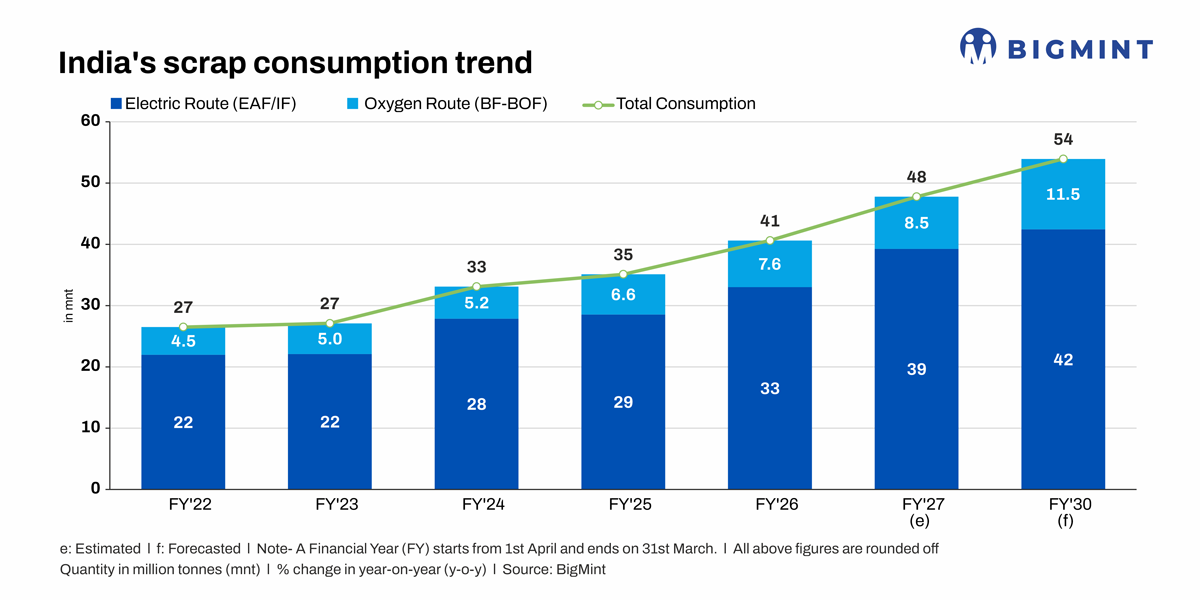
- Scrap demand from electric route to rise 29%, BF-BOF route to climb 51%
- Domestic scrap generation to reach 47 mnt, leaving supply gap of 8-10 mnt
Data Deep Dive: India’s steel expansion is set to drive a sharp increase in ferrous scrap consumption through FY’30, strengthening the material’s role as an increasingly strategic metallic for steelmakers.
According to BigMint’s projections, total steel scrap consumption is seen rising by around 32.8% to 53.9 million tonnes (mnt) by FY’30 from 40.6 mnt in FY’26, mirroring the 33% growth in crude steel production to 225 mnt by FY’30 compared to 169 mnt in FY’26.
However, the increase in scrap demand will outpace the growth in domestic scrap generation, pointing to continued reliance on imports even as India’s own recycling pool expands. Domestic scrap generation is projected to reach 47 mnt by FY’30, leaving a potential gap of around 8-10 mnt against projected consumption of 54 mnt.
At the same time, growing global competition for recyclable material, alongside the possibility of tighter export policies in major scrap-producing countries, could make access to imported scrap less predictable. This will place greater emphasis on domestic scrap collection and processing, diversified procurement, and flexibility in switching between scrap and alternative metallics as relative economics change.
Steel production growth to lift scrap demand to 54 mnt
India’s steel production is projected to expand across all three major routes through FY’30. We see blast oxygen furnace (BOF)-based crude steel output increasing 51% to 109.1 mnt by FY’30 from 72.2 mnt in FY’26. Induction furnace (IF) production is projected to rise 22% to 78.8 mnt from 64.4 mnt, while electric arc furnace (EAF) output is set to increase 14% to 37.1 mnt from 32.6 mnt.
The expansion of the electric and induction furnace segments is particularly significant for scrap buyers. These routes are the principal consumers of ferrous scrap, direct reduced iron (DRI), and other metallics, making raw material procurement a central issue for future production planning.
Scrap consumption through the electric route, including EAF and IF steelmaking, is expected to increase 29% to 42.5 mnt from 33 mnt. This means the electric route will account for the bulk of the increase in India’s scrap requirement, even as producers continue to balance scrap with DRI and other metallic inputs depending on relative economics.
Meanwhile, scrap consumption through the BF-BOF route is projected to increase 51% to 11.5 mnt by FY’30 from 7.6 mnt in FY’26 as integrated producers raise scrap charging alongside higher crude steel production. For integrated producers, higher scrap charging can improve metallic efficiency and reduce emissions intensity.
Domestic generation to improve to 47 mnt by FY’30
India’s domestic scrap generation (including foundry) is projected to increase 30% to 46.9 mnt by FY’30 from 36.1 mnt in FY’26, supported by a larger installed steel base, rising industrial activity, end-of-life vehicles, and the gradual release of steel from existing infrastructure and manufactured goods.

End of life scrap (including ELV, Building Demolition, Industrial discards, ship recycling and foundry)will remain the largest individual contributor to India’s scrap pool, expanding 22% to 17.5 mnt by FY’30 from 14.4 mnt in FY26. This category represents post-consumer steel reclaimed from demolished buildings, old infrastructure, and discarded machinery, highlighting the gradual maturation of India’s long-term steel lifecycle.
While old scrap is expected to lead in absolute volume, home scrap is likely to grow at the fastest pace, rising 44% to 12.1 mnt from 8.4 mnt. This surge directly mirrors the rapid expansion of domestic crude steel production capacities, as home scrap is generated internally during the steel manufacturing and casting processes.
Meanwhile, end-of-life vehicle (ELV) scrap is projected to climb up by 29.8% to 10.9 mnt in FY’30 from 8.4 mnt in FY’26. This increase underscores the gradual institutionalisation of organised vehicle scrappage centres across the country, turning automotive waste into a vital resource for secondary steelmakers.
Additionally, reflecting solid downstream manufacturing activity (such as automotive manufacturing, engineering, and white goods fabrication), the availability of industrial fabrication scrap is projected to grow 29% from 4.9 mnt to 6.3 mnt in FY’30.

Domestic supply gap of 8-10 mnt to keep imports essential
The projected 8-10 mnt gap between domestic scrap generation (41 mnt) and consumption in steel making (54 mnt) provides a clear indication that imports will remain an important balancing source for Indian steelmakers through FY’30 with a gap of 13-15mnt.
However, global ferrous scrap availability is expected to tighten as major exporting regions increasingly prioritise domestic recycling and circularity. Such a contraction in international scrap trade would expose Indian mills to higher freight sensitivity, currency movements, export restrictions, and supplier concentration.
 For Indian steelmakers, this will make imported scrap procurement more complex. Buyers may need to secure material earlier, diversify origins and maintain flexibility between imported HMS, shredded scrap, domestic scrap, DRI and pig iron. Imported scrap will continue to play an important balancing role, but its availability may become less predictable and its landed cost more volatile.
This trend could also strengthen the premium for reliable, specification-grade material. In a tighter market, mills may increasingly prioritise consistency, low contamination and assured delivery over simply buying at the lowest spot price.

Fragmented scrap collection, processing remains key hurdles
Even as domestic scrap generation improves, the principal challenge will be not only the quantity of scrap but also its quality, location and availability at the right price. India’s scrap market remains fragmented, with a substantial portion of collection and processing handled by small and informal operators. This can result in inconsistent grading, contamination, limited traceability and higher logistics costs.
Other constraints include insufficient organised shredding and processing capacity, regional imbalances between scrap generation and steelmaking centres, high inland freight and handling costs, inconsistent quality benchmarks and limited price transparency, taxation and compliance-related delays in inter-state movement, and continued dependence on imports for prime and specification-grade scrap.
As demand approaches the FY’30 projection, the market will require more organised collection, better segregation and greater investment in processing infrastructure.
Scrap procurement to become more strategic by FY30
For steelmakers, the projected scrap gap will require a more structured procurement strategy. Mills will need to diversify across domestic scrap, imported HMS, shredded scrap, DRI and pig iron, while building longer-term relationships with recyclers, dismantlers, aggregators and industrial generators.
Investment in quality testing, pre-processing and grade-wise segregation will be important to improve consistency, while tracking regional scrap generation against furnace capacity can help optimise sourcing and logistics. A balanced mix of spot and contracted procurement can manage price volatility, with strategic scrap inventories providing a buffer against supply disruptions.
Overall, procurement will need to focus not just on cost, but also on quality, availability and supply security.
Outlook
India’s FY’30 steel growth story will be closely linked to the development of its scrap ecosystem. By FY’30, scrap is expected to play three increasingly important roles in India’s steel value chain. First, it will remain a growth-enabling metallic for EAF and IF steelmaking, with availability directly influencing operating rates, production costs and procurement strategies. Second, greater scrap use can support decarbonisation by reducing the requirement for primary ironmaking inputs, particularly when combined with renewable power and efficient furnace operations. Third, stronger domestic scrap recovery can improve supply security by reducing exposure to international price cycles, export policy changes and long-distance imports.
The bigger challenge will be converting India’s growing scrap pool into usable steelmaking feedstock while maintaining access to imported material. Rising global competition for scrap and the possibility of export restrictions could increase procurement risks for Indian mills, making supply diversification, domestic processing and flexibility across alternative metallics increasingly important.

Leave a Reply