- Coal supplies 60% of incremental generation, renewables 40%
- Pithead stocks adequate but power plant stocks remain low
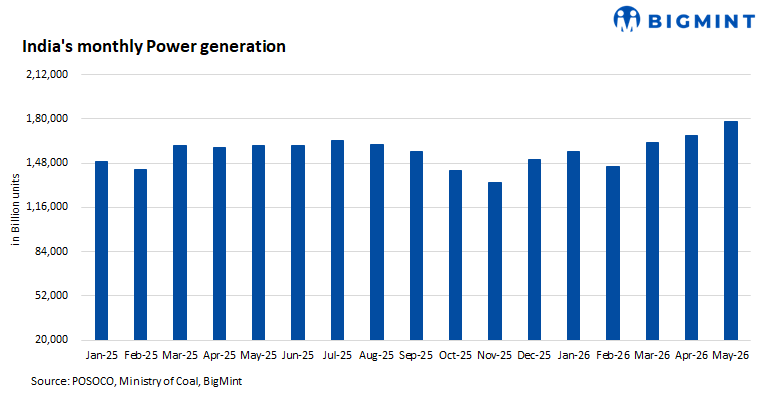
India’s power sector delivered one of its strongest performances in recent years during May 2026, supplying record levels of electricity to an economy that continues to become increasingly power intensive. Total electricity generation rose to 178,315 million units (MU) during the month, while peak demand reached a record 270,820 MW on 21 May, underscoring the combined impact of economic growth, rising air-conditioning penetration, urbanisation and electrification.
The system successfully met the demand surge without major disruption, but the effort came at a cost. Coal-fired generation rose sharply, power plant coal inventories declined, and spot prices surged to their highest levels of the month. Yet the data also reveals a more important conclusion: India’s challenge is increasingly one of logistics rather than coal availability.
Demand growth signals a more electricity-intensive economy
The most important story from May 2026 is the sharp rebound in electricity demand.

May 2025 increasingly appears to have been a temporary pause caused by milder weather and stronger renewable generation. By contrast, May 2026 saw electricity generation rise by 17,929 MU y-o-y, while peak demand surged by almost 40 GW, representing a 17.2% increase over May 2025.
The scale of the increase suggests that the demand growth story extends beyond weather alone. Rising household cooling demand, increasing industrial activity, expanding commercial consumption, and broader electrification are all contributing to a steadily rising electricity intensity of the Indian economy.
Perhaps the clearest indication of this shift is that the lowest demand day in May 2026 (216 GW) was close to the highest demand days recorded during May 2025. India’s demand floor is rising, not just its peak.
Coal, renewables together power growth
India’s energy transition was visible in the generation mix, but so too was the continued importance of coal.

Renewables were the fastest-growing source of electricity, rising by 7,239 MU or 29.3% y-o-y, increasing their share of the generation mix from 15.4% to 17.9%. Coal generation also rose strongly, increasing by 10,906 MU or 9.8% y-o-y, reflecting its continuing role as the backbone of the system.

Coal supplied about 61% of incremental generation, while renewables supplied around 40%. This highlights an important reality: India’s energy transition is occurring alongside rapid demand growth rather than replacing thermal generation outright.
IEX prices revealed where system was under stress
The Indian Energy Exchange (IEX) provided the clearest indication of tightening market conditions. As peak demand crossed 260 GW, market clearing prices rose sharply, reaching INR 6,520/MWh on 21 May when demand hit a record 270.8 GW.

The data suggests that once demand moved above roughly 260 GW, the system’s flexibility tightened considerably. While solar generation helped suppress midday prices, the evening peak remained heavily dependent on coal-fired generation and other dispatchable sources.
Coal stocks fell at power plants, but system was not short of coal
The coal stock position at generating stations deteriorated during May.

Plant inventories fell by 4.55 mnt during the month despite increased coal receipts, reflecting the intensity of demand and coal burn required to support generation.
However, the power plant stock data tells only part of the story.
According to a Coal India Limited regulatory filing released in May 2026, pithead coal inventories stood at approximately 113.5 mnt. The filing also disclosed around 50 mnt of in-situ inventory-coal already exposed and prepared for extraction that can be mined rapidly when required. In addition, approximately 6-7 mnt of coal was moving through the rail and logistics network.

Against power-sector coal consumption of approximately 2.4 mnt/day, these inventories represent a substantial strategic buffer.
The real challenge is logistics, not coal availability
The contrast between abundant pithead stocks and low inventories at several power stations reveals the true challenge facing the sector.
Despite more than 113 mnt of coal at mine pitheads, several plants in Andhra Pradesh, Telangana, Tamil Nadu and Madhya Pradesh continued operating with less than 30% of normative stock levels. Central Electricity Authority (CEA) reports repeatedly highlighted the need for additional supplies from MCL, SECL, and SCCL, greater rake availability and, in some cases, road movement of coal to supplement rail deliveries.
Coal must move from mines in Odisha, Chhattisgarh, Jharkhand, and Madhya Pradesh to demand centres often located hundreds or thousands of kilometres away. During periods of elevated demand, the key constraint becomes not how much coal exists in the system, but how quickly it can be transported to the plants that need it most.
This distinction becomes particularly important as the monsoon approaches. Coal India can increase dispatches by drawing down pithead inventories and accelerating extraction from in-situ stocks, but the effectiveness of that response ultimately depends on rail availability, loading infrastructure, rake turnaround times and last-mile evacuation.

Leave a Reply