- Engineering capabilities will drive specialised aluminium growth
- Collaboration can accelerate high-value application development
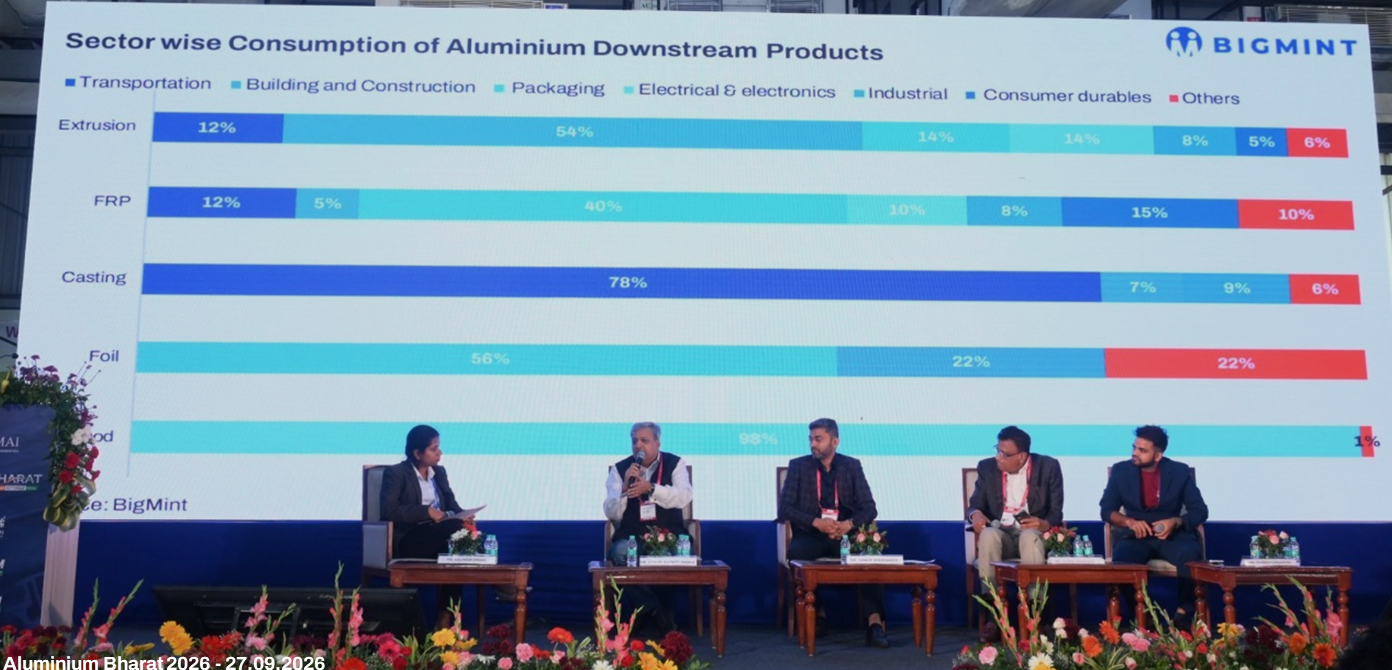
India’s aluminium industry is entering a new phase of growth, with rising opportunities across solar, railways, electric vehicles (EVs), defence and aerospace. However, discussions at Aluminium Bharat 2026, organised by ALEMAI and co-hosted by BigMint, highlighted that the next phase of growth will depend not only on higher aluminium consumption, but also on specialised alloys, advanced processing, precision manufacturing and application-specific solutions.
Solar offers scale, but competitiveness remains key
India’s rapidly expanding solar sector presents a significant opportunity for aluminium extruders, particularly through module frames and mounting systems. However, domestic manufacturers continue to face cost and quality competition from Chinese suppliers.
Mr. Sandip Khokhariya, CEO, Surat Aluminium (Hindver Group), highlighted the need for greater efficiency, improved surface treatment and consistent product quality to strengthen India’s competitiveness in solar applications.
The panel noted that future opportunities will increasingly move towards customised profiles, tighter specifications and higher-value applications rather than standard products alone.

Rail demand moving towards complex profiles
Railways are emerging as another major application area, with growing demand for large and complex aluminium extrusions for coaches, metros and high-speed rail.
The discussion highlighted challenges around producing longer profiles with tight dimensional tolerances, including die-making, equipment capability and transportation infrastructure. Speakers noted that developing the capability to manufacture longer sections must go hand in hand with the infrastructure required to transport them efficiently.
Defence and aerospace require specialised capabilities
Defence and aerospace offer opportunities for higher-value aluminium products but require significant investment in specialised equipment, testing and certification.
Mr. Sushil Agarwal, Co-Managing Director, Sumangalam Aluminium Extrusions Pvt. Ltd., highlighted the importance of building domestic capabilities and supporting infrastructure for specialised applications, particularly where demand volumes may initially be limited.
The panel stressed that a stronger ecosystem involving aluminium producers, equipment manufacturers, component makers and end users will be essential to develop these capabilities.
From metal supplier to solution partner
A key theme emerging from the discussion was the need for India to move beyond conventional commodity-based aluminium supply.
Mr. Vikram Jhunjhunwala, Managing Director, Century Extrusions Ltd., stressed the need for the industry to become an “application provider” and “solution partner” across emerging sectors such as EVs, solar, railways and defence.
He also highlighted engineering capability as an important area for development. While aluminium availability may not be the biggest constraint, the ability to engineer materials and products to meet demanding application requirements will increasingly determine competitiveness.
Collaboration and approvals remain critical
Developing application-specific aluminium products requires close coordination between primary producers, extruders, component manufacturers and OEMs. New alloys, customised sizes, specialised equipment, testing and certification can require significant time and investment.
The panel also highlighted customer qualification and approval timelines as an important bottleneck. Faster development and approval processes could help Indian manufacturers respond more quickly to emerging opportunities across EVs, solar, railways, defence and aerospace.
Building competitiveness beyond cost
The discussion also brought attention to India’s cost competitiveness compared with China. Speakers pointed to differences in raw material pricing, scale, productivity and the maturity of the supporting industrial ecosystem.
While policy support may be important during the initial development of specialised capabilities, the panel emphasised that sustainable competitiveness will ultimately depend on technology, engineering capabilities, productivity, efficiency and scale.
The next growth phase will be application-led
Overall, the panel highlighted that India’s aluminium growth will increasingly be driven by application-led, value-added products across EVs, solar, rail, defence and aerospace. Strengthening engineering capabilities, specialised alloys, technology and collaboration across the value chain will be critical to improve competitiveness. The industry’s focus must gradually shift from being a metal supplier to an application and solution partner.
Leave a Reply