- Production from Odisha declines by 10% y-o-y
- NMDC lifts production by 21%, OMC logs 5% drop
- JSW’s output drops 32% on Jajang mines surrender
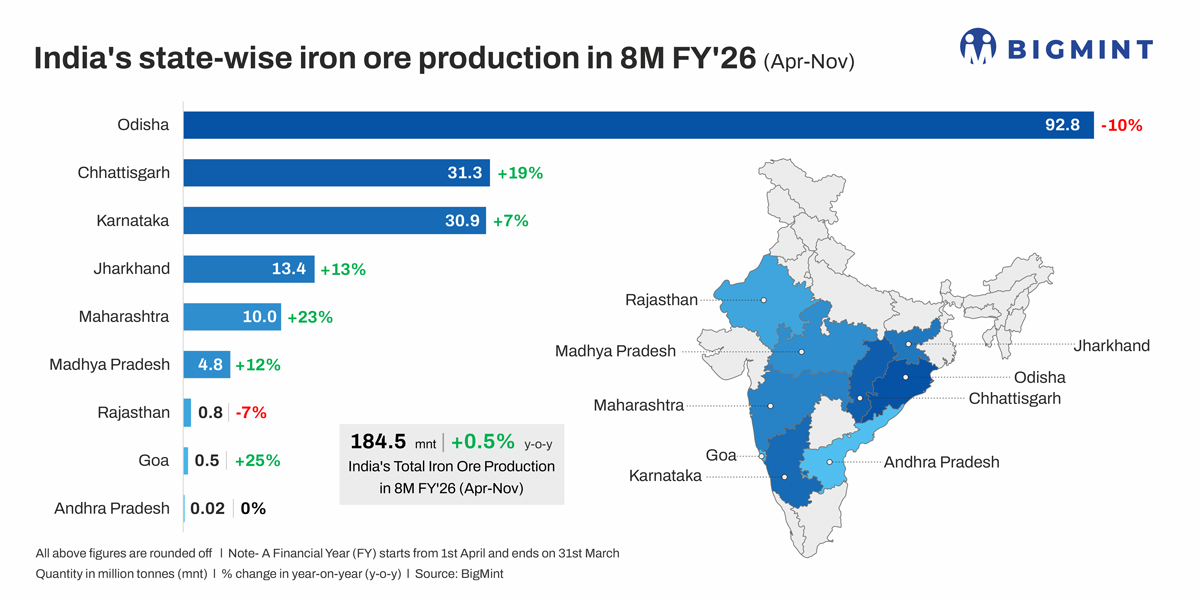
Morning Brief: India’s iron ore production rose a mere a 0.5% y-o-y in April-November 2025 (8MFY’26) to 184.5 million tonnes (mnt), according to provisional data maintained by BigMint.
Throughout 8MFY’26, iron ore production growth has lagged behind that of crude steel output, which increased at 11% y-o-y to 109.491 mnt. This has created a supply shortfall, especially of high-grade ore, leading to elevated prices and operational challenges for manufacturers of downstream products such as sponge iron and steel.
Consequently, India’s imports of iron ore fines/lumps have increased by 126% y-o-y to around 7 mnt in 8MFY’26 against 3 mnt in 8MFY’25.
Odisha, the leading iron ore-producing state, recorded a decline of 10% y-o-y, as leading miners from the state, including the Odisha Mining Corporation (OMC),
JSW Steel, and Rungta Mines, experienced challenges in boosting output. Lower output from Odisha has been the primary contributor to the slower production growth in India, as most other major hubs registered double-digit growth.
Notably, production by captive miners was down by 1% at 67.5 mnt. Conversely, merchant miners’ output increased by 1% y-o-y.
State-wise iron ore production
Iron ore production from Odisha dropped by 10% y-o-y to 92.8 mnt in 8MFY’26, accounting for 50% of India’s total output against 56% in the year-ago period.
Chhattisgarh recorded strong growth of 19% to 31.3 mnt, while Karnataka’s production increased by a slower 7% y-o-y to 30.9 mnt.
Production from Jharkhand, Maharashtra, Madhya Pradesh, and Goa increased by 13%, 23%, 12%, and 25% respectively.
Besides Odisha, Rajasthan was the only state to register a decline in volumes (-7%).
Factors influencing India’s iron ore production in 8MFY’26
OMC’s production falls by 5%: An extended monsoon disrupted OMC’s mining operations, causing a 5% drop in production to 20.2 mnt. Elevated stocks and weak downstream demand at the beginning of the financial year also prompted moderation in output.
However, the pace of production seems to have increased in October-November, given that the 5% drop in 8MFY’26 is lower than the 13% decline recorded in H1FY’26.
JSW suffers steep 32% drop: JSW Steel’s production stood at 11.2 mnt, a sharp 32% decrease y-o-y. This was due to the surrender of its Jajang mines in Odisha due to cost pressures, while delays in the operationalisation of freshly secured mines seem to have prevented the steelmaker from raising its output.
Notably, JSW Steel has imported around 6.6 mnt of iron ore during 8MFY’26, possibly to make up for the production shortfall.

NMDC’s production surges: A 21% increase in production to 31.5 mnt by NMDC, India’s largest iron ore miner, helped lift the country’s total output. It should be noted that NMDC experienced operational disruptions in the last fiscal due to labour strikes, leading to a low base.
In FY’26, NMDC has set a target of 55.4 mnt, the entirety of its environmental clearance (EC).
Lloyds’ output jumps amid major capacity expansions: Lloyds Metal and Energy Limited raised its production by 27% to 9.8 mnt amid major investments in capacity expansion. For example, in late June, Lloyds announced it has secured an EC to expand its mining capacity to 55 mnt/year.
Production from other major miners declines: Among other major miners, Rungta Mines’ production fell by 23% to 10.8 mnt. Vedanta and ESL’s output fell by 15% to 6.7 mnt, while AM/NS’s production was down by 18% at 6 mnt due to a monsoon-driven slowdown. Meanwhile, Tata Steel’s production remained unchanged y-o-y in 8MFY’26, contrasting with a 3% increase in H1FY’26.
Outlook
The Indian government is working out measures to boost iron ore production and address the under-utilisation or non-operationalisation of mines. These include stricter timelines, specific milestone-based timelines for mining leases and composite licences, enhanced performance security mechanisms, online transparency measures, and restrictions on exports. It is expected that iron ore production will increase in the second half if these reforms are implemented.
Additionally, industry associations have also highlighted the divergence between firm iron ore prices and the downtrend in steel pricing, which has pressured margins. Notably, only one virgin mine has started production in the last 11 years of the auction regime, cited the Chhattisgarh Sponge Iron Manufacturers Association. In a recent letter to the Indian mines ministry, the consortium has recommended export duties, a review of the current auction model, and mining incentives to boost domestic availability of iron ore.
Leave a Reply