- India has to convert a pre-commissioning pipeline into operating capacity
- The 100 mnt/y target is technically possible only as a stretch case
- Projects with captive coal, assured offtake, CO2 management are best placed
Data Deep Dive: India’s coal gasification programme seeks to convert domestic coal and lignite into synthesis gas, or syngas, and then into urea, ammonia, ammonium nitrate, methanol, synthetic natural gas (SNG), hydrogen, dimethyl ether (DME), chemicals and reducing gas for steelmaking. In effect, the country is trying to build a coal-to-molecules industry alongside its coal-to-power system.
The strategic case is clear. India has large coal resources but imports much of the natural gas and several chemical and fertiliser inputs that syngas can replace. The government estimates that imports of LNG, urea, ammonium nitrate, ammonia, coking coal, methanol, DME and related products cost about INR 2.77 lakh crore in FY’25. Gasification could create a non-power demand channel for coal, reduce exposure to volatile international gas markets and support industrial activity in coal-bearing regions.
The execution case is much harder. Gasification is capital intensive, technically sensitive to coal quality, water and oxygen intensive, and potentially highly carbon intensive unless carbon capture, utilisation and storage (CCUS) is integrated. India’s policy has therefore moved from setting a target to underwriting early projects. Even so, financial support can reduce capital risk; it cannot by itself guarantee a suitable gasifier, a competitive end-product, dependable coal quality, an offtake contract or permanent carbon storage.
From mission document to industrial policy
The National Coal Gasification Mission, issued in September 2021, formalised a target to gasify 100 mnt of coal by 2030. Its original three-stage roadmap was sequential: establish Talcher Fertilisers and the Dankuni coal-to-methanol project using about 4 mnt/y; scale four Coal India projects using another 6 mnt/y; and then mobilise the remaining 90 mnt/y after the technology had been demonstrated.
That sequence has changed. The pilot projects did not create a rapid, proven template, while the 2030 deadline continued to approach. The government responded by creating direct capital support and inviting public and private developers to proceed in parallel.
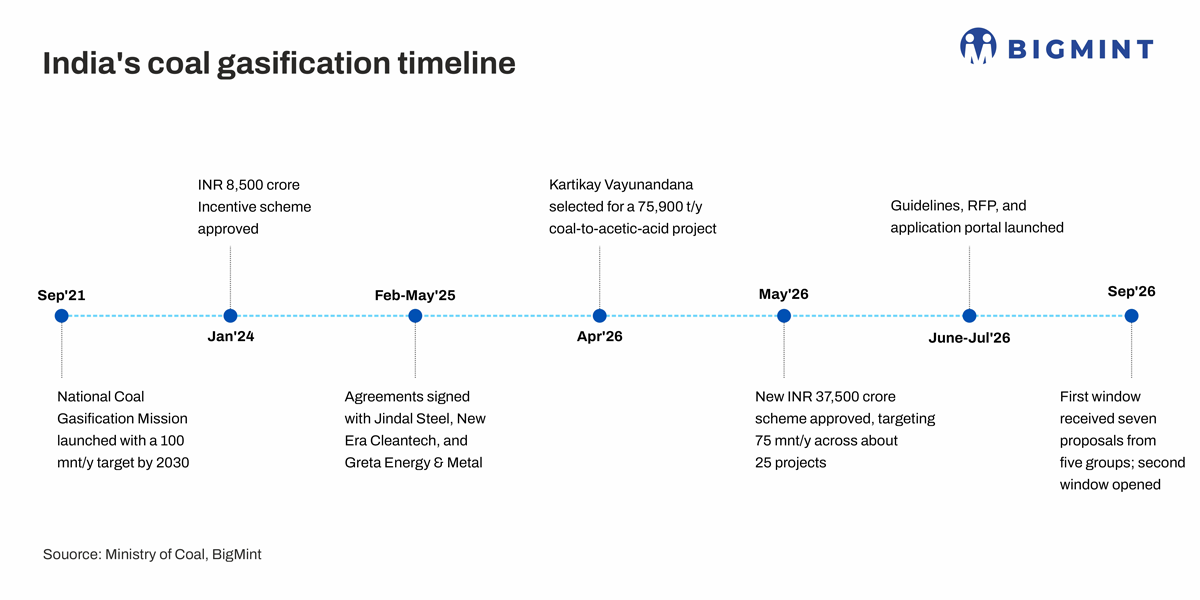
The first Financial Incentive Scheme, approved in January 2024, carried an INR 8,500 crore outlay. It separated support into three categories: government PSUs; private companies and other PSUs; and demonstration or small-scale projects. The first round ultimately produced eight projects with about 12 mnt/y of coal gasification capacity and approved assistance of INR 6,233 crore, according to the Ministry of Coal. Three Category II agreements were signed with Jindal Steel, New Era Cleantech Solution and Greta Energy and Metal. A further small coal-to-acetic-acid project from Kartikay Vayunandana was selected in April 2026.
In May 2026, the Cabinet approved a much larger INR 37,500 crore scheme. It targets roughly 75 mnt /y of coal and lignite gasification across an estimated 25 projects and aims to mobilise INR 2.5-3 lakh crore of investment. Financial assistance can cover up to 20% of eligible plant and machinery cost, compared with the earlier scheme’s general 15% ceiling. Support is capped at INR 5,000 crore for one project, INR 12,000 crore for one corporate group and INR 9,000 crore for one product, except SNG and urea. Disbursement is in four milestone-linked instalments.
The new scheme is technology agnostic, although indigenous technology is encouraged. It also extends coal-linkage tenure for eligible syngas projects to as much as 30 years. Most importantly, subsequent clarifications allow imported coal to be used where required, easing an earlier tension between the self-reliance objective and the technical reality that high-ash Indian coal is not suitable for every gasifier without washing, blending or technology modification.
Policy and incentive chronology.

What the government is trying to achieve
The 100 mnt target combines at least five policy objectives.
First is import substitution. Syngas can replace imported natural gas as a feedstock or fuel and can be converted into products that India imports. Urea and ammonium nitrate are especially attractive because demand is large, strategic and relatively visible. Methanol and SNG offer large theoretical markets but face direct competition from internationally traded molecules.
Second is coal-demand diversification. Roughly four-fifths of Indian coal has historically gone to power generation. As renewable capacity rises, gasification offers coal producers a higher-value industrial outlet that is not tied directly to electricity generation.
Third is steel sector security. Syngas can act as a reducing gas in DRI and can be injected into blast furnaces or used for industrial heating. Jindal Steel’s Angul complex demonstrates the concept. Wider deployment could reduce exposure to imported coking coal and gaseous fuels, although coal-derived syngas is not automatically low-carbon.
Fourth is industrialisation in coal-bearing regions. Pit-head conversion reduces the need to transport large volumes of low-calorific-value, high-ash coal and can anchor chemical, fertiliser or metals clusters. The government expects about 50,000 direct and indirect jobs from the new scheme.
Fifth is technology localisation. India wants gasifiers and balance-of-plant systems capable of handling its own high-ash coal, reducing reliance on foreign licensors and EPC contractors. The BHEL pressurised fluidised-bed gasifier selected for the Lakhanpur project is intended to become a commercial-scale demonstration of this approach.
Capacity base and investment pipeline
The Ministry of Coal stated in July 2026 that about 22.6 mnt /y was operational or under implementation: around 8 mnt at Jindal Steel, 2.6 mnt at Talcher Fertilisers and about 12 mnt across the eight projects supported by the INR 8,500 crore scheme. This classification needs care. Only the Jindal capacity is described as operational; the remaining 14.6 mnt /y is still under implementation. Announced or proposed projects should not be treated as existing consumption.
Major operating, committed and proposed investments

The table separates operating assets, committed projects, MoUs and applications. This distinction is critical. An EOI or scheme application signals interest; it does not establish technical selection, financing, environmental approval, offtake or construction readiness.
What the first large-scheme application round says
The first application window under the INR 37,500 crore scheme closed on 7 September 2026 with seven proposals from five companies. Adani Enterprises submitted three urea proposals. NTPC proposed SNG. Talcher Fertilisers submitted a urea proposal, Gallantt Ispat proposed DRI and syngas, and Shyam Sel & Power proposed syngas.
This is meaningful participation, but it is not yet evidence that 75 mnt/y has been bid. Project coal input, locations, technology licensors, proposed incentive amounts and commissioning schedules were not all public at the time of review. The proposals must be evaluated, selected, converted into agreements, financed and built.
The product pattern is nevertheless informative. Four of the seven proposals concern urea if Talcher is included. Urea has an established domestic market and policy mechanisms that can support producer economics. Steel-linked syngas also has a captive user. SNG is potentially large but must compete with administered domestic gas, imported LNG and alternative fuels.
The market is therefore gravitating towards projects where the developer can control or secure the downstream offtake.
Pre-application questions submitted by companies including Adani further expose bankability concerns: treatment of technology licence and engineering costs, equity-infusion milestones, project modification, the five-year commissioning condition, eligibility of imported coal, carbon capture expenditure and the ability to use an SPV. These are not administrative details. They determine how much of a project cost qualifies for support and how execution and market risks are allocated.
Technology choices and the Indian coal problem
Gasification reacts coal with controlled oxygen and steam to create a mixture dominated by carbon monoxide and hydrogen.
The raw gas must then be cooled and cleaned to remove particulates, sulphur compounds, mercury and other contaminants.
Its hydrogen-to-carbon-monoxide ratio is adjusted for the downstream product. Additional units convert the cleaned syngas into ammonia, methanol, methane, hydrogen or reducing gas.
The gasifier is only one part of an integrated complex. Air separation, coal preparation, ash or slag handling, gas clean-up, water treatment, carbon dioxide removal, product synthesis and utilities often account for a large share of cost and operating complexity.
India’s coal is commonly low rank and high in ash. Entrained-flow gasifiers can achieve high conversion but expend energy melting ash into slag and may require coal washing or blending. Moving-bed systems need suitable size distribution and have limits on fines and caking behaviour. Fluidised-bed gasifiers can accept a broader range of high-ash feedstocks, but scaling an indigenous design from pilot to a continuously operating chemical complex carries performance risk.
The 2021 mission document itself identified consistent coal quality, high ash, reliance on foreign licensors and limited domestic operating experience as central constraints. Allowing imported coal improves technical flexibility and may protect plant availability. However, it also weakens the pure import-substitution narrative and introduces seaborne price, freight and foreign exchange exposure. The economically correct solution may be a controlled blend rather than an absolute domestic-coal rule.
Carbon cost and CCUS
Gasification is cleaner than direct combustion for local pollutants only in a qualified sense: contaminants can be removed from a concentrated process stream before use. It does not make coal intrinsically low-carbon. Converting coal to hydrogen-rich products produces a concentrated CO2 stream, and additional emissions arise when carbon-containing products are ultimately used.
CCUS is therefore central to any claim of low-carbon syngas or steel. Capture may be technically easier from a concentrated pre-combustion stream than from dilute flue gas, but transport and permanent storage remain unresolved at scale in India.
Utilising a limited quantity of CO2 in urea or beverages is not equivalent to permanent abatement; much of that carbon is later released. Project appraisals should disclose gross emissions, capture rate, residual emissions, downstream release, transport route, storage liability and cost per tonne of CO2 avoided.

Market implications
If projects are commissioned, gasification can become a structural source of non-power coal demand. The location and quality impact may be more important than the national tonnage alone. MCL and ECL-linked projects could create steady pit-head demand for washed coal, selected grades and rejects. Lignite gasification could diversify NLC’s mining base.
Blending permissions may also introduce demand for imported low-ash coal or petcoke at coastal and eastern plants.
Coal beneficiation, oxygen supply, refractory systems, water treatment, gas cleaning, compressors, catalysts, EPC services and CO2 transport could form a significant ancillary market. For steel and fertiliser consumers, the opportunity is not simply cheaper fuel; it is control over a strategic feedstock and insulation from seaborne volatility.
There is also a substitution boundary. If gasification products require permanent subsidy or remain more expensive than imports across the cycle, the programme may improve security but not pure economic efficiency. If CCUS is omitted, projects may face increasing difficulty attracting finance or claiming alignment with India’s emissions-intensity objectives and export-market carbon rules.
India has now created the strongest policy framework for coal gasification in its history. The cumulative INR 46,000 crore of approved incentive outlay, longer coal linkages, flexible feedstock rules and rolling application windows can move the sector beyond isolated pilots. Industry participation from integrated steelmakers, fertiliser developers, power producers and large conglomerates shows that gasification is being considered as a serious industrial option.
The first INR 37,500 crore application round is encouraging, although seven proposals remain far from 75 mnt/y of commissioned capacity.
The most credible near-term projects are likely to combine four features: secured coal of tested quality, a captive or policy-backed product market, an experienced technology and EPC structure, and a funded carbon-management plan. Urea, ammonium nitrate and integrated steel syngas appear better positioned than stand-alone merchant methanol or SNG unless the latter secure strong offtake and price protection.
Leave a Reply