- Each ferroalloy will have TRQ for exporting countries
- Safeguard measure to extend till 17 Nov’28
The European Commission has officially imposed definitive safeguard measures on imports of certain ferroalloys, concluding an 11-month investigation and stepping up efforts to protect the EU’s ferroalloy industry, which employs about 1,800 workers.
Key highlights
- Country-specific TRQs introduced: Each ferroalloy type will have a tariff rate quota (TRQ) per exporting country. For instance, The EU has set the following TRQs for India for the first year: for ferro silico manganese the quota is ~126,800 t and price threshold: €1,392/t. For ferro manganese ouota has been set at ~69,900 t and price Threshold at €1,316/t.
- Duty-free entry only within quotas: Imports exceeding the quota enter duty-free only if their price is above a defined minimum price threshold.
- Price-based safeguard duty: Shipments priced below the threshold will be charged a duty equal to the difference between their net frontier price and the fixed benchmark.
- Covers all third countries: Includes Norway and Iceland (EEA members), with trimonthly reviews planned to minimise distortions in Europe’s integrated value chain.
- Safeguards valid for three years: Measures will apply until 17 November 2028.
- Compliance ensured: The framework aligns with the EU’s bilateral and regional trade commitments.
Why was safeguard imposed?
- Imports surged 17% between 2019 and 2024.
- EU producers’ market share fell sharply from 38% to 24%.
Exports beyond these volumes or below the threshold prices may attract duties, potentially impacting Indian suppliers’ competitiveness in the EU market.
India top manganese alloys exporter in CY’24
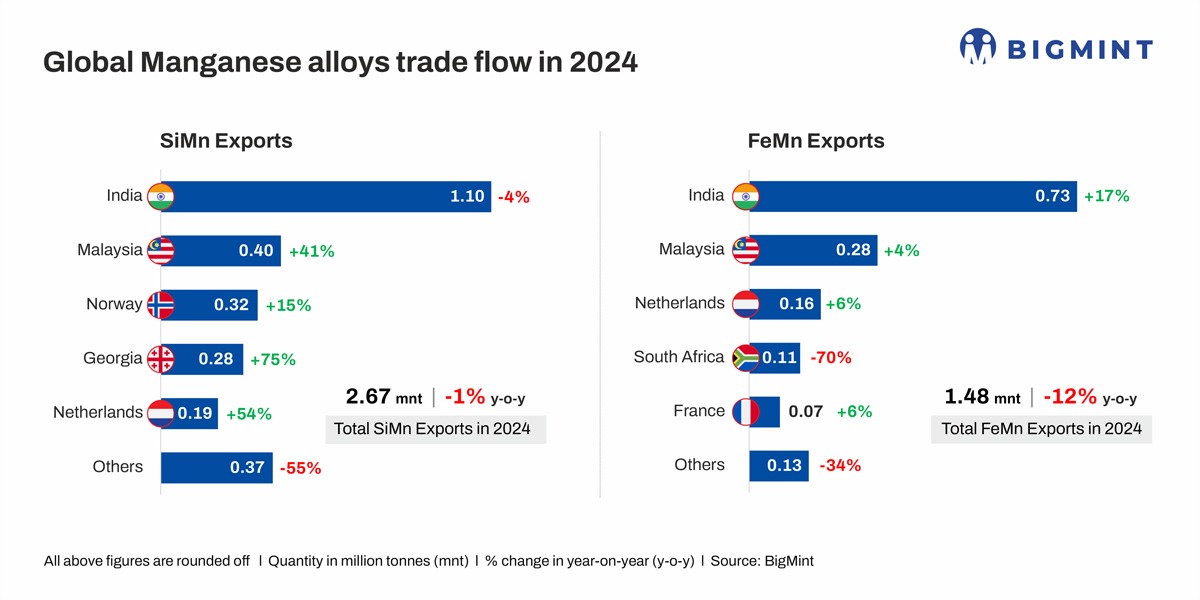
Global manganese alloys exports dropped by 5.5% y-o-y in CY’24, according to latest data available with BigMint. Total trade in manganese alloys dropped to 4.15 mnt in CY’24 from 4.39 mnt in the year prior.
While silico manganese exports fell from 2.71 mnt in CY’23 to 2.67 mnt in CY’24, ferro manganese trade shrunk to 1.48 mnt from 1.68 mnt in CY’23.
Notably, India remained the top exporter globally of both silico and ferro manganese. India’s exports of silico manganese declined marginally in CY’24 to 1.1 mnt. Ferro manganese exports, however, witnessed an uptick, reaching 0.73 mnt in CY’24.
Market sources highlighted the proposed EU safeguard could disrupt 30-40% of India’s ferroalloy export market. Indian smelters remain heavily dependent on EU demand, particularly for manganese alloys. Any quota restrictions or higher import-price thresholds could severely impact shipment flows, potentially forcing producers to absorb deeper discounts, explore new destinations, or even temporarily reduce production depending on the severity of the final measure.
Leave a Reply