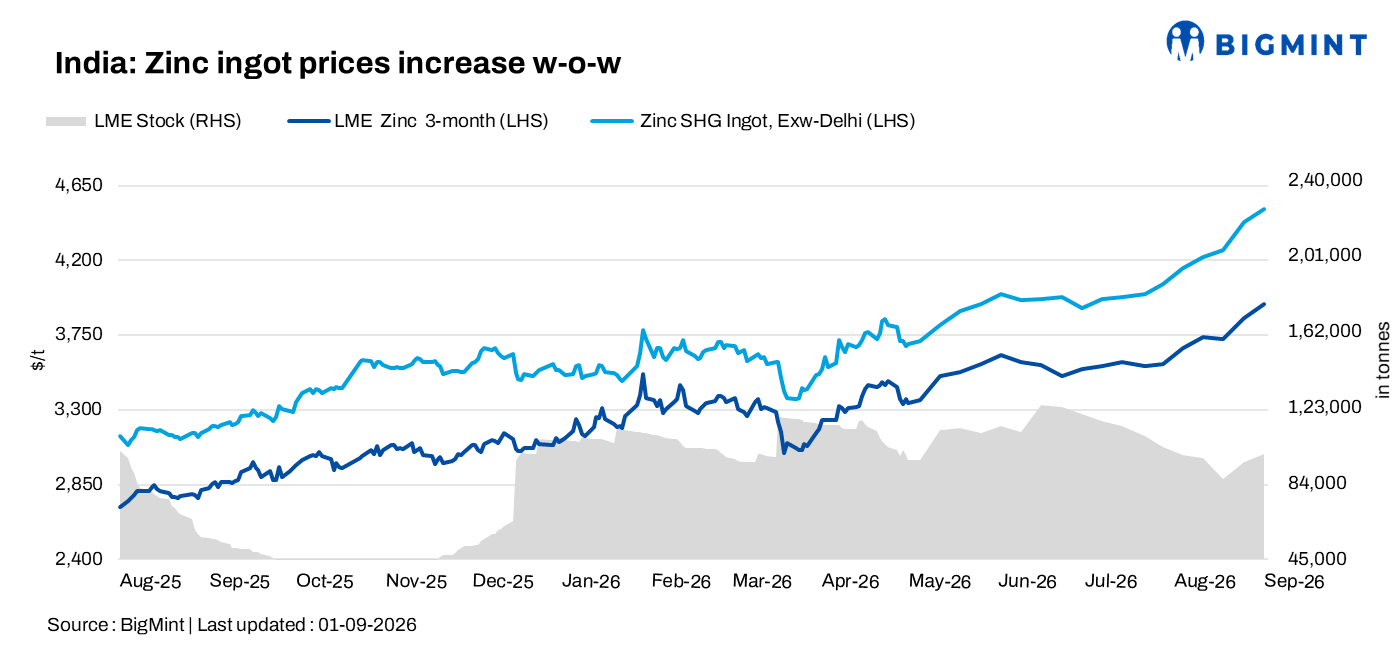
- HZL raises benchmark SHG zinc price by INR 5,500/t amid sustained LME strength
- LME zinc cash price crosses $4,100/t as tight availability supports market
India’s zinc ingot (99.995%) prices continued their upward momentum, with BigMint’s benchmark assessment rising to INR 428,400/t ex-Delhi. The increase was supported by Hindustan Zinc Ltd’s (HZL) latest price hike and sustained strength in international zinc markets, where LME cash prices crossed $4,100/t.
HZL raised its benchmark SHG zinc ingot price by INR 5,500/t to INR 434,400/t on 31 August, while LME zinc continued to trade above four-year highs amid supply concerns and tight availability outside China. However, rising LME inventories and cautious downstream buying could limit the pace of further domestic gains.
HZL hike and stronger LME prices support domestic zinc
Domestic zinc prices remained firm, tracking HZL’s latest benchmark revision and elevated international prices.
HZL increased its SHG zinc ingot benchmark by INR 5,500/t to INR 434,400/t on 31 August, providing further support to domestic spot market sentiment.
BigMint’s benchmark assessment for zinc SHG ingot stood at INR 428,400/t ex-Delhi, up INR 2,800/t from the previous assessment.
International prices also remained elevated. LME zinc cash settlement increased to $4,115/t on 1 September, compared with $3,987/t on 25 August. Meanwhile, the three-month contract rose to $3,937/t from $3,853/t over the same period.
Higher international replacement costs and HZL’s upward revision encouraged domestic sellers to maintain firm offers. However, downstream procurement remained largely need-based, with buyers showing limited willingness to build inventories at elevated price levels.
LME zinc extends rally as supply concerns persist
LME zinc continued its rally into September, supported by supply concerns and limited availability of refined metal outside China. The three-month contract touched an intraday high of around $3,980.50/t, its highest level in more than four years, amid concerns surrounding concentrate availability and regional supply tightness.
The LME cash settlement stood at $4,115/t on 1 September, maintaining a substantial premium of around $178/t over the three-month contract, indicating continued tightness in the nearby market.
LME zinc inventories, however, increased to 99,125 t on 1 September, from 95,050 t on 25 August. The steady inflow of material into exchange warehouses has provided some relief to the tight physical market.
Chinese exports have emerged as an important source of additional metal for the LME market, with deliveries into Asian warehouses helping ease pressure on the London market. However, constrained concentrate availability and low treatment charges continue to weigh on smelter economics outside China and support the broader price structure.
The market therefore remains characterised by a contrasting supply picture: refined zinc availability outside China remains tight, while rising Chinese exports and increasing warehouse inflows could gradually reduce pressure in the nearby market.
Korean zinc remains competitive against domestic material
Imported Korean-origin zinc continued to remain competitive against domestic material.
South Korean SHG zinc was heard at around INR 420,000/t, below the domestic zinc assessment of INR 428,400/t. Korean import premiums were heard at around $250-255/t, while imported SHG material was indicated at approximately $4,135-4,140/t.
Australian-origin zinc was offered at around INR 442,000/t, remaining significantly higher than both domestic and Korean-origin material.
The price gap continues to make Korean zinc an attractive alternative for Indian consumers where prompt availability exists. However, actual import buying will depend on shipment schedules, availability and the economics of replacement costs amid continued volatility in international zinc prices.
Zinc alloy prices remain firm
Zinc alloy prices remained supported by elevated primary zinc costs.
In the Delhi market, Zamak 3 was heard at around INR 431,000/t, while Zamak 5 was indicated at INR 438,000/t. PMI prices were heard in the range of INR 385,000-386,000/t.
Higher primary zinc prices continued to provide support to alloy quotations. However, downstream demand remained selective, with buyers largely procuring material against immediate requirements.
Coated steel prices increase on mill-led hikes
India’s coated flat steel market witnessed further price increases during the week, supported primarily by mill-led hikes and higher raw material and working costs.
BigMint’s benchmark assessment for Mumbai GP coil (0.8 mm/CTL, 120 GSM, IS 277) increased by INR 800/t w-o-w to INR 76,500/t ex-Mumbai as of 27 August.
Mumbai PPGI (0.5 mm/CTL, 90 GSM, IS 14246) also increased by INR 900/t w-o-w to INR 86,200/t ex-Mumbai.
Meanwhile, Mumbai BGL (0.5 mm/CTL, 1220 mm, AZ150) remained stable at INR 90,000/t ex-Mumbai.
Firm mill pricing continued to support the market, although buying activity remained largely need-based. The near-term outlook remains firm, with further movement likely to depend on additional mill revisions and downstream demand conditions.
Outlook
India’s zinc ingot market is expected to remain firm in the near term, supported by HZL’s latest price hike, elevated LME prices and higher international replacement costs.
The international zinc market continues to face tight availability outside China, reflected in the substantial cash-to-three-month backwardation. Concentrate supply concerns and weak treatment charges remain supportive factors for zinc prices, although rising warehouse inventories and Chinese exports into the LME system are beginning to provide additional metal to the market.
For the domestic market, Korean zinc at around INR 424,000/t remains below the BigMint domestic assessment of INR 428,400/t, potentially increasing competition from imported material if availability improves. Australian-origin material, at around INR 442,000/t, remains comparatively less competitive.
Domestic buyers are likely to continue purchasing cautiously at elevated prices. While the underlying international supply tightness and HZL’s pricing strategy remain supportive, the pace of further gains will depend on LME inventory inflows, Chinese export availability, import competitiveness and the downstream demand response.
Leave a Reply