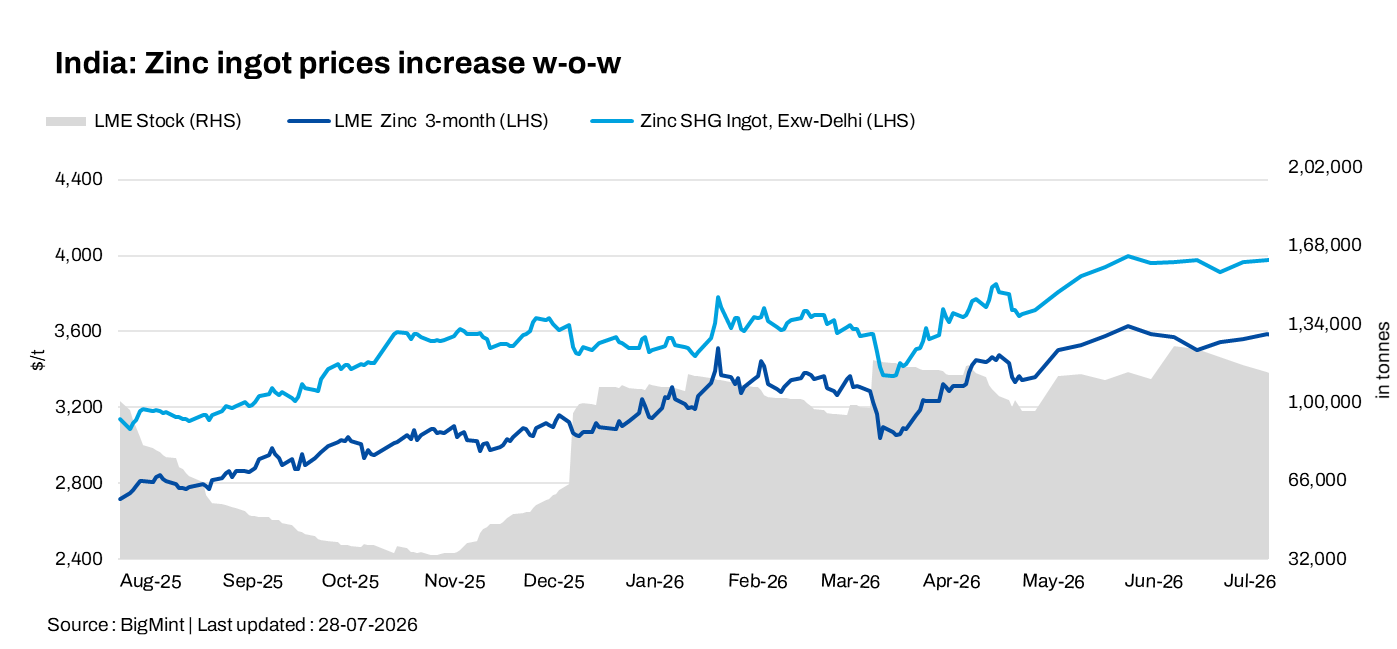
- LME zinc stocks fall 6% w-o-w, supporting market sentiment
- Downstream demand muted, need-based buying continues
India’s zinc ingot (99.995%) prices increased by INR 4,300/t w-o-w to INR 387,900/t ex-Delhi, according to BigMint’s latest assessment. The increase was driven primarily by Hindustan Zinc Ltd’s (HZL) latest benchmark price hike, while continued drawdowns in London Metal Exchange (LME) inventories lent additional support to global zinc fundamentals. However, downstream demand remained moderate, with galvanisers and alloy manufacturers continuing to procure largely on a need-based basis.
HZL hike, falling LME stocks support domestic prices
Domestic market sentiment strengthened after HZL increased zinc ingot prices by INR 6,100/t on 27 July compared with its previous revision on 23 July. Following the latest revision, the producer’s benchmark Special High Grade (SHG) zinc ingot price increased to INR 393,700/t.
The sharp upward revision reinforced HZL’s position as the primary pricing benchmark for the domestic market, pushing spot prices higher despite limited buying activity. Market participants noted that consumers continued to avoid aggressive stocking, purchasing only against immediate requirements.
Global market fundamentals also remained supportive. LME three-month zinc prices edged up to $3,576/t on 28 July from $3,566/t on 21 July, while cash settlement prices increased to $3,631.5/t from $3,591/t over the same period. Meanwhile, LME zinc inventories declined to 102,500 t from 108,500 t, a fall of 6,000 t (around 6%) during the week, reinforcing expectations of tighter exchange availability.
Imports remain limited as domestic material dominates
Import activity remained subdued, with market participants reporting very limited arrivals and stronger reliance on domestic supply.
Australian-origin zinc ingots were offered at around INR 402,000-403,000/t ex-Delhi, while Korean-origin SHG material was heard at around INR 385,000/t ex-Delhi. Korean-origin zinc continued to be offered at around $3,850-3,855/t, with premiums largely steady at $270-275/t.
Despite Korean-origin material remaining price competitive, market participants indicated that imports are expected to remain minimal over the next four to five months, with domestic consumers relying primarily on HZL material owing to better availability and supply confidence.
Alloy prices move higher in line with zinc
Downstream alloy prices increased alongside higher domestic zinc values. Zamak 3 was assessed at around INR 396,000/t, while Zamak 5 was assessed at INR 403,000/t. Primary Metal Ingot (PMI) was assessed at around INR 340,000/t.
Demand from die-casting, engineering and allied manufacturing sectors remained moderate, with consumers continuing to procure primarily against confirmed orders. Although higher zinc prices lifted alloy quotations, buying activity remained cautious amid weak downstream consumption.
Coated steel market weakens on sluggish demand
Activity in the coated steel segment remained subdued, with prices either declining or remaining stable amid weak buying interest.
BigMint’s benchmark assessment for Mumbai GP coil (0.8 mm/CTL, 120 GSM, IS 277) was assessed at INR 73,500/t ex-Mumbai, down INR 400/t w-o-w from INR 73,900/t, amid weak demand and lower transaction levels.
Meanwhile, Mumbai PPGI (0.5 mm/CTL, 90 GSM, IS 14246) was assessed at INR 84,300/t, down INR 900/t w-o-w from INR 85,200/t, as sluggish buying interest and limited bookings continued to weigh on prices.
Similarly, Mumbai BGL (0.5 mm/CTL, 1220 mm, AZ150) remained stable w-o-w at INR 89,500/t, with subdued demand and muted booking activity keeping prices range-bound during the week.

Outlook
India’s zinc ingot market is expected to remain cautiously firm in the near term. HZL’s latest benchmark price increase, coupled with continued declines in LME inventories, is likely to provide underlying support to domestic prices.
However, subdued downstream demand and persistent need-based procurement are expected to cap sharper gains. Import arrivals are likely to remain limited over the next four to five months, increasing the domestic market’s dependence on HZL supplies. Market participants will closely monitor HZL’s future pricing strategy, LME inventory movements, global zinc price trends and the pace of recovery in downstream demand for clearer market direction.

Leave a Reply