- Alcoa reports higher aluminium output q-o-q, acquires South32’s aluminium assets
- Norsk Hydro warns global aluminium supply deficit may widen amid Middle East tensions
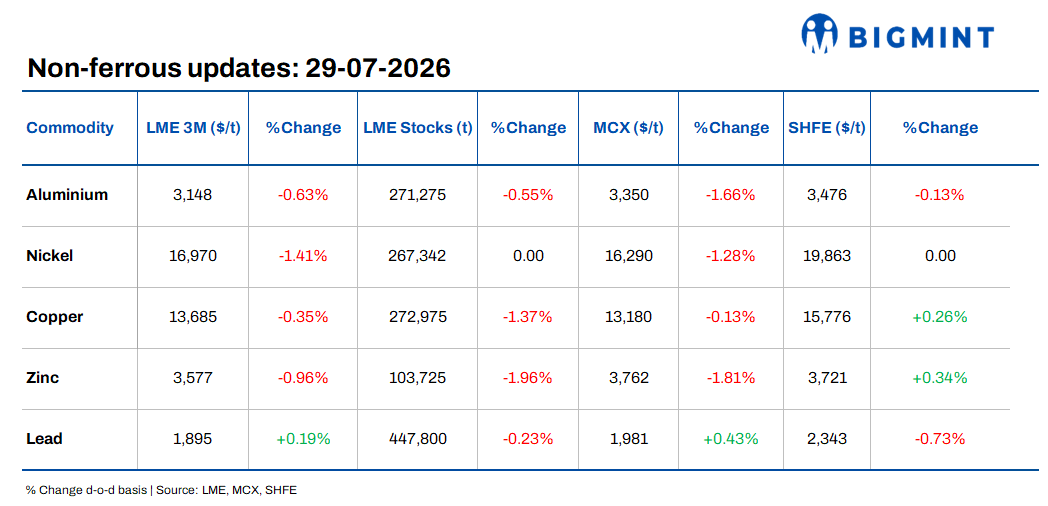
LME base metals traded mostly lower on 28 July as investors remained cautious amid renewed geopolitical tensions and macroeconomic uncertainty. Nickel recorded the steepest decline, falling 1.41% day-on-day (d-o-d) to $16,970/t. Zinc slipped 0.96% to $3,577/t, while aluminium declined 0.63% to $3,148/t. Copper eased 0.35% to $13,685/t. Lead outperformed the complex, edging 0.19% higher to $1,895/t.
LME inventories also moved lower across most major base metals, indicating continued tightness in physical availability. Zinc stocks recorded the largest decline, dropping 1.96% d-o-d to 103,725 t. Copper inventories fell 1.37% to 272,975 t, while aluminium stocks declined 0.55% to 271,275 t. Lead inventories eased 0.23% to 447,800 t. Nickel inventories remained unchanged at 267,342 t.
Domestic market overview
India’s non-ferrous scrap market witnessed mixed price movements on 28 July. Aluminium tense scrap (loose), ex-Delhi, declined by INR 5,000/t (2%) d-o-d to INR 248,000/t, reflecting subdued buying interest and weaker overseas aluminium prices. Prices in Chennai remained steady at INR 250,000/t as regional demand stayed balanced.
Copper armature scrap (Cu 99%), ex-Delhi, also softened. Prices fell by INR 4,000/t (0.3%) d-o-d to INR 1,262,000/t from INR 1,266,000/t. The decline tracked weaker LME copper prices and cautious procurement by domestic consumers.
Other updates
Alcoa posts record quarterly earnings
Alcoa reported record Q2CY’26 revenue of $4 billion and net income of $407 million. Adjusted EBITDA rose 51% q-o-q to $901 million. The company also agreed to acquire South32’s bauxite, alumina, and aluminium assets, strengthening its upstream portfolio. Meanwhile, aluminium production increased 5% q-o-q to 636,000 t. The acquisition is expected to enhance Alcoa’s integrated supply chain and long-term market position.
Strait of Hormuz risks remain in focus
Norsk Hydro warned that prolonged disruptions in the Strait of Hormuz could widen the global aluminium supply deficit beyond 900,000 t. Middle Eastern smelters are evaluating alternative logistics routes to reduce supply risks. Although Hydro reported stronger earnings and a 15% y-o-y rise in recycling output, it said continued shipping disruptions could tighten aluminium availability and support prices.
Iran attack raises geopolitical risk premium
Iran launched missile attacks on US military bases on 28 July, ending a brief ceasefire and renewing concerns over the Strait of Hormuz. Although non-ferrous production remains unaffected, higher freight costs, rising energy prices, and supply chain risks could increase market volatility. As a key route for alumina and aluminium trade, any prolonged disruption could add a geopolitical risk premium to base metals.
Nickel recovery supported by supply constraints
LME nickel recently reached a one-month high after posting a third consecutive w-o-w gain. The recovery has been driven by lower exchange inventories, supportive policies in Indonesia, and slower ore shipments from the Philippines. However, a stronger US dollar and ongoing tariff uncertainty continue to limit further upside in the nickel market.
US copper inventories rise ahead of tariffs
US copper importers continued to build inventories ahead of a potential Section 232 tariff decision covering copper cathodes and upstream products. COMEX copper inventories climbed 40% to 635,894 t from 453,448 t at the start of 2026, as buyers accelerated imports during the current tariff-free period. The stockpiling has tightened copper availability in other regions, with LME inventories declining to 281,425 t and SHFE stocks falling to 79,909 t. If tariffs are implemented, the shift in global inventories could support international copper prices by reducing supply outside the US.
Leave a Reply