- Coal, renewables meet record demand
- Peak demand crosses 270 GW-mark
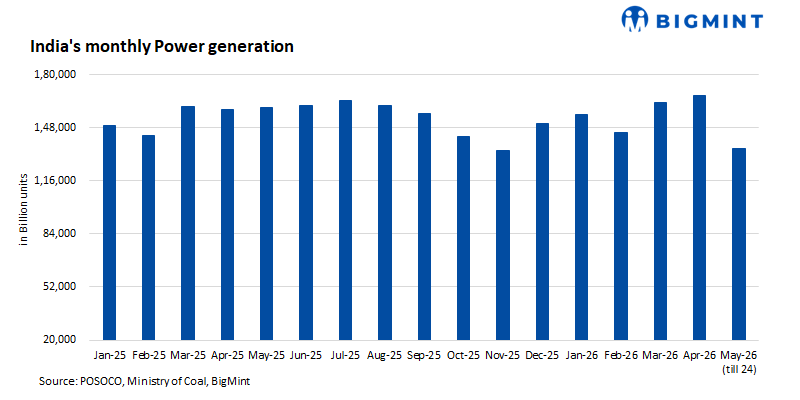
India’s power sector faced one of its toughest operational tests in the first 24 days of May 2026 as an intense and widespread heatwave pushed electricity demand into uncharted territory. Peak demand repeatedly scaled new highs, touching a record 270.82 GW on 21 May, forcing the grid to lean simultaneously on higher coal generation, stronger renewable output and elevated market procurement to keep supply flowing.
Yet the data tells a more nuanced story than a simple coal-versus-renewables narrative. India met the surge in demand through a simultaneous rise in both thermal and renewable generation, even as regional coal shortages and grid tightness exposed operational vulnerabilities.
Heatwave pushes India into new demand band
Power demand moved decisively higher this summer. Average daily peak demand during 1-24 May 2026 rose to around 241 GW, compared with 217 GW in the same period last year. Demand remained persistently elevated after the second week of May, frequently crossing 240 GW and breaching 250 GW on several occasions before peaking at 270.82 GW on 21 May, sharply above 230.99 GW a year ago.
The surge came against the backdrop of more widespread and severe heatwave conditions across North, Central and Eastern India than in 2025. Prolonged high daytime temperatures and warmer nights across major consumption centres boosted cooling demand and extended air-conditioning loads deeper into the day.
Unlike previous summers where peaks were episodic, May 2026 saw sustained high demand, signalling a structural upward shift in India’s summer load profile.
Coal remains the backbone, but renewables gain ground
India generated 137,407 million units (MU) during the first 24 days of May, up 9.8% year-on-year from 125,166 MU.
Coal-fired generation remained the system’s anchor, rising 7% to 94,268 MU. However, coal’s share of the generation mix slipped modestly as renewable energy expanded at a much faster pace.

Renewables emerged as the fastest-growing source, rising 32.2% year-on-year and lifting their share of generation to 17.4% from 14.5% last year. Strong solar irradiation and improving wind conditions reduced pressure on thermal generation during daylight hours, while hydro helped balance evening demand as solar output tapered.
Gas-based generation, however, continued to retreat despite elevated market prices, underscoring the fuel’s weak competitiveness in India’s dispatch order.
Afternoon peaks signal changing stress patterns
India’s summer stress profile is also changing.
Several of the highest-demand days in May recorded peaks during the afternoon window between 3 pm and 4 pm, coinciding with maximum cooling load. The record 270.82 GW peak on 21 May occurred at 3:45 pm, pointing to rising commercial and cooling demand during solar hours.
That said, elevated night temperatures also sustained demand after sunset, with some days, including 24 May, recording late-evening peaks.
IEX signals a tighter, more competitive market
The Indian Energy Exchange reflected growing tightness in the system.
Average market clearing prices (MCP) during 1-24 May rose to around INR 4,147/MWh, up 13% year-on-year. More telling than prices, however, was the shift in bidding behaviour.
Purchase bids surged around 66%, while sell bids increased only 13%, tightening the buy-sell ratio from 0.61 last year to 0.89 this year. Buyers increasingly competed for limited supply, particularly during non-solar evening hours.
Coal stocks hold steady, but local stress rises
India avoided a broad coal inventory crisis despite record demand.
Power plant coal stocks remained largely stable at 50.41 mnt on 1 May and 50.03 mnt on 24 May. However, the number of critical plants rose from 18 to 22, signalling rising stress at specific locations.
The challenge lay less in aggregate availability and more in distribution. Pithead stations remained relatively comfortable, while several non-pithead plants dependent on long-distance rail movement continued operating with tighter inventory buffers.
Stretched, but not breaking
Did India face significant power outages?
Not nationally – but stress was visible.
The system experienced localised shortages, frequency deviations and regional balancing challenges rather than widespread blackouts. On 24 May, India met peak demand of nearly 248 GW, but select regions still recorded shortages, underscoring the tightness of operating margins.
The broader takeaway from May 2026 is clear: India’s power system bent, but did not break. Record demand was absorbed through a combination of higher coal generation, stronger renewable output, market-based balancing and operational discipline.
But the month also exposed a deeper reality – India’s challenge is no longer just building enough capacity. It is increasingly about managing when demand arrives, where it emerges and how flexibly the system can respond during extreme weather.

Leave a Reply