- Base metals inventories indicate selective tightness
- India’s non-ferrous scrap market remains firm on strong buying
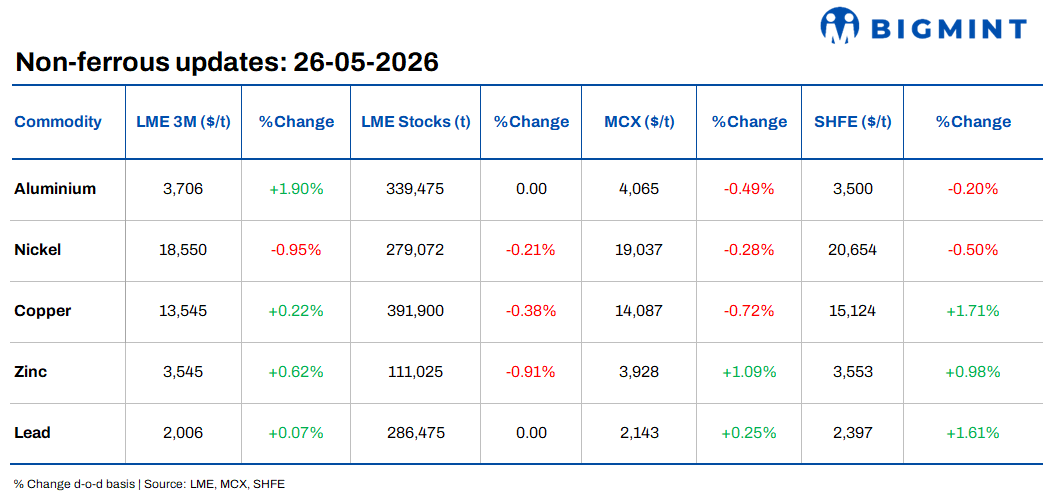
Base metals prices on the London Metal Exchange (LME) traded mixed on 26 May 2026, with gains in aluminium, copper, zinc and lead outweighing weakness in nickel. Aluminium recorded the highest increase among major non-ferrous metals, rising 1.90% d-o-d to $3,706/t, followed by zinc, which gained 0.62% to $3,545/t. Copper edged higher by 0.22% to $13,545/t, while lead remained largely stable with a marginal 0.07% increase to $2,006/t. Meanwhile, nickel was the sole laggard, declining 0.95% to $18,550/t, reflecting mixed sentiment across the broader metals complex.
LME inventory trends were also mixed across major base metals. Zinc stocks recorded the sharpest decline, falling 0.91% d-o-d to 111,025 t, followed by copper inventories, which declined 0.38% to 391,900 t, indicating some tightness in exchange-monitored warehouses. Nickel inventories also edged lower by 0.21% to 279,072 t, while aluminium and lead stocks remained unchanged at 339,475 t and 286,475 t, respectively.
Domestic market overview
India’s non-ferrous scrap market remained largely firm d-o-d, with aluminium scrap prices showing mixed regional trends. Aluminium tense scrap (loose), ex-Delhi, remained unchanged at INR 304,000/t, while ex-Chennai prices increased by INR 1,500/t to INR 311,500/t, reflecting improved regional buying activity.
Meanwhile, copper armature scrap (Cu 99%), ex-Delhi, increased by INR 15,000/t or 1.2% d-o-d to INR 1,235,000/t from INR 1,220,000/t, supported by stronger buying interest amid firm domestic sentiment despite mixed global price trends.

Other updates
Oil prices tumble amid easing geopolitical tensions
Oil prices fell sharply on 26 May 2026, with WTI crude declining 5.81% d-o-d to $91.67/bbl and Brent crude dropping 5.67% to $98.21/bbl, as optimism over a potential peace deal between Israel and Iran eased concerns over supply disruptions through the Strait of Hormuz, a key global oil transit route.
Natural gas prices also declined 2.20% to $2.94/MMBtu, reflecting broader weakness across the energy complex. However, despite the sharp correction, prices remain elevated compared to pre-conflict levels, as uncertainty over the finalization of the agreement and potential shipping disruptions continue to keep markets cautious.
Copper eases on Middle East uncertainty
Copper prices eased on Tuesday as heightened uncertainty in the Middle East kept inflationary pressures and interest rate concerns in focus. However, prices remained supported by strong expectations for long-term copper demand driven by AI-led data center expansion, electrification, and the global clean energy transition, while potential supply disruptions, including sulfur shortages for copper smelting, continued to provide underlying support.
China economy slows amid weak demand
China’s economic momentum weakened further in April 2026, with industrial output growth slowing to its weakest pace in nearly three years, retail sales remaining subdued, and fixed-asset investment slipping into contraction, signaling broad-based weakness in domestic demand.
The prolonged downturn in the property sector, marked by continued declines in house prices, has further weighed on consumer confidence and investment sentiment, while external disruptions have added pressure, increasing expectations for stronger policy stimulus to support growth.
Leave a Reply